Overview
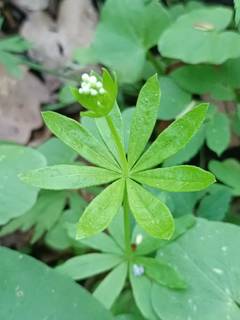
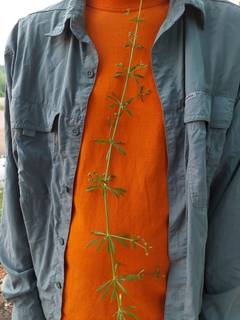
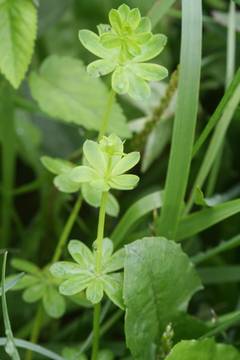
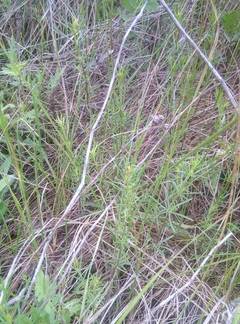
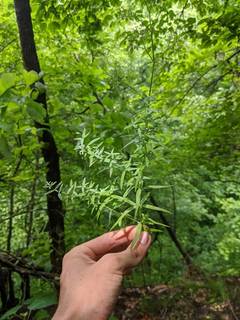
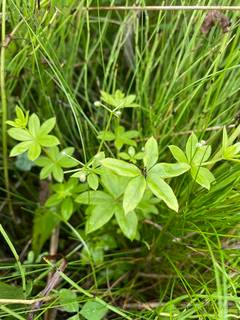
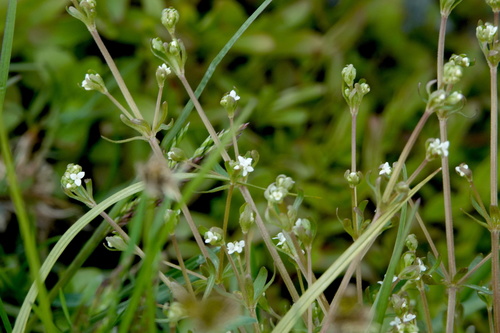
Galium trifidum is a delicate, scrambling native perennial in the coffee family (Rubiaceae) reaching 4-18 inches (10-45 cm) in length with a 6-18 inch (15-45 cm) spread. Stems are square in cross-section, slender, weak, reclining to ascending, and slightly rough on the angles with tiny retrorse prickles — much less coarse than those of G. aparine. Leaves are in whorls of 4 at each node (rarely 5-6), linear to oblanceolate, 0.2-0.6 inch (5-15 mm) long, with slightly rough margins. Flowers carry only 3 petals (in contrast to the 4 petals of most Galium), white, tiny, 0.04 inch (1 mm) across, borne singly or in pairs on slender peduncles from the leaf axils. Fruit is a pair of smooth, globose nutlets 0.04-0.06 inch (1-1.5 mm) in diameter, lacking the hooked bristles found on G. aparine. Plants grow in wet habitats including bogs, fens, wet meadows, and margins of ponds and streams. In garden and agricultural settings, G. trifidum is rarely weedy; the species is included in teaching collections for comparison with weedy Galium species. The plant spreads by slender rhizomes and seed.
Native Range
Galium trifidum has a circumboreal distribution and is native to North America, Europe, and northern Asia, occurring in bogs, fens, wet meadows, pond margins, and streambanks from sea level to approximately 9,000 feet (2,700 m). Recorded across most of the United States (except the arid Southwest) and all Canadian provinces.Suggested Uses
Used in weed identification courses for comparison with the weedy G. aparine (cleavers), teaching differentiation by leaf whorl number, flower petal count, and fruit surface. Included in wetland botany and native plant identification curricula. A component of bog and fen plant communities in restoration ecology.How to Identify
Appearance
Size & Dimensions
Height4" - 1'6"
Width/Spread6" - 1'6"
Bloom Information
Flowers appear June through August. Individual flowers open for 1-2 days. Flowers are produced singly or in pairs from the leaf axils over 4-6 weeks. In the Pacific Northwest, flowering peaks in July. The species is self-pollinating. Smooth, round nutlets mature 2-3 weeks after pollination.
Detailed Descriptions
Flower Description
White, tiny (0.04 inch / 1 mm across), three-petaled, borne singly or in pairs on slender peduncles from leaf axilsFoliage Description
Light to medium green, small, linear to oblanceolate, in whorls of 4 at each node; slightly rough marginsGrowing Conditions
Sun Requirements
Requires 3-8 hours of direct sunlight daily
• Full Sun: 6+ hours of direct sunlight
• Partial Shade: 3-6 hours of direct sunlight
• Full Shade: Less than 3 hours of direct sunlight