Galanthus, Genus, nivalis, Species,
- Genus & species
common snowdrop
Europe (Pyrenees to W Ukraine; deciduous woodlands, meadows, riverbanks)
Overview
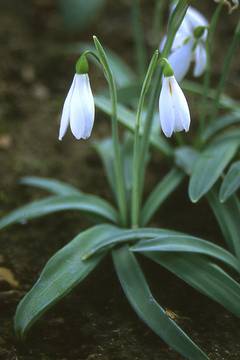
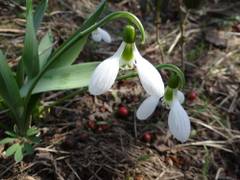
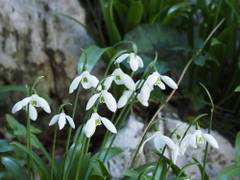
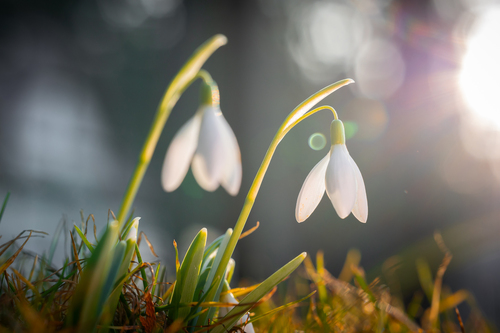
Galanthus nivalis is a bulbous clumping deciduous perennial reaching 4–6 inches (10–15 cm) tall with a spread of 2–3 inches (5–8 cm) per clump, spreading vigorously by offset bulbs and self-seeding to form large colonies over time. The species is the small-flowered common snowdrop of European gardens, stocked by virtually every general bulb supplier and naturalized so extensively across northern Europe that the species is often assumed to be native even in areas of introduction. Leaves are narrow and linear, 0.25–0.4 inch (6–10 mm) wide, gray-green to blue-green with a slight glaucous bloom—both narrower and less strongly blue than G. elwesii. Pendant white bell-shaped flowers measure 0.5–1 inch (1–2.5 cm) long, with three outer petals of pure white and three shorter inner petals marked with a single inverted V-shaped green mark at the tip only (no base marking, which distinguishes the species from G. elwesii). Flowers open in January–March and carry a light honey scent that attracts early-winter-active bumblebees during warm spells. The species is the most prolific naturalizer of any snowdrop and builds vast sheets of bloom in old gardens over decades of self-seeding and offset expansion. Summer dormancy is complete after spring foliage decline. Cold hardiness reaches zone 3—the widest zone range of any Galanthus. All parts contain galantamine and lycorine alkaloids that are toxic to pets and humans if ingested.
Native Range
Galanthus nivalis is native to a broad European range extending from the Pyrenees through France, Italy, and the Balkans to western Ukraine, growing in deciduous woodlands, meadows, and riverbanks. The species is widely naturalized across the British Isles, Scandinavia, and the Low Countries, where Roman and medieval introduction has blurred the line between native and introduced status to the point that both categories apply depending on the specific locality. The species epithet 'nivalis' translates from Latin as 'of the snow,' referring to the flowers that frequently emerge through late-winter snow cover.Suggested Uses
Planted in woodland gardens, under deciduous trees, in lawns (where the grass is left uncut until the snowdrop foliage has yellowed in June), and in naturalized drifts at 3 inch (8 cm) spacing. The species is the most reliable prolific-naturalizing snowdrop and is the usual first choice for gardeners who want large drifts of early-spring bloom with minimal ongoing maintenance. Functions under deciduous canopy, in lawns on a delayed first-mow schedule, and at woodland edges where the summer shade and winter-to-spring light match the species' seasonal requirements. The earliest major flower display of the temperate garden year opens with this species, often weeks before Crocus or early Narcissus. Paired with Eranthis hyemalis (winter aconite) and Cyclamen coum for a winter-to-early-spring bulb succession, the species combines well in woodland-edge plantings. Dry soils and hot climates without reliable winter chill are poor fits for the species.How to Identify
Appearance
Size & Dimensions
Height4" - 6"
Width/Spread2" - 3"
Bloom Information
Pendant white bell-shaped flowers 0.5–1 inch (1–2.5 cm) long open in January–March. Three outer petals are pure white; three inner petals carry a single inverted V-shaped green mark at the tip. Bloom duration is 3–4 weeks. Light honey-scented flowers draw early-winter-active bumblebees during warm spells, providing a rare nectar source at a season when almost no other temperate flowers are open.
Detailed Descriptions
Flower Description
White with single green V-mark at tip of inner petals; pendant bell-shapedFoliage Description
Gray-green to blue-green with slight glaucous bloom; narrow linearGrowing Conditions
Sun Requirements
Requires 3-8 hours of direct sunlight daily
• Full Sun: 6+ hours of direct sunlight
• Partial Shade: 3-6 hours of direct sunlight
• Full Shade: Less than 3 hours of direct sunlight
Care & Maintenance
Care Guide
Plant bulbs 3 inches (8 cm) deep in partial shade to full sun in moist humus-rich well-drained soil. Planting 'in the green' (as growing plants with foliage) gives higher establishment success than dry dormant bulbs, which desiccate quickly in storage. Hardy to zone 3 (−40°F / −40°C)—the widest zone range of any snowdrop in cultivation, extending the species into colder regions than G. elwesii or G. ikariae can occupy. Foliage is left to die back naturally; the senescence period funds the following year's flowers through carbohydrate transfer from leaves to bulb. Natural colonization proceeds aggressively through offset bulb division and self-seeding, and large established colonies develop 5,000+ flowering bulbs per square meter after 20–30 years under favorable conditions—the species is the most reliable naturalizer among temperate-garden bulbs. All parts contain alkaloids toxic to pets and humans.Pruning
No pruning is needed. Foliage is allowed to yellow and die back naturally by early summer; premature removal prevents the bulb from recharging carbohydrate reserves for the following year.Container Growing
Suitable for container growing
Minimum container size: 1 gallons