Galanthus, Genus, elwesii, Species,
- Genus & species
giant snowdrop
SE Europe and W Turkey (Balkans, Greece, Anatolia; deciduous woodlands, 500-5,000 ft)
Overview
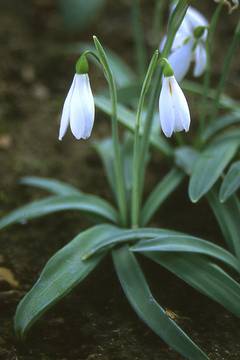
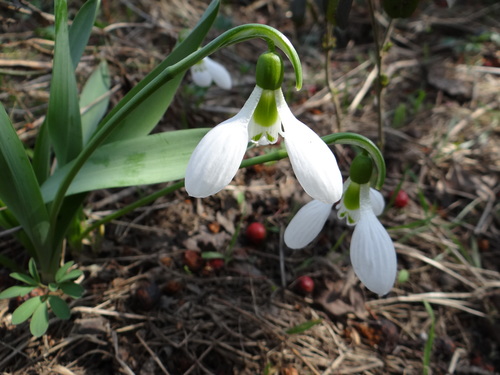
Galanthus elwesii is a bulbous clumping deciduous perennial reaching 6–10 inches (15–25 cm) tall with a spread of 3–4 inches (8–10 cm) per clump, spreading over time by offset bulbs and self-seeding into colonies under favorable conditions. The species is the largest-flowered snowdrop in common commerce—pendant white bell-shaped flowers measure 1–1.5 inches (2.5–4 cm) long, with three outer petals of pure white and three shorter inner petals marked with green at both the base and the tip (building the characteristic V-shaped or H-shaped green mark that separates this species from G. nivalis). Leaves are broader and more glaucous-blue than G. nivalis—strap-shaped, 0.5–0.75 inch (1–2 cm) wide, blue-gray to blue-green, frequently showing the folded leaf-in-leaf arrangement (plicature) where margins wrap around one another as the shoots emerge. Flowers open in January–March, placing the species among the earliest spring-blooming bulbs in temperate gardens. The plant enters dormancy by late spring, and foliage dies back completely by early June—a summer-dormant lifecycle that matches the Mediterranean-summer ecology of the native range. All parts contain galantamine and lycorine alkaloids that are toxic to pets and humans if ingested in quantity. Hardy to zone 5.
Native Range
Galanthus elwesii is native to southeastern Europe and western Turkey, from the Balkans through Greece and into western Anatolia, growing in deciduous woodlands, scrub, and rocky hillsides at 500–5,000 feet (150–1,500 m). The native range experiences hot dry summers and cool wet winters, and the bulb's summer-dormant growth pattern matches that climatic cycle. The species epithet 'elwesii' honors Henry John Elwes (1846–1922), the English plant collector and author who introduced the species to British cultivation in the 1870s.Suggested Uses
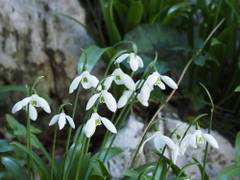
Planted in woodland gardens, under deciduous trees and shrubs, and in naturalized drifts at 3–4 inch (8–10 cm) spacing, with 20–30 bulbs per square foot (200–300 per square meter) for immediate visual impact at planting time. The January–March bloom carries the earliest flower display in the temperate garden year, opening before Crocus and several weeks before the earliest Narcissus cultivars. Functions under deciduous canopy where the bulbs receive winter and spring sun during their active growth period and summer shade during dormancy—a seasonal light pattern that matches the oak and beech woodland ecology of the native range. Natural colony expansion proceeds over 5–10 years as offset bulbs and self-seeded seedlings fill gaps between the original planted bulbs. Paired with other early bloomers (Eranthis hyemalis, Cyclamen coum, Crocus tommasinianus), the species combines well in winter-to-early-spring bulb sequences. Dry soils, dense evergreen shade, and hot climates without winter chill (below zone 8 in California-type Mediterranean summers) are poor fits for the species.How to Identify
Appearance
Size & Dimensions
Height6" - 10"
Width/Spread3" - 4"
Bloom Information
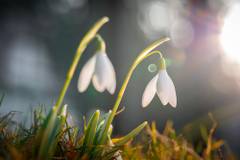
Pendant white bell-shaped flowers 1–1.5 inches (2.5–4 cm) long open in January–March. Three outer petals are pure white; three inner petals carry green markings at both base and tip. Bloom duration is 3–4 weeks. Among the earliest spring-flowering bulbs in temperate gardens, the species opens as early as mid-January in mild winters and carries light honey-scented flowers that attract the first winter-active bumblebees and honeybees in years when warm spells coincide with flowering.
Detailed Descriptions
Flower Description
White with green markings at base and tip of inner petals; pendant bell-shapedFoliage Description
Blue-gray to blue-green; broad strap-shaped; glaucous; dies back by JuneGrowing Conditions
Sun Requirements
Requires 3-6 hours of direct sunlight daily
• Full Sun: 6+ hours of direct sunlight
• Partial Shade: 3-6 hours of direct sunlight
• Full Shade: Less than 3 hours of direct sunlight
Care & Maintenance
Care Guide
Plant bulbs 3–4 inches (8–10 cm) deep in partial shade to full sun in moist humus-rich well-drained soil. Planting 'in the green' (as growing plants with foliage) gives better establishment than dry dormant bulbs—Galanthus bulbs desiccate quickly when stored dry, and in-the-green transplanting is the standard commercial practice for this reason. Hardy to zone 5 (−20°F / −29°C). Foliage is left to die back naturally; cutting before yellowing prevents the bulb from recharging carbohydrate reserves for the following year's flowers. Full dormancy sets in by June and the plant is invisible above ground until the next winter's emergence. Naturalization proceeds through offset bulb division and self-seeding in favorable humus-rich soils. All parts contain alkaloids that are toxic to pets and humans if ingested.Pruning
No pruning is needed during the growing season. Foliage is allowed to die back naturally by June—the bulb draws carbohydrates from the leaves through this senescence period to fund the following year's flowers, and premature removal weakens the plant progressively over several seasons. Only fully yellowed or dead leaves are removed.Container Growing
Suitable for container growing
Minimum container size: 1 gallons