Galanthus, Genus, ikariae, Species,
- Genus & species
Ikarian snowdrop
Eastern Aegean islands, Greece (Ikaria, Samos, Andros; moist deciduous woodland)
Overview
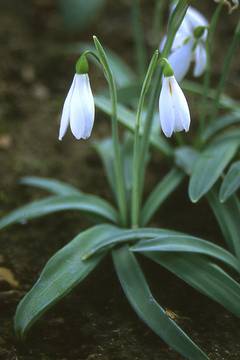
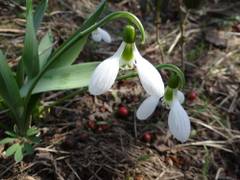
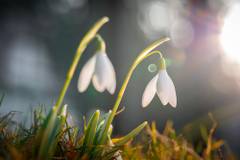
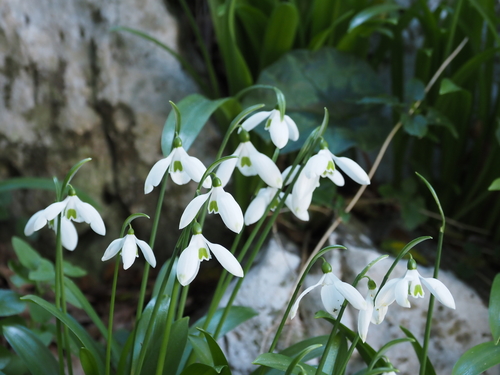
Galanthus ikariae is a bulbous clumping deciduous perennial reaching 6–8 inches (15–20 cm) tall with a spread of 3–4 inches (8–10 cm) per clump. The species is the Aegean island snowdrop, carrying bright glossy green leaves that separate it from the blue-gray glaucous-leaved G. nivalis and G. elwesii—the foliage of G. ikariae is the glossiest and greenest produced by any snowdrop in cultivation, lacking the waxy glaucous coating that the other common species share. Leaves are strap-shaped, 0.5–0.75 inch (1–2 cm) wide, curving outward from the bulb and recurving at the tips in a shape characteristic of the species. Pendant white bell-shaped flowers are 0.75–1 inch (2–2.5 cm) long, with three outer petals of pure white and three inner petals marked with green at the tip only—simpler than the base-plus-tip marking of G. elwesii. Flowers open in February–March, slightly later than G. elwesii, extending the snowdrop season when both are planted together. The plant enters summer dormancy after spring foliage decline. Spread is by offset bulbs rather than aggressive self-seeding. All parts contain galantamine and lycorine alkaloids that are toxic to pets and humans if ingested. Hardy to zone 6.
Native Range
Galanthus ikariae is native to the eastern Aegean islands of Greece—primarily Ikaria (the source of the species epithet), Samos, Andros, and Tinos—growing in moist shaded deciduous woodlands and scrub on both volcanic and limestone soils. The island endemic distribution has given the species a narrower wild range than G. nivalis or G. elwesii, and the population is protected under local conservation frameworks. The species epithet 'ikariae' is the feminine genitive of Ikaria, the Greek island where the species was first collected for cultivation.Suggested Uses
Planted in woodland gardens and under deciduous trees at 3–4 inch (8–10 cm) spacing where the bright glossy foliage can be seen at close range—the green foliage sets the species apart from the blue-gray snowdrops visually, and the contrast carries garden value when the three common species are planted together in the same bed. Functions alongside G. elwesii to extend the snowdrop season by 2–3 weeks at the late end. Naturalization proceeds through offset bulb division in favorable conditions, though self-seeding is less aggressive than in G. nivalis. Dry soils, dense evergreen shade, hot climates without winter chill, and sites where the subtle visual difference from glaucous-leaved snowdrops would be unremarked are poor fits for the species.How to Identify
Appearance
Size & Dimensions
Height6" - 8"
Width/Spread3" - 4"
Bloom Information
Pendant white bell-shaped flowers 0.75–1 inch (2–2.5 cm) long open in February–March. Three outer petals are pure white; three inner petals carry green markings at the tip only. Bloom duration is 3–4 weeks. The species blooms slightly later than G. elwesii (January–March) and slightly earlier than later-flowering Galanthus cultivars, and planting multiple species together extends the genus's display window.
Detailed Descriptions
Flower Description
White with green markings at tip of inner petals; pendant bell-shapedFoliage Description
Bright glossy green (not glaucous); broad strap-shaped; recurving tipsGrowing Conditions
Sun Requirements
Requires 3-6 hours of direct sunlight daily
• Full Sun: 6+ hours of direct sunlight
• Partial Shade: 3-6 hours of direct sunlight
• Full Shade: Less than 3 hours of direct sunlight
Care & Maintenance
Care Guide
Plant bulbs 3–4 inches (8–10 cm) deep in partial shade in moist humus-rich well-drained soil. Planting 'in the green' (as growing plants with foliage) gives higher establishment success than dry dormant bulbs—Galanthus bulbs desiccate quickly in storage, and in-the-green transplanting is the standard commercial practice for the genus. Hardy to zone 6 (−10°F / −23°C)—slightly less cold-hardy than G. elwesii or G. nivalis, reflecting the warmer Mediterranean maritime origin of the species. Foliage is left to die back naturally; premature cutting prevents the bulb from recharging carbohydrates for next year's flowers. Summer dormancy is complete, and the plant is invisible above ground from June through the following January. Commercial availability is lower than G. elwesii or G. nivalis—specialist bulb nurseries carry the species more reliably than general garden centers. All parts contain alkaloids toxic to pets and humans.Pruning
No pruning is needed. Foliage is allowed to yellow and die back naturally by June; the bulb transfers carbohydrates from the leaves through this senescence period to support the following year's flowering.Container Growing
Suitable for container growing
Minimum container size: 1 gallons