Phlox, Genus, subulata, Species, 'Fort Hill', Cultivar,
- Genus & species
- Cultivar
fort hill creeping phlox
Overview
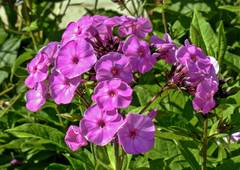
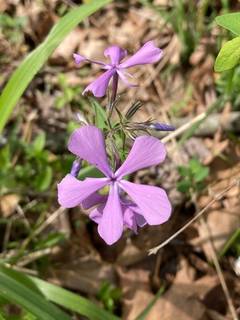
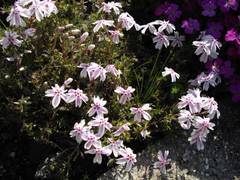
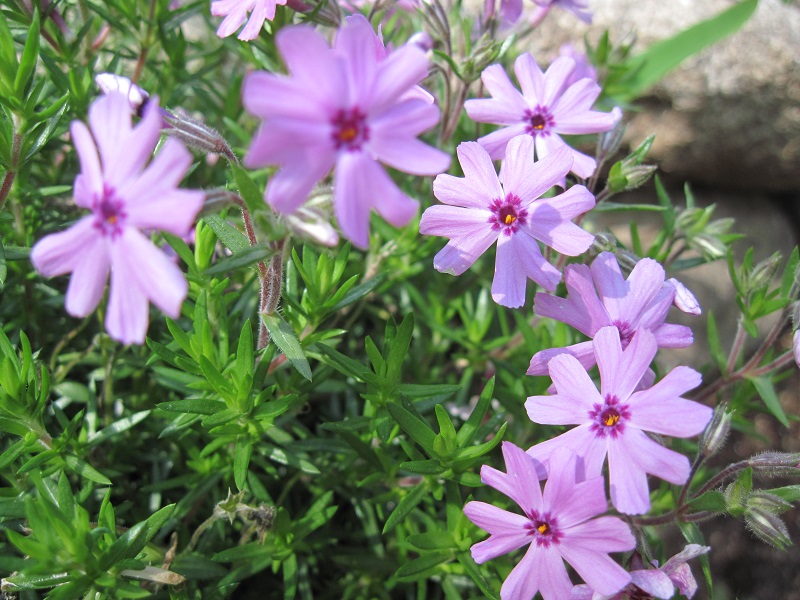
Phlox subulata 'Fort Hill' is a low evergreen mat-forming perennial reaching 4-6 inches (10-15 cm) tall and 18-24 inches (45-60 cm) wide at maturity. Stems are creeping, rooting at nodes, with needle-like dark green leaves 0.5-1 inch (1.3-2.5 cm) long arranged in opposite pairs. Leaves persist year-round in zones 5-8 and partially burn back in zones 3-4. Five-petaled flowers are 0.75 inch (2 cm) across with deep rose-pink petals notched at the tips, each marked with a darker pink central eye. Flowers cover the foliage in a dense sheet from late April through May in zones 5-7, and from early April in zones 8-9. Total bloom period extends 3-4 weeks. Plants spread 2-4 inches (5-10 cm) per year by stem layering, forming a continuous mat that excludes weeds within 3-4 years from a 1-gallon (3.8 L) starter plant. Mites and powdery mildew develop in dry summers with reflected heat from paving; sustained drought thins the mat. Selected from a wild population near Fort Hill, Massachusetts in the 1930s.
Native Range
The species Phlox subulata is native to eastern and central North America from southern New York and Michigan south to Tennessee and North Carolina, growing on dry rocky outcrops, sandy slopes, and open woodlands at 100-3,500 feet (30-1,070 m) elevation. 'Fort Hill' is a wild-collected selection from Fort Hill, Massachusetts.Suggested Uses
Used as a groundcover on slopes, between stepping stones, draping over walls, and in rock gardens spaced 18 inches (45 cm) apart. Suits dry, well-drained sites in full sun where lawn turf does not establish. Plants in containers of at least 1 gallon (3.8 L) trail 12-18 inches (30-45 cm) over the rim and persist 3-4 years before requiring replacement.How to Identify
Appearance
Size & Dimensions
Height4" - 6"
Width/Spread1'6" - 2'
Bloom Information
Late April through May in zones 5-7, with peak bloom lasting 2 weeks in early May. Bloom begins 3-4 weeks earlier in zones 8-9 (early to mid-April) and ends by early May. Individual flowers last 7-10 days; total bloom period extends 3-4 weeks. Bloom timing varies by 7-10 days year to year depending on spring temperatures.
Detailed Descriptions
Flower Description
Deep rose-pink with darker pink eyeFoliage Description
Dark greenGrowing Conditions
Sun Requirements
Requires 6-10 hours of direct sunlight daily
• Full Sun: 6+ hours of direct sunlight
• Partial Shade: 3-6 hours of direct sunlight
• Full Shade: Less than 3 hours of direct sunlight
Care & Maintenance
Care Guide
Water weekly during the first growing season with 2-3 gallons (7.5-11 L) per session in the absence of rain. Established mats tolerate 3-4 weeks of drought; sustained dry periods of 6-8 weeks cause foliage browning and partial mat dieback. Crown rot and stem rot develop on heavy clay soils with poor drainage; raised beds or amendment with sand and compost reduce risk. Spider mites colonize foliage during hot dry summers, producing yellow stippling and webbing on stem tips; strong water sprays every 2-3 days reduce populations. Powdery mildew on foliage in humid summers is cosmetic and rarely affects plant health. Light shearing after bloom by 1-2 inches (2.5-5 cm) maintains mat density and promotes branching at the base.Pruning
Shear plants by 1-2 inches (2.5-5 cm) after bloom in late May or June to maintain mat density and reduce woody centers; bare patches in older clumps may be filled by tucking trimmed stems into soil where they root readily. Fall and winter pruning are not required; evergreen foliage adds winter texture in zones 5-8. Renewal cutting to 1 inch (2.5 cm) every 5-7 years rejuvenates declining mats.Pruning Schedule
Prune: May–June
late spring
Container Growing
Suitable for container growing
Minimum container size: 1 gallons