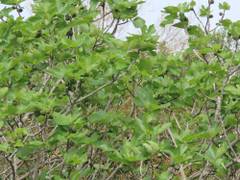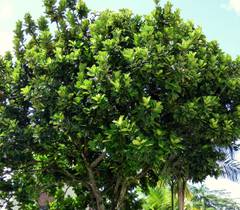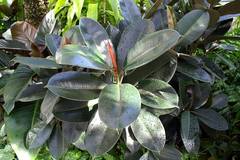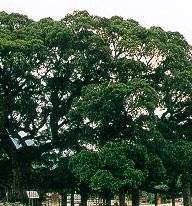
Ficus, Genus, altissima, Species,
- Genus & species
council tree
Southeast Asia from northeastern India through southern China, Myanmar, Thailand, Vietnam, and the Malay Peninsula to Sumatra, Java, and Borneo
Overview
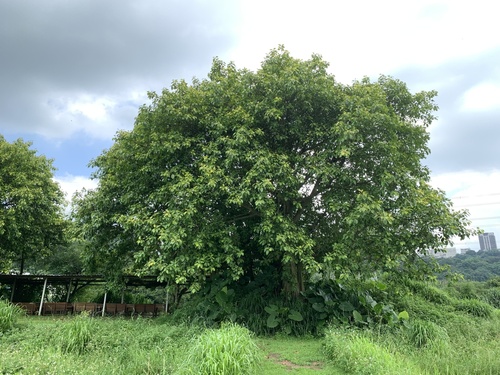
Ficus altissima is a large evergreen banyan-type fig from Southeast Asia grown indoors as a foliage tree, reaching 48–144 inches (120–360 cm) tall and 24–60 inches (60–150 cm) wide in container culture. The species epithet 'altissima' translates as 'tallest' and refers to the wild canopy height, where mature trees reach 100 feet (30 m) and develop the aerial root systems characteristic of banyans. Foliage is composed of broadly oval thick leathery leaves 4–8 inches (10–20 cm) long and 3–5 inches (8–13 cm) wide carried alternately along upright woody stems; the leaf is deep green with prominent yellow-green primary veins and a waxy upper surface. The species-form leaves are solid green; the cultivar 'Yellow Gem' carries a yellow leaf margin and is the form most commonly sold in the houseplant trade. The plant produces a milky white latex sap when stems or leaves are cut; the sap stains skin and fabric and is toxic to dogs and cats. The species was the seventh-most common houseplant in 2022 trade-data surveys and gained rapid popularity as a more forgiving alternative to Ficus lyrata (fiddle-leaf fig), which drops leaves dramatically in response to relocation or watering changes. Cultural failure modes are leaf drop from sudden lighting changes, lower-leaf yellowing from over-watering, and brown leaf edges from chronically low humidity below 30 percent. Hardy outdoors only in USDA zones 10–12. The genus name Ficus translates as 'fig' from Latin, and the family includes the edible fig F. carica alongside several hundred species of mostly tropical trees.
Native Range
Ficus altissima is native to Southeast Asia, with a range from northeastern India through southern China, Myanmar, Thailand, Vietnam, and the Malay Peninsula to Sumatra, Java, and Borneo, where it grows as a strangler fig in tropical lowland and lower montane rainforest, often beginning life as an epiphyte on another tree before sending roots to the ground.Suggested Uses
Used as a tall indoor foliage tree for living rooms, sunrooms, and entryways in containers of 7 gallons (26 liters) or larger. The deep green broadly oval foliage suits modern and tropical-style interiors. Combines with smaller foliage houseplants such as Philodendron cultivars and Calathea for layered tropical indoor plantings. Less suited to households with cats and dogs that browse foliage due to latex toxicity. Outdoors in USDA zones 10–12 used as a shade tree in tropical landscapes.How to Identify
Appearance
Size & Dimensions
Height4' - 12'
Width/Spread2' - 5'
Colors
Foliage Colors
Fall Foliage Colors
Bloom Information
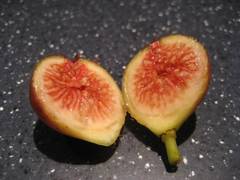
Does not flower in container culture. Outdoor mature trees produce 0.5–0.75 inch (12–19 mm) reddish syconia (fig fruits) pollinated by host-specific fig wasps. Indoor plants are grown for the foliage, which is the year-round display.
Detailed Descriptions
Flower Description
Does not flower in container cultureFoliage Description
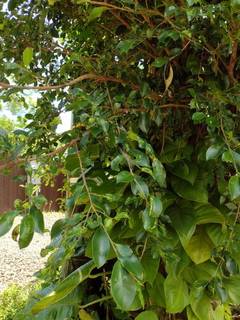
Deep green broadly oval thick leathery leaves 4-8 inches (10-20 cm) long and 3-5 inches (8-13 cm) wide with prominent yellow-green primary veins and a waxy upper surfaceGrowing Conditions
Sun Requirements
Requires 4-8 hours of direct sunlight daily
• Full Sun: 6+ hours of direct sunlight
• Partial Shade: 3-6 hours of direct sunlight
• Full Shade: Less than 3 hours of direct sunlight
Care & Maintenance
Care Guide
Place in bright indirect light at 200–500 foot-candles; the plant tolerates partial direct sun in the morning and scorches in afternoon sun above 4 hours of direct exposure. Water when the top one-third of the soil volume has dried; over-watering causes lower-leaf yellowing and drop. Soil mix should be free-draining (peat-based potting mix amended with 25–30 percent perlite). Wipe leaves monthly with a damp cloth to remove dust, which the waxy leaf surface accumulates more than other foliage houseplants. Feed at half the label rate with a balanced liquid fertilizer monthly during active growth (spring through early autumn) and skip feeding in winter. The plant adjusts to relocation with less leaf drop than F. lyrata but still drops 3–6 leaves in the first 2–3 weeks after a move. Latex sap stains skin and fabric — handle pruning cuts with a damp paper towel pressed to the cut to slow flow.Pruning
Cut the leader stem with clean pruners to encourage branching; cuts heal with a small stipule scar and 2–3 new branches emerge below the cut within 6–10 weeks. Latex sap flows from any cut and stains skin and fabric. Cuttings root in moist potting mix in 6–10 weeks for new plants. Older specimens can be reshaped by hard pruning back to a desired branch structure; the species recovers from cutbacks better than most Ficus houseplants.Container Growing
Suitable for container growing
Minimum container size: 7 gallons