Erythranthe, Genus, guttata, Species,
- Genus & species
yellow monkey-flower
Alaska south through British Columbia, Washington, Oregon, and California; east through Idaho, Montana, and the Rocky Mountains; streambanks, seeps, wet meadows, dripping cliffs, and moist disturbed ground
Overview
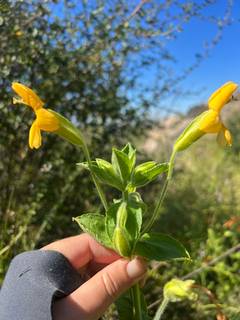
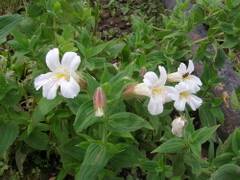
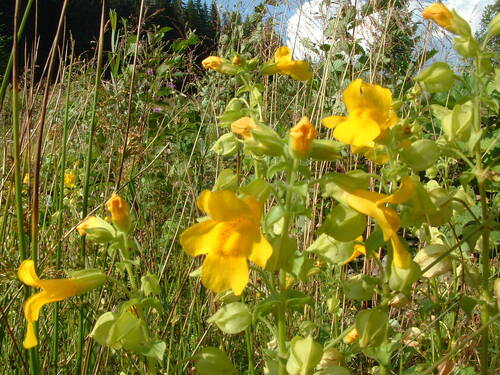
Erythranthe guttata is a mat-forming to upright herbaceous perennial growing 6-30 inches (15-75 cm) tall and 8-18 inches (20-45 cm) wide from hollow succulent branching stems that root at the lower nodes in saturated soil. The species was formerly classified as Mimulus guttatus and is native to wet habitats of western North America. Leaves are opposite, broadly ovate to nearly round, 0.5-3 inches (1.3-7.5 cm) long, medium green, with irregularly toothed margins. Vivid yellow two-lipped (bilabiate) snapdragon-like flowers 0.6-1.5 inches (1.5-4 cm) long appear from leaf axils from May through September — 20 weeks of bloom in favorable moist sites. Each flower has a hairy throat and small red spots on the lower lip; the specific epithet guttata means 'spotted'. The flowers are visited by bumblebees, native bees, butterflies, and hummingbirds. The species self-sows freely in wet ground and forms large colonies along streambanks and seeps; growth is short-lived and sparse in sites that dry out in summer. Hardy zones 5-9. In Phrymaceae.
Native Range
Native to wet habitats from Alaska south through British Columbia, Washington, Oregon, and California, east through Idaho, Montana, and the Rocky Mountains. Grows on streambanks, seeps, wet meadows, dripping cliffs, and moist disturbed ground. Naturalized across temperate regions of the Northern Hemisphere.Suggested Uses
Grown in rain gardens, pond margins, bog gardens, streamside plantings, seep gardens, and containers of 2 gallons (7.5 L) or more kept saturated, spaced 12-18 inches (30-45 cm). The plant performs as a short-lived perennial or reseeding colony in wet ground and behaves as an annual in drier sites. Hardy zones 5-9.How to Identify
Appearance
Size & Dimensions
Height6" - 2'6"
Width/Spread8" - 1'6"
Bloom Information
Late spring through early fall (May-September). Vivid yellow bilabiate snapdragon-like flowers 0.6-1.5 inches (1.5-4 cm) long with small red spots on the lower lip, borne singly from upper leaf axils. 20 weeks in favorable moist sites. Visited by bumblebees, native bees, butterflies, and hummingbirds. The species self-sows freely and often acts as a short-lived perennial or reseeding annual.
Detailed Descriptions
Flower Description
Vivid yellow two-lipped (bilabiate) snapdragon-like flowers 0.6-1.5 inches (1.5-4 cm) long with a hairy throat and small red spots on the lower lip, borne singly from upper leaf axils from May through SeptemberFoliage Description
Medium green; opposite, broadly ovate to nearly round leaves 0.5-3 inches (1.3-7.5 cm) long with irregularly toothed margins on hollow succulent branching stems; foliage yellows and dies back in fallGrowing Conditions
Sun Requirements
Requires 3-8 hours of direct sunlight daily
• Full Sun: 6+ hours of direct sunlight
• Partial Shade: 3-6 hours of direct sunlight
• Full Shade: Less than 3 hours of direct sunlight
Care & Maintenance
Care Guide
Plant in moist to wet loam, clay, or silt pH 5.5-7.5 in 3-8 hours of sun. Water is the primary requirement — soil must stay consistently moist to saturated through the growing season, and stems collapse and bloom ends within a week in dry soils. The species grows well on pond margins, rain garden floors, and along seep lines. Self-sown seedlings appear in moist ground each spring and extend colonies. Hardy zones 5-9.Pruning
Cut back spent flowering stems to the base in October after bloom ends, or leave them to disperse seed into surrounding moist ground. Cut any remaining winter-damaged stems to the ground in February before new growth emerges. No routine pruning is needed during the growing season.Pruning Schedule
Prune: February & October
fallearly spring
Container Growing
Suitable for container growing
Minimum container size: 2 gallons