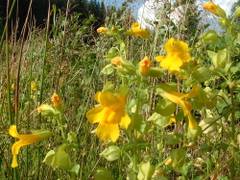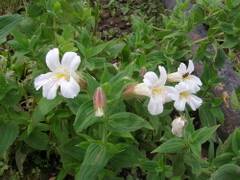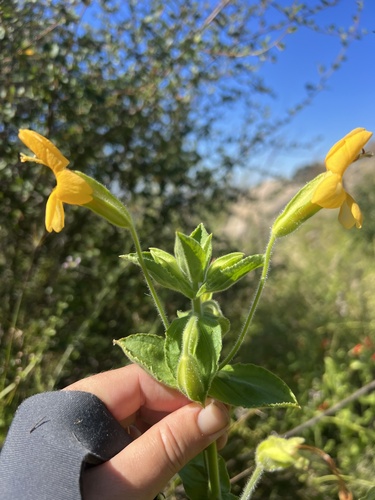
Erythranthe, Genus, cardinalis, Species,
- Genus & species
scarlet monkeyflower
Overview
Erythranthe cardinalis is an herbaceous perennial reaching 12-36 inches (30-90 cm) tall and spreading 12-24 inches (30-60 cm) wide by short rhizomes. Stems are square, sticky-pubescent, and weakly branched. Leaves are opposite, ovate to elliptic, 1-3 inches (2.5-7.5 cm) long, with toothed margins and clasping bases. Flowers are tubular and two-lipped, 1.5-2.5 inches (4-6 cm) long, scarlet to bright red with reflexed lobes, borne singly in upper leaf axils on long pedicels. The corolla tube projects past the calyx with stamens and style protruding from the throat, a structural adaptation to hummingbird pollination. Bloom occurs from May through October in mild-summer regions, peaking June through August. Plants persist 4-7 years in native moist habitats and 2-4 years in cultivation under regular irrigation. Cool-summer growers go semi-dormant above 95°F (35°C), shedding lower leaves and resuming growth as temperatures drop. Hardy to USDA zone 7; behaves as a tender perennial or annual in zones 5-6 with winter mulch. The species was reclassified from Mimulus cardinalis in recent phylogenetic revisions.
Native Range
Native to western North America from southern Oregon south through California to northern Baja California, and east through southern Nevada, Arizona, and New Mexico. Found along seeps, stream banks, springs, and riparian corridors at 0-8,000 feet (0-2,450 m) elevation.Suggested Uses
Used along pond edges, stream banks, rain gardens, and bog gardens at 18-24 inch (45-60 cm) spacing. Suited to hummingbird gardens and seasonal seep plantings; flowers attract Anna's, Allen's, and Rufous hummingbirds in western North America. Performs poorly in dry, fast-draining sites without supplemental irrigation.How to Identify
Appearance
Size & Dimensions
Height1' - 3'
Width/Spread1' - 2'
Bloom Information
Flowers open from May through October in mild-summer regions, with peak bloom from June through August. Individual flowers last 4-7 days; total bloom period extends 12-20 weeks per plant. Bloom duration extends to 20 weeks in coastal climates with continuous moisture; inland populations stop flowering during drought and resume when soil moisture returns. Hummingbirds visit flowers throughout daylight hours.
Detailed Descriptions
Flower Description
scarlet to bright redFoliage Description
medium green; opposite, ovate, with toothed marginsGrowing Conditions
Sun Requirements
Requires 4-8 hours of direct sunlight daily
• Full Sun: 6+ hours of direct sunlight
• Partial Shade: 3-6 hours of direct sunlight
• Full Shade: Less than 3 hours of direct sunlight
Care & Maintenance
Care Guide
Plants require consistent moisture year-round; the top 4 inches (10 cm) of soil typically remain damp during the growing season in cultivation. Brief flooding of 2-3 weeks is tolerated, but waterlogged crowns rot through winter in cold-climate plantings. Spider mites infest stressed plants in hot, dry conditions, producing stippled foliage and webbing on leaf undersides. Botrytis affects flowering stems in humid coastal climates with overhead irrigation. Plants self-sow on bare moist soil, producing 20-50 seedlings per parent annually. Cut back to 4 inches (10 cm) in late fall in zones 7-9 or after foliage dies back in colder zones.Pruning
Cut stems back by half in midsummer to extend bloom and reduce lax growth. After bloom in fall (zones 7-9) or after frost-killed foliage collapses (zones 5-6), cut all stems to 4 inches (10 cm) above the crown. Remove spent flowering stalks during the season; this reduces seed set and prolongs flowering by 2-3 weeks.Pruning Schedule
Prune: July–August & October–November
summerfall
Container Growing
Suitable for container growing
Minimum container size: 3 gallons