Epilobium, Genus, ciliatum, Species,
- Genus & species
common willowherb (native)
North America, Central America, and South America, from Alaska south to Mexico and into the Andean regions of South America; moist disturbed ground, streambanks, ditches, and irrigated fields from sea level to approximately 10,000 feet (3,000 m).
Overview
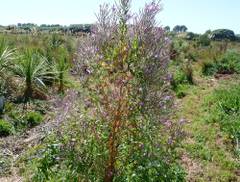
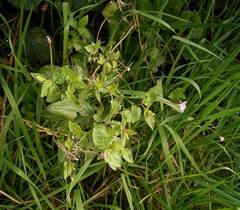
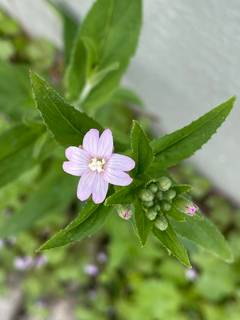
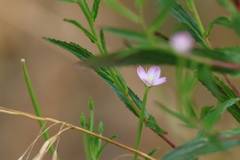
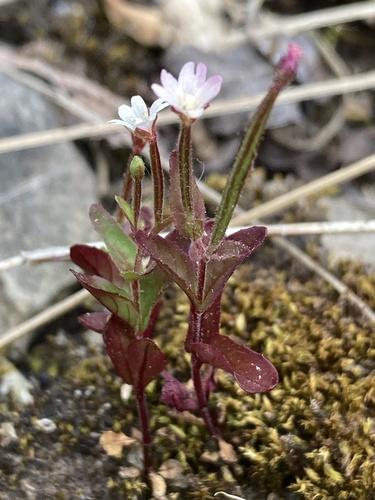
Epilobium ciliatum is an herbaceous perennial reaching 12-60 inches (30-150 cm) tall and 8-18 inches (20-45 cm) wide, native throughout the Americas. Plants function as a weed in horticultural and agricultural settings, with populations in Pacific Northwest container nurseries, greenhouses, irrigated fields, and disturbed moist ground. Stems are erect, branching, bearing short appressed to spreading hairs and raised lines (strigillose ridges) running down from each leaf base. Leaves are lance-shaped to narrowly elliptic, 1.5-4 inches (4-10 cm) long, with finely serrate margins; lower leaves are opposite, upper leaves alternate. Four-petaled flowers 0.15-0.3 inch (4-8 mm) across appear in the upper leaf axils from June through September, in pink to white with notched petal tips. Fruit is a slender capsule 1.5-3 inches (4-8 cm) long that splits into four segments and releases seeds bearing a tuft of white silky hairs (coma) for wind dispersal; a single plant produces 10,000-60,000 seeds. Plants also spread by short stolons and by basal rosettes that form in fall and overwinter. Hardy in USDA zones 3-9 (-40°F / -40°C).
Native Range
Epilobium ciliatum is native throughout the Americas, occurring from Alaska and northern Canada south through the United States, Mexico, Central America, and into South America, from sea level to over 10,000 feet (3,000 m). Plants grow in moist disturbed ground, streambanks, ditches, gardens, nurseries, and irrigated agricultural fields, and the species has also naturalized in parts of Europe and Asia.Suggested Uses
The species is used in nursery weed management training as a common container weed of the Pacific Northwest and is studied in native plant ecology and wind seed dispersal biology. Dried specimens are used in Onagraceae morphology exercises for demonstrating inferior ovary position, four-parted flower structure, and coma-bearing seed adaptation.How to Identify
Appearance
Size & Dimensions
Height1' - 5'
Width/Spread8" - 1'6"
Bloom Information
Four-petaled flowers 0.15-0.3 inch (4-8 mm) across open continuously from June through September in the upper leaf axils, with a total bloom span of 12-14 weeks in the Pacific Northwest as the stem elongates through the season. Individual flowers last 1-2 days. Capsules mature 2-3 weeks after flowering and split to release seeds dispersed by wind on silky coma hairs. Flowers are self-pollinating and do not require insect visitation for seed set.
Detailed Descriptions
Flower Description
Pink to white four-petaled flowers 0.15-0.3 inch (4-8 mm) across with notched petal tips, produced in the upper leaf axils from June through SeptemberFoliage Description
Medium green; lance-shaped to narrowly elliptic, 1.5-4 inches (4-10 cm) long, with finely serrate margins; opposite on lower nodes, alternate on upper nodes; held on branching stems with raised lines (strigillose ridges) running down from each leaf baseGrowing Conditions
Sun Requirements
Requires 4-10 hours of direct sunlight daily
• Full Sun: 6+ hours of direct sunlight
• Partial Shade: 3-6 hours of direct sunlight
• Full Shade: Less than 3 hours of direct sunlight