Epilobium, Genus, canum, Species,
- Genus & species
California fuchsia
Western United States and northwestern Mexico
Overview
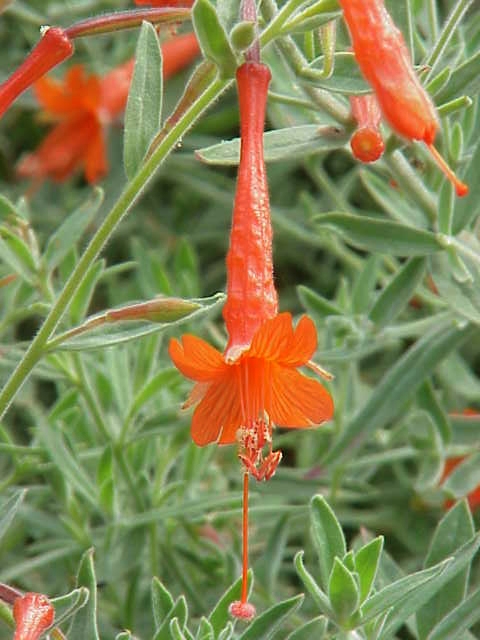
Epilobium canum, long known in gardens as Zauschneria californica, is a spreading perennial subshrub native to California and the southwestern United States. It grows 1-3 feet (30-90 cm) tall and spreads 2-4 feet (60-120 cm) wide by underground rhizomes, forming loose mounds of narrow leaves. The foliage is gray-green to silvery, 0.5-1.5 inches (1-4 cm) long, and often softly hairy. From late summer into autumn the plant carries tubular scarlet to orange-red flowers about 1-1.5 inches (2.5-4 cm) long, flaring into four notched lobes with protruding stamens. The flowers coincide with the autumn migration of hummingbirds, which are the main pollinators. After bloom, slender capsules split to release silky-plumed seeds. E. canum grows on dry slopes, rocky outcrops, and chaparral edges, and tolerates heat, drought, and lean soils once established. Its rhizomes can spread aggressively in rich, watered ground, crowding smaller neighbors. The stems die back or look ragged in winter and are usually cut to the base. It is hardy in USDA zones 7 through 10.
Native Range
Native to the western United States and northwestern Mexico, centered on California and extending into Oregon, Nevada, Arizona, and Baja California. It grows on dry rocky slopes, cliffs, road banks, and chaparral margins.Suggested Uses
Planted in dry borders, rock gardens, slopes, and water-wise and native gardens across the western states. It works as a late-season nectar source for hummingbirds and as a bank cover on dry sites.How to Identify
Appearance
Size & Dimensions
Height1' - 3'
Width/Spread2' - 4'
Bloom Information
Flowering runs from midsummer into autumn, generally August through October, often continuing until the first hard frost. The tubular red flowers open over many weeks and coincide with southbound hummingbird migration. Bloom is heaviest in full sun and tapers in shade.
Detailed Descriptions
Flower Description
Scarlet to orange-redFoliage Description
Gray-green to silveryGrowing Conditions
Sun Requirements
Requires 6-10 hours of direct sunlight daily
• Full Sun: 6+ hours of direct sunlight
• Partial Shade: 3-6 hours of direct sunlight
• Full Shade: Less than 3 hours of direct sunlight
Care & Maintenance
Care Guide
Grow E. canum in full sun and fast-draining soil; it tolerates sand, decomposed granite, and rocky ground, and resists drought once established. Limited summer water deepens flower color and keeps growth compact, while rich soil and frequent irrigation encourage rampant rhizome spread. Cut the plant to the base in late winter to clear old stems before new growth begins. It needs little fertilizer and few inputs in lean soils. In colder zones a layer of mulch shelters the roots through winter. Divide or pull excess rhizomes in spring to keep clumps within bounds.Pruning
Cut the stems back to a few inches above the ground in late winter or early spring before new shoots emerge. Shearing lightly after the first flush can prompt a second round of bloom. Remove wayward rhizomatous shoots through the season to limit spread.Pruning Schedule
Prune: February–March
winterearly spring
Container Growing
Suitable for container growing
Minimum container size: 3 gallons