Overview
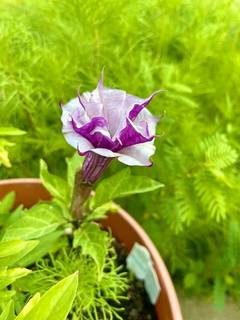
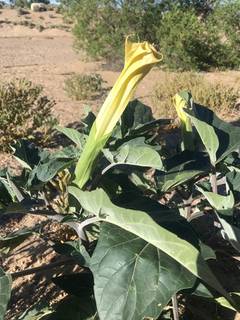
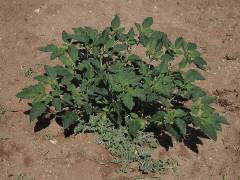
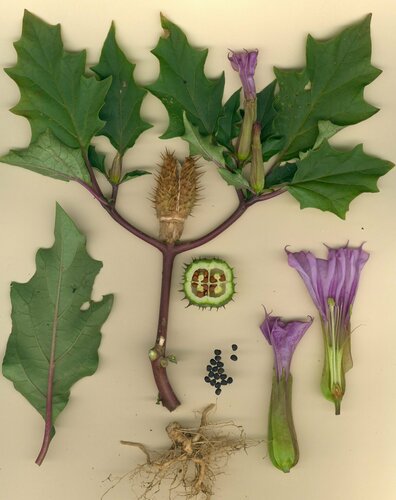
Datura stramonium is an annual in the nightshade family, branching into a bushy plant 24-60 inches (60-150 cm) tall and nearly as wide. Stems are stout, pale green to purplish, and smooth. Leaves are 3-8 inches (8-20 cm) long, ovate with coarse, irregular teeth, and release a rank odor when crushed. Flowers are erect, trumpet-shaped, 2.5-4 inches (6-10 cm) long, white to pale violet, and open in the evening with a faint fragrance. Each bloom is followed by an egg-shaped capsule about 1.5-2 inches (4-5 cm) long, covered in sharp spines, which splits into four parts to release numerous black seeds. All parts of the plant contain tropane alkaloids including atropine, scopolamine, and hyoscyamine, which are poisonous to people and animals if eaten. The plant grows in disturbed soil, fields, barnyards, and roadsides, and self-seeds freely. Seeds remain viable in the soil for many years. Plants grow quickly through summer and are killed by the first hard frost. The species is regulated as a noxious weed in several jurisdictions.
Native Range
Datura stramonium is of uncertain origin, likely native to Central America, and is now naturalized across temperate and subtropical regions worldwide. It grows in disturbed ground, croplands, pastures, and roadsides.Suggested Uses
Rarely cultivated, D. stramonium appears mostly as a volunteer weed of disturbed ground. It has a history of use in traditional medicine and ritual, though all parts are poisonous. Night-flying moths visit the evening flowers for nectar.How to Identify
Appearance
Size & Dimensions
Height2' - 5'
Width/Spread2' - 4'
Bloom Information
Detailed Descriptions
Flower Description
white to pale violetFoliage Description
greenGrowing Conditions
Sun Requirements
Requires 6-12 hours of direct sunlight daily
• Full Sun: 6+ hours of direct sunlight
• Partial Shade: 3-6 hours of direct sunlight
• Full Shade: Less than 3 hours of direct sunlight
Water & Climate
Water Needs
Drought Tolerance
Drought tolerant when established
Care & Maintenance
Care Guide
This frost-tender annual grows in full sun and warm, fertile, well-drained soil, tolerating poor and dry ground once established. Seeds germinate in late spring once the soil has warmed, and plants grow rapidly through summer. No fertilizer or staking is usually needed. All parts are poisonous if ingested, containing tropane alkaloids, and the plant self-seeds aggressively from long-lived seed. Plants die with the first hard frost. Volunteer seedlings often appear the following year.Pruning
No routine pruning is required for this annual. Removing the spiny seed capsules before they split reduces self-seeding for the next year. Plants are pulled out and discarded after frost.Toxicity Warning
Toxic to pets and humansPlanting Guide
Planting Methods & Timing
Planting Method
direct sow