Overview
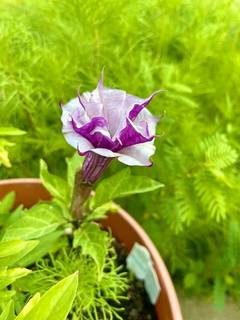
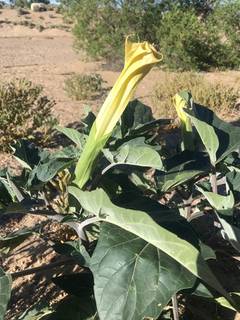
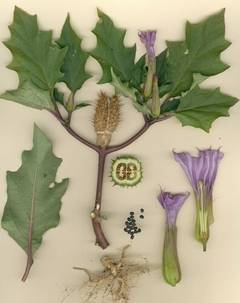
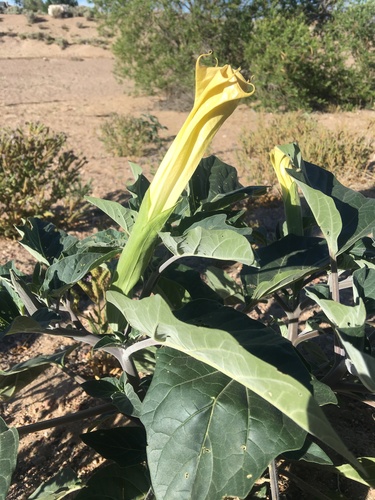
Datura is a genus of about nine species of annual and short-lived perennial plants in the nightshade family (Solanaceae), called devil's trumpets or thornapples, native mainly to the warm regions of the Americas. They are separated from the related angel's trumpets (Brugmansia) by their upright or outward-facing flowers, where Brugmansia flowers hang down. Plants form bushy, branching mounds 2-5 feet (0.6-1.5 m) tall and as wide, with broad, often gray-green leaves that have a rank scent when bruised. The trumpet-shaped flowers are 6-8 inches (15-20 cm) long, white, cream, yellow, or purple, opening in the evening and releasing a strong fragrance that fades by midday. Flowering runs from summer into autumn, each bloom lasting about a day. The flowers are followed by rounded, spiny seed capsules that split to release flattened seeds, the source of the name thornapple. All parts of the plant contain tropane alkaloids including atropine, hyoscyamine, and scopolamine, which are poisonous to people, pets, and livestock if eaten. Plants tolerate heat and drought and self-sow readily, becoming weedy in warm climates.
Native Range
The genus is native chiefly to the southwestern United States, Mexico, and Central America, with some species extending into South America. Several, such as jimsonweed (D. stramonium), have naturalized widely across temperate and tropical regions as agricultural and roadside weeds.Suggested Uses
Daturas are planted as summer feature plants in warm borders, gravel gardens, and large containers, spaced 24-36 inches (60-90 cm) apart, where the evening fragrance is noticeable near patios and paths. They are used in night and moon gardens for their pale, evening-opening flowers. Because every part is poisonous, they are excluded from plantings accessible to young children and grazing animals.How to Identify
Appearance
Size & Dimensions
Height2' - 5'
Width/Spread2' - 4'
Bloom Information
Flowering runs from early summer until frost, with peak bloom in the heat of midsummer. The flowers open in the late afternoon and evening, are fragrant overnight, and wilt by the following midday. New buds form continuously through the season, so a plant carries flowers and developing spiny pods at the same time.
Detailed Descriptions
Flower Description
white, cream, yellow, or purpleFoliage Description
gray-greenGrowing Conditions
Sun Requirements
Requires 6-10 hours of direct sunlight daily
• Full Sun: 6+ hours of direct sunlight
• Partial Shade: 3-6 hours of direct sunlight
• Full Shade: Less than 3 hours of direct sunlight
Water & Climate
Water Needs
Drought Tolerance
Drought tolerant when established
Care & Maintenance
Care Guide
Datura species grow in full sun in average to poor, well-drained soil with a pH of 6.0-7.5 and tolerate heat, drought, and lean ground once established. They are grown as warm-season annuals in cold regions and as tender perennials in USDA zones 8-10, where the roots survive mild winters. Excess water and rich soil produce soft growth at the expense of flowers. All parts are poisonous if eaten, and the sap can irritate skin and eyes. Spider mites, whitefly, and tobacco budworm are the main pests. Plants self-sow heavily, and unwanted seedlings are easily pulled while small.Pruning
Little pruning is needed beyond removing frost-killed or straggly stems. In frost-free areas, tender perennial species are cut back hard in late winter to renew compact growth. Spiny seed pods are removed before they split where self-sowing is not wanted.Container Growing
Suitable for container growing
Minimum container size: 5 gallons
Toxicity Warning
Toxic to pets and humansPlanting Guide
Planting Methods & Timing
Planting Method
both
Indoor Start
8 weeks before last frost
Direct Sow Timing
After the last frost when soil has warmed to at least 60F (15C)
Days to Maturity
60–90 days
Plant Spacing
30 inches