Cyclamen, Genus, spp., Multiple species,
- Genus
- Multiple species
cyclamen
Mediterranean Basin east to Iran and North Africa
Overview
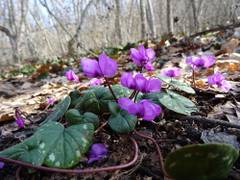
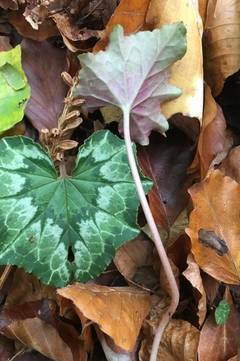
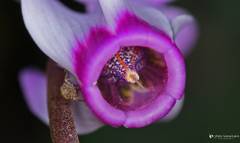
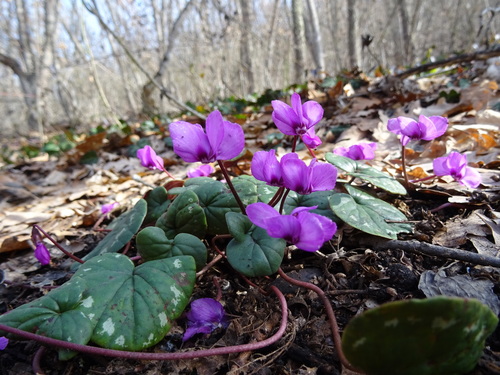
Cyclamen is a genus of about 23 species of tuberous perennials in the family Primulaceae, native to the Mediterranean region and adjacent areas. Plants grow from a flattened underground tuber and reach 2–12 inches (5–30 cm) tall, forming low mounds of long-stalked leaves. Leaves are rounded to heart- or ivy-shaped, 1–6 inches (2.5–15 cm) across, often patterned with silver or pewter zones over deep green. Flowers are held singly on slender stalks above the foliage, each with five petals sharply reflexed and twisted backward, in white, pink, rose, magenta, or red, 0.4–1.2 inches (1–3 cm) long. After flowering, the stalks of many species coil downward to set seed at ground level. Most species are dormant in summer, with leaves emerging in fall and persisting through winter and spring. C. hederifolium and C. coum are frost-hardy, while C. persicum and its cultivars are tender and grown as houseplants or winter container plants. All parts, especially the tuber, contain saponins that are toxic to people and pets if eaten.
Native Range
Native to the Mediterranean Basin, from Spain and the Canary Islands east to Iran, and south to the mountains of North Africa and Somalia. Grows in woodland, scrub, and rocky slopes, often in dappled shade and free-draining soil, from sea level to about 4,000 feet (1,200 m).Suggested Uses
Hardy species grow under deciduous trees and shrubs, in rock gardens, and naturalized in drifts, spaced 4–6 inches (10–15 cm) apart. C. persicum is grown as a winter-flowering houseplant and in seasonal container displays. All parts are toxic to pets and people if eaten.How to Identify
Appearance
Size & Dimensions
Height2" - 1'
Width/Spread4" - 1'
Bloom Information
Flowering time varies by species across the year. C. hederifolium blooms late summer to fall, C. coum in winter to early spring, and C. persicum from fall through spring under cool conditions. Each plant carries flowers for 6–12 weeks, with individual blooms lasting 1–2 weeks. High temperatures end flowering and push plants into summer dormancy.
Detailed Descriptions
Flower Description
white, pink, rose, magenta, to redFoliage Description
deep green with silver markingsGrowing Conditions
Sun Requirements
Requires 2-5 hours of direct sunlight daily
• Full Sun: 6+ hours of direct sunlight
• Partial Shade: 3-6 hours of direct sunlight
• Full Shade: Less than 3 hours of direct sunlight
Water & Climate
Water Needs
Care & Maintenance
Care Guide
Grows in part shade and gritty, well-drained soil rich in leaf mold, kept slightly moist while in leaf and drier during summer dormancy. Hardy species tolerate winter lows to about 5°F (-15°C) under mulch, while C. persicum is damaged below 40°F (4°C). Tubers sit shallowly, with the top at or just below the soil surface. Overwatering and wet summer soil rot the tubers. Vine weevil larvae and gray mold occur in containers and damp conditions. Self-sown seedlings spread colonies of hardy species over several years.Pruning
No structural cutting is needed. Faded flowers and yellowing leaves pull away cleanly at the tuber, which limits gray mold. Seed capsules left in place ripen and self-sow, extending hardy colonies; removing them prevents that spread.Container Growing
Suitable for container growing
Minimum container size: 1 gallons