Hamamelis, Genus, virginiana, Species,
- Genus & species
common witch hazel
Overview
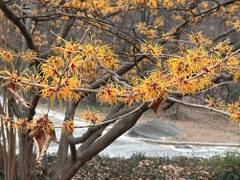
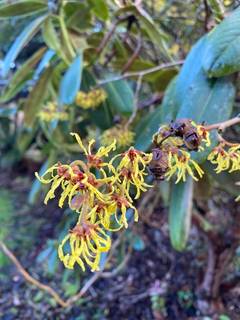
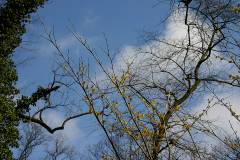
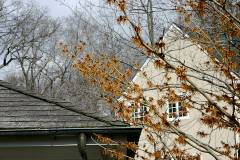
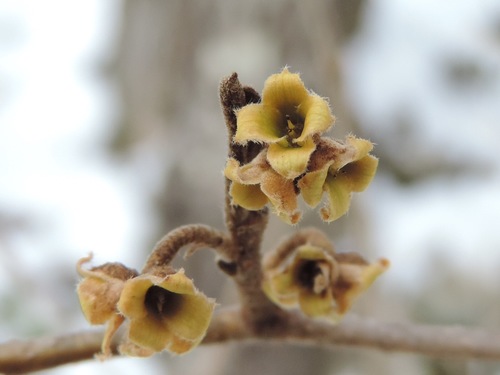
Hamamelis virginiana is a deciduous shrub or small tree reaching 15-25 feet (4.5-7.5 m) tall and 12-20 feet (3.6-6 m) wide, often multi-stemmed with an open, irregular, vase-shaped form. Bark is smooth and grayish-brown, becoming scaly with age. Leaves are alternate, ovate to obovate, 3-6 inches (7.5-15 cm) long, with wavy or coarsely toothed margins and an asymmetrical leaf base. Foliage is medium green in summer, turning yellow with bronze tones in October. Fragrant ribbon-like flowers with four crinkled, narrow yellow petals 0.5-0.8 inch (12-20 mm) long open from late October through December, often appearing while the leaves are still falling. Each flower bears a small reddish-brown calyx. Fruits are woody capsules 0.5 inch (12 mm) long that mature 12-13 months after flowering and forcefully eject two black seeds up to 30 feet (9 m) when ripe. Growth rate is slow to moderate, about 12-18 inches (30-45 cm) per year, with full mature size developing over 15-20 years. Lower branches retain dead leaves into winter (marcescence) on some plants. Form becomes leggy and flowering decreases in dense shade.
Native Range
Hamamelis virginiana is native to eastern North America from Nova Scotia and Quebec south to Florida and west to Texas, Arkansas, and Wisconsin. Found as an understory shrub in deciduous forests, along streambanks, and on moist rocky hillsides, typically associated with oaks, hickories, and beech at elevations from sea level to 4,000 feet (1,200 m).Suggested Uses
Used as an understory shrub in woodland gardens, in shrub borders, and as a multi-stemmed specimen, spaced 12-18 feet (3.6-5.5 m) apart. Fall flowering and yellow autumn foliage extend the season of interest in deciduous landscapes from October through December. Bark and leaves are the commercial source of witch hazel astringent, with distilled extracts used in skin care products.How to Identify
Appearance
Size & Dimensions
Height15' - 25'
Width/Spread12' - 20'
Bloom Information
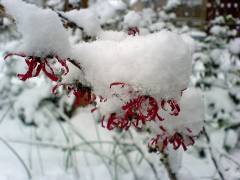
Yellow ribbon-like flowers open from late October through December in zones 4-7, with peak bloom in November. In zones 8-9, flowering may shift to November through January. Individual flowers tolerate freezing temperatures by curling their petals on cold days and reopening when temperatures rise above 30°F (-1°C). Total bloom period extends 4-6 weeks per plant, with significant variation in flowering time among individuals within a single forest.
Detailed Descriptions
Foliage Description
Medium green in summer, yellow with bronze tones in autumnGrowing Conditions
Sun Requirements
Requires 3-8 hours of direct sunlight daily
• Full Sun: 6+ hours of direct sunlight
• Partial Shade: 3-6 hours of direct sunlight
• Full Shade: Less than 3 hours of direct sunlight
Care & Maintenance
Care Guide
Water deeply every 7-10 days during the first two growing seasons; established plants tolerate dry conditions for 3-4 weeks, but flowering and growth slow under prolonged drought. Sites with consistent soil moisture produce the largest plants. Powdery mildew and leaf spot occur in humid summers with poor air circulation and present as cosmetic discoloration. Witch hazel cone gall aphids cause cone-shaped galls on leaves without affecting plant health. Mulch with 2-3 inches (5-7.5 cm) of organic material in a 3-foot (90 cm) ring to maintain even moisture. Plants typically live 50-80 years in cultivation and longer in native woodland sites.Pruning
Pruning is generally limited; the natural vase-shaped form is the typical growth habit. Remove dead, crossing, or rubbing branches in late winter while the plant is dormant and flower buds for the following autumn are visible. Severe rejuvenation pruning every 10-15 years cuts the oldest stems to ground level over 3 seasons to renew the plant. Suckers from the base can be removed in spring or left to develop a multi-stemmed thicket form.Pruning Schedule
Prune: February–March
winterearly spring