Vines
Clerodendrum, Genus, thomsoniae, Species,
- Genus & species
Bleeding-heart vine
Tropical West Africa, from Senegal to Nigeria and Cameroon
Overview
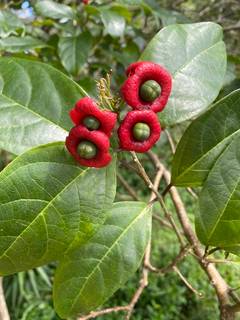
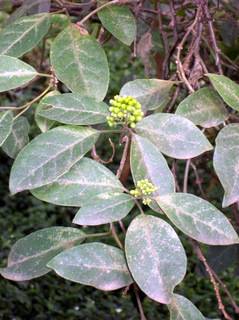
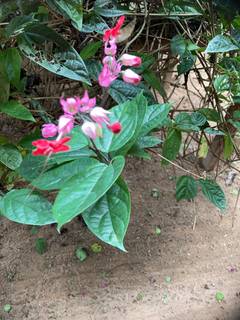
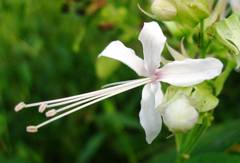
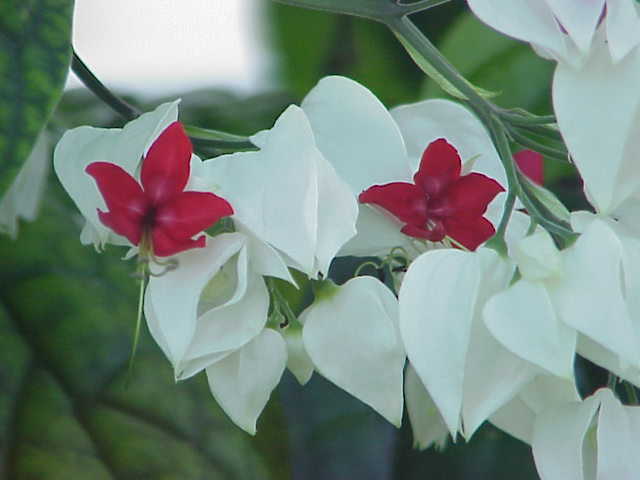
Clerodendrum thomsoniae is an evergreen to semi-evergreen twining vine in the mint family (Lamiaceae), with slender stems that climb 8–15 feet (2.4–4.6 m) by twining around supports. Leaves are opposite, ovate to elliptic, 3–6 inches (7.5–15 cm) long and 1.5–3 inches (4–7.5 cm) wide, dark green, with a smooth margin and a prominent set of veins. Flowers are held in loose, branched clusters (cymes) 3–6 inches (7.5–15 cm) wide at the leaf axils and stem tips. Each flower has an inflated, bell-shaped calyx 0.8–1 inch (2–2.5 cm) long, white to cream, and a crimson-red corolla 0.5–0.8 inch (12–20 mm) long with long protruding stamens. The white calyx persists after the red corolla falls and often turns pink to purple with age. Fruits are small, fleshy drupes, 0.4 inch (10 mm) across, black to orange-red. Growth is vigorous at 3–6 feet (0.9–1.8 m) per year in warm, humid conditions. The species is frost-tender and loses leaves below 50°F (10°C), with stem death near 32°F (0°C). Plants shed leaves under dry, cold, or low-light conditions in winter, and stems are brittle and break in strong wind.
Native Range
Clerodendrum thomsoniae is native to tropical West Africa, from Senegal and Sierra Leone east to Cameroon and Nigeria. It grows in forest margins, thickets, and secondary growth in humid lowland areas.Suggested Uses
Grown as a trellis or arbor vine in tropical and subtropical gardens in zones 10–12. Grown in containers on hoops and trellises indoors or in conservatories. Stems reach 8–15 feet (2.4–4.6 m) in a single season in warm conditions, so supports are installed at planting.How to Identify
Appearance
Size & Dimensions
Height8' - 15'
Width/Spread3' - 6'
Bloom Information
Flowers open from spring through early autumn, March–September in warm climates, for 20–24 weeks, with peak flowering in spring and early summer. The red corolla lasts 5–7 days and the white calyx remains for 2–4 weeks. Indoors, flowering follows a winter rest of 6–8 weeks at 55–60°F (13–16°C).
Detailed Descriptions
Flower Description
White calyx with crimson corollaFoliage Description
Dark greenGrowing Conditions
Sun Requirements
Requires 4-6 hours of direct sunlight daily
• Full Sun: 6+ hours of direct sunlight
• Partial Shade: 3-6 hours of direct sunlight
• Full Shade: Less than 3 hours of direct sunlight
Care & Maintenance
Care Guide
Grows in bright, filtered light to part sun, 4–6 hours of direct sun, on rich, moist, well-drained soil at pH 5.5–6.5. Water is applied weekly at about 1 inch (2.5 cm) during active growth, and watering is cut by about half in winter. Temperatures of 65–85°F (18–29°C) and relative humidity above 50% are typical, and USDA zones 10–12 permit outdoor growth. Container plants are repotted in spring into pots 10–14 inches (25–35 cm) wide. Fertilizer is applied monthly from spring to late summer at half strength. Whiteflies, mealybugs, and spider mites feed on the leaves.Pruning
Stems are cut back by one-third to one-half in late winter, before new growth, to 6–12 inches (15–30 cm) above the base, which controls length and removes weak shoots. Flowers form on new growth, so pruning before spring does not reduce bloom. Stem cuttings of 4–6 inches (10–15 cm) root in 3–5 weeks.Pruning Schedule
Prune: February–March
winterearly spring
Container Growing
Suitable for container growing
Minimum container size: 3 gallons