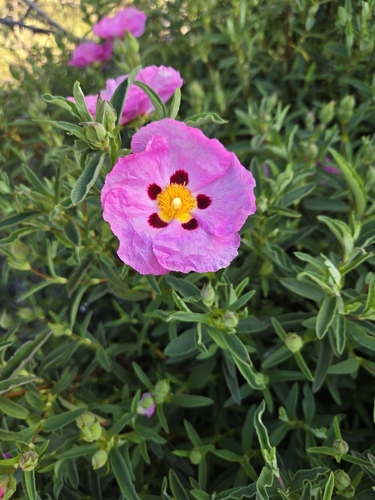
Cistus purpureus
purple rock rose
Natural hybrid from western Mediterranean (Spain, Portugal, southern France) where parent species {C. ladanifer} and {C. creticus} overlap
Overview
Cistus × purpureus is a medium upright to rounded broadleaf evergreen shrub in the rock rose family (Cistaceae spp.) reaching 3–5 feet (0.9–1.5 m) tall with a spread of 3–5 feet (0.9–1.5 m). The natural hybrid combines C. ladanifer and C. creticus parentage and carries large crinkled papery dark reddish-pink to rosy-purple flowers 3–3.5 inches (8–9 cm) across — among the larger flowers of any Cistus spp. in cultivation. Each petal has a prominent dark maroon-red basal blotch, and the blotches create a ringed pattern around the central boss of yellow stamens. Individual flowers last one day. Leaves are lanceolate 2–3 inches (5–8 cm) long, dark green, slightly sticky and aromatic. The habit is more upright and larger than most other commercial rock roses. Growth rate is moderate. Hardy to zone 7b with protection — tolerates temperatures to 10°F (−12°C), which is at the cold end of the Cistus spp. hardiness range. Individual plants are short-lived at 6–10 years (longer-lived than most rock roses). Summer irrigation in heavy soils causes root rot. The resinous foliage is flammable. The combination of large flower size, dark basal blotches, and relative cold hardiness has made this hybrid a standard purple-flowered rock rose across the nursery trade.
Native Range
Cistus × purpureus is a natural hybrid occurring where the parent species (C. ladanifer and C. creticus) overlap in range, primarily in the western Mediterranean (Spain, Portugal, southern France). The hybrid is also widely naturalized in cultivation.Suggested Uses
Grown in Mediterranean-style gardens, gravel gardens, dry borders, and coastal plantings at 3–5 foot (0.9–1.5 m) spacing. The large dark-blotched flowers carry strong color across a dry-climate planting where the saturated reddish-pink contrasts with silver, blue, and gray companions. Informal hedging and slope stabilization are functional uses at 3-foot spacing. Container culture works in 5 gallon (19 L) or larger pots with sharp drainage. The relative cold hardiness extends the cultivation range to zone 7b, further north than most other rock roses. Pairing with Lavandula spp., Rosmarinus spp., other Cistus spp. species, and Mediterranean sub-shrubs extends the garrigue planting palette. Irrigated borders and heavy clay are not suitable growing conditions.How to Identify
Appearance
Size & Dimensions
Height3' - 5'
Width/Spread3' - 5'
Reaches mature size in approximately 4 years
Bloom Information
Large crinkled dark reddish-pink to rosy-purple flowers 3–3.5 inches (8–9 cm) across with dark maroon-red basal blotches and yellow stamens open daily from May through July. Individual flowers last one day and drop by evening. Bloom duration is 6–8 weeks with successive daily flower production across the canopy.
Detailed Descriptions
Flower Description
Dark reddish-pink to rosy-purple with dark maroon-red basal blotches and yellow stamens, large crinkled 3-3.5 inchesFoliage Description
Dark green, lanceolate 2-3 inches, slightly sticky and aromaticGrowing Conditions
Sun Requirements
Requires 6-12 hours of direct sunlight daily
• Full Sun: 6+ hours of direct sunlight
• Partial Shade: 3-6 hours of direct sunlight
• Full Shade: Less than 3 hours of direct sunlight
Care & Maintenance
Care Guide
Grows in full sun in sharply drained lean poor soil at pH 6.0–8.0, tolerating sand, rocky, and loam substrates. Hardy to zone 7b with winter protection — tolerates temperatures to 10°F (−12°C), which extends the growing range further north than most rock roses. Summer irrigation is not applied once established — summer water in heavy soils causes root rot and plant death. Fertilizer is not applied. Coastal conditions and salt spray are tolerated. Individual plants are short-lived at 6–10 years, though somewhat longer-lived than most rock roses. The resinous foliage is flammable; fire-prone landscapes require defensible-space separation from structures. No serious pest or disease problems aside from wet-soil root rot.Pruning
Prune lightly after flowering in late July. Cut back by about one-third of the season's growth to maintain the compact upright shape. Cutting back into bare leafless wood is avoided, as the plant does not regenerate from old wood. Plants that become leggy after 6–10 years are removed and replaced rather than rejuvenated.Pruning Schedule
J
F
M
A
M
J
J
A
S
O
N
D
summer
Container Growing
✓ Suitable for container growing
Minimum container size: 5 gallons