Image 1 of 11
1 / 11
© No machine-readable author provided. Dlanglois assumed (based on copyright claims)., some rights reserved (CC-BY-SA) · Wikimedia Commons
Banksia, Genus, spinulosa, Species,
- Genus & species
hairpin banksia
Overview
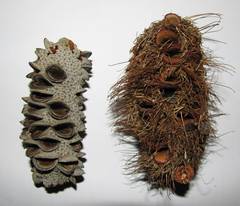
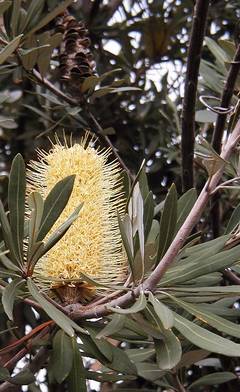
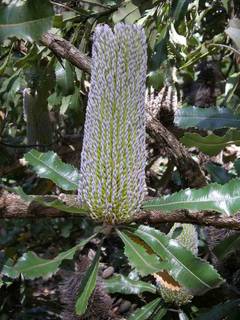
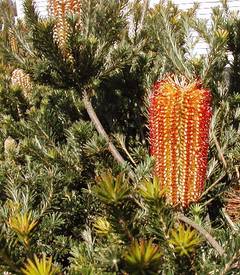
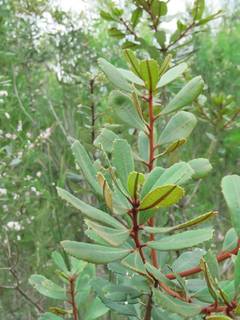
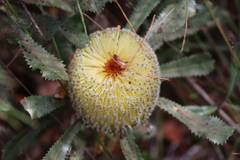
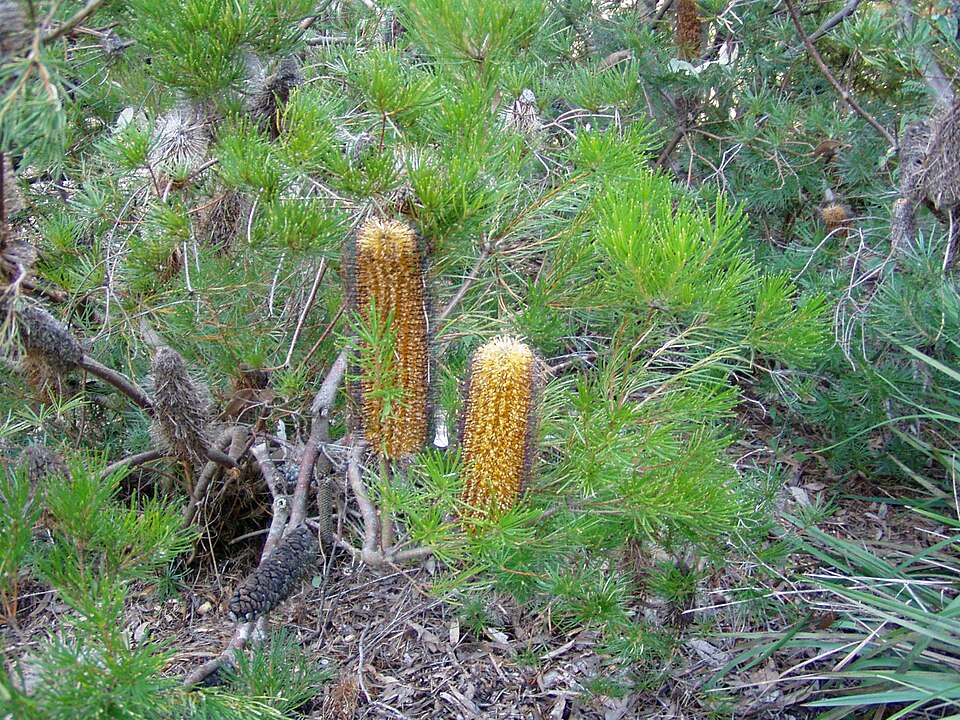
Banksia spinulosa, the hairpin banksia, is an evergreen shrub in the family Proteaceae growing 3-10 feet (1-3 m) tall and 5-10 feet (1.5-3 m) wide, with a woody lignotuber that lets it resprout after fire. The narrow leaves are 1-3 inches (3-8 cm) long, dark green above and whitish below, with margins that are smooth or finely toothed and rolled under. From autumn into winter it carries cylindrical flower spikes 2-6 inches (5-15 cm) tall, packed with hundreds of small flowers in gold to yellow, the long curved styles tipped red, orange, or black and projecting like hooked pins, the feature behind the common name. Woody seed follicles develop within the old spikes and may stay closed until heated. The species grows in heath, woodland, and open forest on sandy and rocky low-nutrient soils through eastern Australia. It draws honeyeaters and other nectar-feeding birds. Roots are adapted to phosphorus-poor soils and are damaged by standard phosphorus fertilizers, and the plant declines in heavy, poorly drained ground.
Native Range
Banksia spinulosa is native to eastern Australia, ranging from Victoria through New South Wales to Queensland. It grows in coastal heath, sandstone woodland, and dry open forest on sandy or gravelly soils low in nutrients.Suggested Uses
Grown as a feature shrub, informal screen, or bird-attracting plant in native gardens, with dwarf forms used in containers and low borders. Suited to sandy coastal and low-nutrient sites. Spaced 5-8 feet (1.5-2.4 m) apart, or closer for compact forms.How to Identify
Appearance
Size & Dimensions
Height3' - 9'10"
Width/Spread5' - 9'10"
Bloom Information
Flowering runs from autumn through winter, mainly April to August, when the cylindrical spikes open from the base upward over several weeks. Nectar draws honeyeaters, lorikeets, and insects. The contrasting dark styles against yellow flowers mark the peak display.
Detailed Descriptions
Flower Description
gold to yellow with red, orange, or black stylesFoliage Description
dark green above, white beneathGrowing Conditions
Sun Requirements
Requires 6-10 hours of direct sunlight daily
• Full Sun: 6+ hours of direct sunlight
• Partial Shade: 3-6 hours of direct sunlight
• Full Shade: Less than 3 hours of direct sunlight
Care & Maintenance
Care Guide
Grows in full sun to light shade on freely draining sandy, gravelly, or rocky soils that are neutral to acidic. Established plants are drought tolerant and need watering only in long dry spells. Standard phosphorus fertilizers damage the specialised proteoid roots, so feeding is limited to low-phosphorus native blends or none at all. Heavy clays and constant moisture cause root rot and dieback, making drainage the key requirement. Many forms carry a lignotuber and reshoot from the base after cutting or fire. Mulch kept clear of the stem base reduces collar rot.Pruning
Pruning after flowering, cutting spent spikes and up to one third of the stem length, keeps the shrub compact. Lignotuberous forms tolerate hard cutting back to the woody base and reshoot, while non-lignotuberous forms are pruned only into leafy growth. Pruning is usually done in late winter or spring.Pruning Schedule
Prune: August–September
winterearly spring
Container Growing
Suitable for container growing
Minimum container size: 10 gallons