Overview
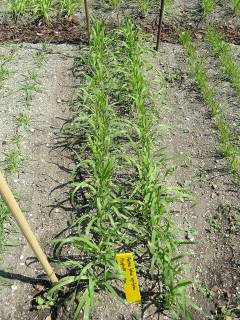
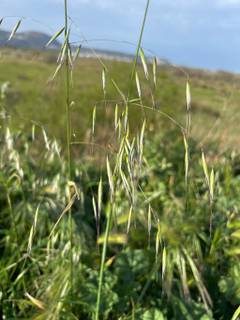
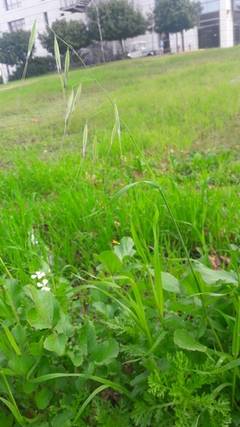
Avena sativa, the common or cultivated oat, is an annual cereal grass in the family Poaceae grown for grain, forage, and as a cover crop. It forms upright tufts of hollow, jointed stems (culms) 24-59 inches (60-150 cm) tall, with flat, linear leaf blades 4-12 inches (10-30 cm) long arising from a fibrous root system. The inflorescence is an open, branching panicle 6-12 inches (15-30 cm) long, carrying pendulous spikelets that each hold two or three florets enclosed in papery glumes. The grain is a caryopsis wrapped in the lemma and palea, ripening from green through straw-yellow. Oats are wind-pollinated and largely self-fertile, maturing roughly 90 to 120 days after spring sowing. The crop grows in cool, moist climates and tolerates poorer, more acidic soils than wheat or barley, though it has a high water demand and is sensitive to heat and drought during grain fill. Tall stands lodge readily in fertile soils or after storms, and the foliage is prone to crown rust. Once the grain ripens the whole plant dies, completing its cycle within a single season.
Native Range
Avena sativa is a domesticated species not found truly wild. It was brought into cultivation from wild oat relatives of the Mediterranean basin and the Near East, probably first as a weed of early wheat and barley crops, and is now grown across cool-temperate regions worldwide.Suggested Uses
Grown as a grain and forage crop and widely sown as a cool-season cover crop and green manure, often drilled in rows about 6 inches (15 cm) apart. The dense root system and quick growth suppress weeds and reduce erosion on bare ground over winter.How to Identify
Appearance
Size & Dimensions
Height2' - 4'11"
Width/Spread6" - 1'
Bloom Information
Oats flower in early to mid summer, generally June and July in temperate regions, about eight to ten weeks after spring sowing. The small green to straw-coloured florets open within the hanging spikelets and are wind-pollinated and mostly self-fertile, so they are inconspicuous. Flowering across a panicle lasts roughly two weeks before the grain begins to fill.
Detailed Descriptions
Flower Description
green to strawFoliage Description
green to straw-yellowGrowing Conditions
Sun Requirements
Requires 6-12 hours of direct sunlight daily
• Full Sun: 6+ hours of direct sunlight
• Partial Shade: 3-6 hours of direct sunlight
• Full Shade: Less than 3 hours of direct sunlight
Water & Climate
Water Needs
Care & Maintenance
Care Guide
Avena sativa grows in full sun on moisture-retentive loam or clay-loam of moderate fertility and a pH near 5.5 to 7.0. It is direct-sown in early spring, or in autumn where winters are mild, and needs steady moisture through stem extension and grain fill. Cool, damp summers suit it, while heat and drought during flowering sharply reduce yield. Excess nitrogen produces tall, soft stems that lodge in wind or rain. Crown rust and aphid-borne barley yellow dwarf virus are the main disease pressures. The crop needs no staking and is harvested once the panicles turn straw-coloured and the grain hardens.Pruning
No pruning is needed for this annual grass. Stands grown as a cover crop are mown or rolled before seed set to return organic matter to the soil and limit self-seeding. Grain crops are cut whole and threshed at maturity.Toxicity
Non-toxicPlanting Guide
Planting Methods & Timing
Planting Method
direct sow
Direct Sow Timing
early spring, or autumn in mild-winter regions
Days to Maturity
90–120 days
Plant Spacing
6 inches
Companion Planting
Good Companions