Argemone, Genus, albiflora, Species,
- Genus & species
white prickly poppy
Central and Southeastern United States
Overview
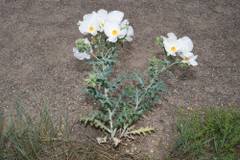
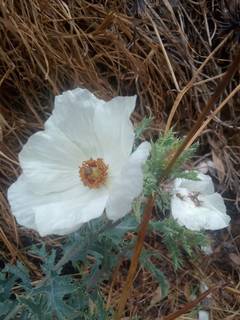
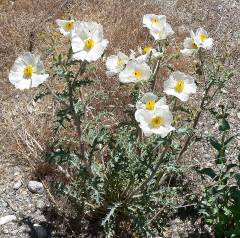
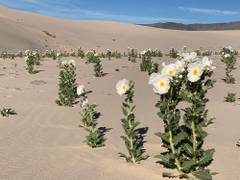
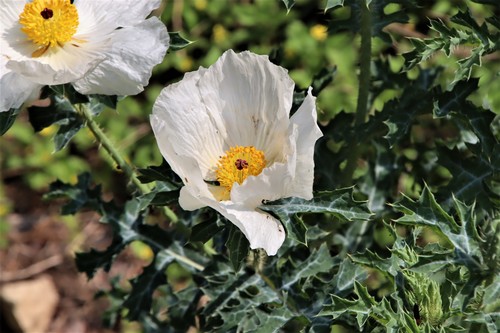
Argemone albiflora is an erect annual or short-lived perennial in the poppy family, native to open, disturbed ground across the central and southeastern United States. It grows 24-40 inches (60-100 cm) tall on stout, sparsely prickly stems that exude a yellow sap when cut. The blue-green leaves are deeply lobed, 4-8 inches (10-20 cm) long, clasping the stem, with spiny teeth along the margins and pale veins. From spring into summer it opens white flowers 3-4 inches (7.5-10 cm) across, each with four to six crinkled, papery petals around a dense cluster of yellow to orange stamens. The flowers last a day or two and give way to oblong, spiny seed capsules that split at the top to release many small seeds. All parts contain alkaloids that are poisonous if eaten, and the spines deter grazing animals. The plant grows on poor, dry, sandy or gravelly soils where little else establishes, but its prickly stems and heavy self-seeding make it a weed in cultivated ground.
Native Range
Native to the central and southeastern United States, from Missouri and Virginia south to Florida and Texas, on roadsides, fields, pastures, and other open disturbed sites.Suggested Uses
Used in dry meadow, wildflower, and xeric plantings on poor soils where its drought tolerance is an asset. The flowers draw bees, and the seeds feed small birds. Its spiny foliage and toxicity make it suited to naturalized areas away from paths and grazing stock.How to Identify
Appearance
Size & Dimensions
Height2' - 3'4"
Width/Spread1' - 1'6"
Bloom Information
Detailed Descriptions
Foliage Description
blue-green with pale veinsGrowing Conditions
Sun Requirements
Requires 6-10 hours of direct sunlight daily
• Full Sun: 6+ hours of direct sunlight
• Partial Shade: 3-6 hours of direct sunlight
• Full Shade: Less than 3 hours of direct sunlight
Water & Climate
Water Needs
Drought Tolerance
Drought tolerant when established
Care & Maintenance
Care Guide
Grows in full sun on dry, sandy, gravelly, or rocky soils of low fertility with sharp drainage. It is strongly drought tolerant and needs no irrigation or feeding once rooted. A soil pH of 6.0 to 8.0 suits it, and rich or wet soils cause weak, rot-prone growth. Propagation is by seed sown in fall or early spring where the plants are to grow, since the taproot resents transplanting. All parts are poisonous if eaten, which is the main caution in pastures and family gardens. Insect pests and disease are seldom serious.Pruning
No structural pruning is needed on this short-lived plant. Spent flower stems can be cut after bloom, and removing the spiny capsules before they open limits self-sown seedlings. Plants are pulled out once they set seed and decline.Toxicity Warning
Toxic to pets and humansPlanting Guide
Planting Methods & Timing
Planting Method
direct sow
Direct Sow Timing
fall or early spring
Days to Maturity
90–120 days
Plant Spacing
12 inches