Aquilegia, Genus, formosa, Species,
- Genus & species
red columbine
Western North America from Alaska to Baja California
Overview
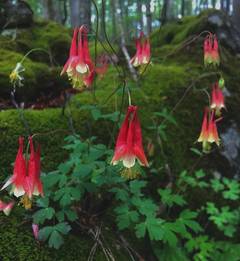
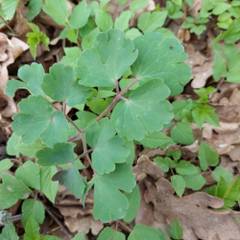
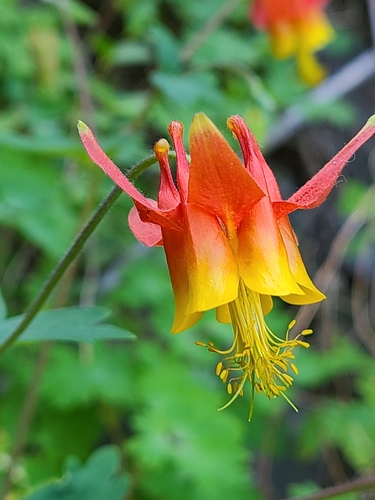
Aquilegia formosa is a herbaceous perennial reaching 12-36 inches (30-90 cm) tall and 12-18 inches (30-45 cm) wide. Stems erect and branching, glabrous below and lightly hairy above. Basal leaves twice-compound (biternate) with rounded, three-lobed leaflets 0.5-1.5 inches (1.3-4 cm) wide; foliage blue-green. Flowers nodding, 1.5-2 inches (4-5 cm) long including spurs, with five red sepals reflexed back, five yellow inner petals forming a cup, and five red curved spurs 0.5-0.8 inch (12-20 mm) long projecting upward. Stamens yellow, projecting from the petal cup 0.2-0.4 inch (5-10 mm). Bloom April through August across the range, peaking in May-June at lower elevations. Seed capsules dry, five-chambered, 0.5-1 inch (1.3-2.5 cm) long, ripening in July-September; each capsule releases 50-200 small black seeds. Self-seeds in cool moist soil, producing 5-20 volunteers per parent plant annually. Crown lifespan 3-5 years; populations persist through self-seeding rather than crown longevity. Foliage damaged below 25°F (-4°C) but plants resprout from rootstock; entire plant dies back below -10°F (-23°C) in zone 4.
Native Range
Native to western North America from southern Alaska south through British Columbia, the Pacific Northwest, and California to northern Baja California, east to Montana, Wyoming, and Utah. Found in moist woodlands, stream banks, meadow edges, seeps, and partially shaded slopes at sea level to 11,000 feet (3,400 m) elevation. Most populations occur in mixed conifer forest understory and along snowmelt-fed streams.Suggested Uses
Planted in shaded native plant gardens, woodland edges, hummingbird gardens, and stream-side plantings at 12-18 inch (30-45 cm) spacing in zones 3-8. Self-seeding habit suits naturalistic and meadow plantings but limits use in formal beds. Container culture is short-lived (2-3 seasons) due to its taproot system and short crown lifespan.How to Identify
Appearance
Size & Dimensions
Height1' - 3'
Width/Spread1' - 1'6"
Colors
Bloom Information
April through August across the range, with peak bloom in May and June at lower elevations and into July-August above 6,000 feet (1,800 m). Individual flowers last 5-7 days; total flowering on a single plant extends 4-6 weeks. Bloom is reduced in deep shade or following dry winters.
Detailed Descriptions
Foliage Description
Blue-greenGrowing Conditions
Sun Requirements
Requires 2-6 hours of direct sunlight daily
• Full Sun: 6+ hours of direct sunlight
• Partial Shade: 3-6 hours of direct sunlight
• Full Shade: Less than 3 hours of direct sunlight
Care & Maintenance
Care Guide
Plants establish from seed sown in fall outdoors with 8-12 weeks of cold stratification, or from 4-inch (10 cm) container stock in spring. Maintain consistent moisture during the first growing season; mature plants tolerate 2-3 weeks without water in shaded sites but decline in summer drought. Leaf miners create cosmetic serpentine trails on foliage in May-June; damage rarely affects flowering. Crown lifespan 3-5 years; populations replenish through self-seeding without intervention. Powdery mildew develops on foliage in late summer in humid climates; cosmetic only. Aquilegia sawfly larvae may defoliate plants in some years.Pruning
Cut spent flower stems back to basal foliage in July or August to reduce self-seeding; alternatively, leave for fall seed dispersal in naturalistic plantings. Remove yellowing or mildewed foliage at the base in fall; cut entire plant to ground level after first hard frost. Volunteer seedlings can be lifted and transplanted in fall or early spring.Pruning Schedule
Prune: July–August & November
summerfall
Container Growing
Minimum container size: 2 gallons