Image 1 of 6
1 / 6
Plant Reference
Alnus, Genus, rubra, Species,
- Genus & species
red alder
Western North America — southeastern Alaska south through coastal British Columbia, Washington, Oregon, and northern California to the vicinity of Santa Barbara, with a primarily coastal distribution that follows the maritime temperate climate of the Pacific Coast; stream banks, river floodplains, landslide scars, logged areas, and other disturbed moist sites from sea level to 3,000 feet (900 m) elevation
Overview
Alnus rubra is an upright fast-growing deciduous tree in the family Betulaceae native to the wet habitats of the Pacific Northwest, reaching 40-80 feet (12-24 m) tall and 20-30 feet (6-9 m) wide at maturity with a typical lifespan of 60-100 years. The species is the largest alder in North America and a central pioneer tree of disturbed moist sites across its coastal range from southeastern Alaska to northern California, colonizing landslide scars, logged areas, beaver-pond margins, stream banks, and river floodplains as the first tree cover on newly exposed mineral soil. Growth rate is among the fastest of any Pacific Northwest native tree at 3-5 feet (0.9-1.5 m) of height per year during the juvenile phase, and a young Alnus rubra on a suitable wet site reaches 20-30 feet in 5-6 years. The species is nitrogen-fixing through an actinorhizal symbiosis with soil bacteria in the genus Frankia (specifically F. alni) that colonize root nodules on young trees and convert atmospheric nitrogen into forms the tree can absorb, and the contribution to site fertility is substantial — published field measurements document nitrogen additions of 60-120 pounds per acre per year from mature red alder stands, which is comparable to heavy agricultural fertilization and transforms the nitrogen status of formerly bare mineral soil over the several decades of an alder stand's lifespan. The nitrogen enrichment is one of the central ecological roles of the species in Pacific Northwest forest succession: early-successional alder stands prepare sites for the later-successional Douglas-fir and western hemlock forests that replace them, and clearcut areas in the Pacific Northwest regenerate through an alder phase before transitioning back to conifer dominance. The wood has important cultural uses in Pacific Northwest Indigenous traditions and in contemporary commercial practice, with the most recognized use being the smoking of salmon over red alder coals for the traditional Pacific Northwest smoked salmon flavor — the wood burns with a mild sweet smoke that imparts a characteristic flavor to fish and is the traditional smoking wood across the region, and the inner bark of cut logs turns red-orange within minutes of exposure to air (giving rise to the common name red alder and the epithet rubra from the Latin word for red). Bark on mature trees is pale gray-white and smooth, standing out against the dark trunks of the surrounding Douglas-fir and western hemlock canopy in Pacific Northwest winter landscapes. Leaves are dark green above with pale grayish-green undersides, broadly ovate to elliptic, 3-6 inches (7-15 cm) long, and carry doubly serrate margins that roll downward at the edges — the rolled-under margin is a recognizable field character that separates A. rubra from other North American alder species including white alder A. rhombifolia and thinleaf alder A. tenuifolia. Reproductive structures appear in late winter before leaf-out: yellow-brown pendulous male catkins 3-6 inches long emerge in clusters alongside smaller reddish erect female catkins, and the female catkins develop through spring and summer into small woody cone-like strobili 0.5-0.75 inch long that persist on the branches through the following winter and provide an easy identifier on bare deciduous branches (the woody cone-like structure is atypical for a broadleaf tree and points immediately toward the alder and birch family Betulaceae). The central garden limitation is the relatively short lifespan of 60-100 years compared to the multi-century lifespans of the Douglas-fir and western hemlock conifers that eventually replace alder in Pacific Northwest forest succession, and gardeners planting red alder should understand that they are planting a fast-growing short-lived pioneer tree rather than a long-lived specimen tree that will persist for several generations. The species is not drought-tolerant and needs consistent soil moisture. Deer browse the foliage on young trees. Non-toxic.
Native Range
Alnus rubra is native to western North America, with a natural range spanning southeastern Alaska south through coastal and near-coastal British Columbia, Washington, Oregon, and northern California to the vicinity of Santa Barbara. The species is primarily a coastal tree that follows the maritime temperate climate zone of the Pacific Coast and extends inland only where the wet climate and moist soil conditions match its requirements — the species does not occur naturally east of the Cascade and Sierra Nevada ranges because the continental climate of eastern Washington and Oregon is too dry for its establishment. Within its range the species grows on stream banks, river floodplains, beaver-pond margins, lake edges, landslide scars, logged areas, and other disturbed moist sites from sea level to about 3,000 feet (900 m) elevation, and is the dominant early-successional broadleaf tree of Pacific Northwest forest recovery after disturbance. The species is an important cultural plant for Pacific Northwest Indigenous peoples who have used the wood for smoking salmon and other foods, the bark for a red dye, and the tree itself for various traditional medicinal and ceremonial applications over thousands of years. Modern commercial forestry in the Pacific Northwest manages red alder as a timber species for furniture, cabinetry, and specialty wood products, with the pale close-grained wood carrying a moderate commercial value and straightforward workability that has made it an important hardwood crop in the region despite the tree's relatively short rotation age of 25-40 years for timber harvest.Suggested Uses
Planted as a fast-growing nitrogen-fixing pioneer tree for stream bank restoration, riparian buffer planting, wet-site reforestation, disturbed-site soil building, fast canopy cover in new Pacific Northwest native gardens, and wildlife habitat enrichment at 20-30 foot (6-9 m) spacing in zones 4-9. The combination of very fast growth, nitrogen fixation, and Pacific Northwest native provenance gives the species a central role in restoration planting and in landscape settings where rapid canopy cover matters more than long-term permanence. Combined with other native riparian and wet-site species including Salix (willows), Populus trichocarpa (black cottonwood), Cornus sericea (red-osier dogwood), Acer macrophyllum (bigleaf maple), and native sedges and rushes in stream-bank and wetland plantings where the shared cultural requirements align. The short 60-100 year lifespan suits the species to nurse-tree roles where Alnus rubra is planted alongside longer-lived Douglas-fir or western red cedar and allowed to fall out of the canopy as the conifers mature, mirroring the natural Pacific Northwest forest succession pattern. Not suited to dry upland garden sites where the moisture requirement cannot be met, small urban lots where the 60-80 foot mature height exceeds the available scale, gardeners planning for a multi-generational specimen tree because the 60-100 year lifespan is short for a landscape tree of this size, or planted specimens in dense dry lawn settings where the trees decline prematurely. Native red alternatives in other regions include Alnus glutinosa (European black alder, though this species is now considered invasive in parts of the eastern United States) and the native Alnus incana (speckled alder) for interior and northern plantings.How to Identify
Appearance
Size & Dimensions
Height40' - 80'
Width/Spread20' - 30'
Bloom Information
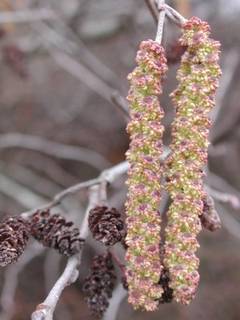
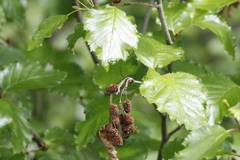
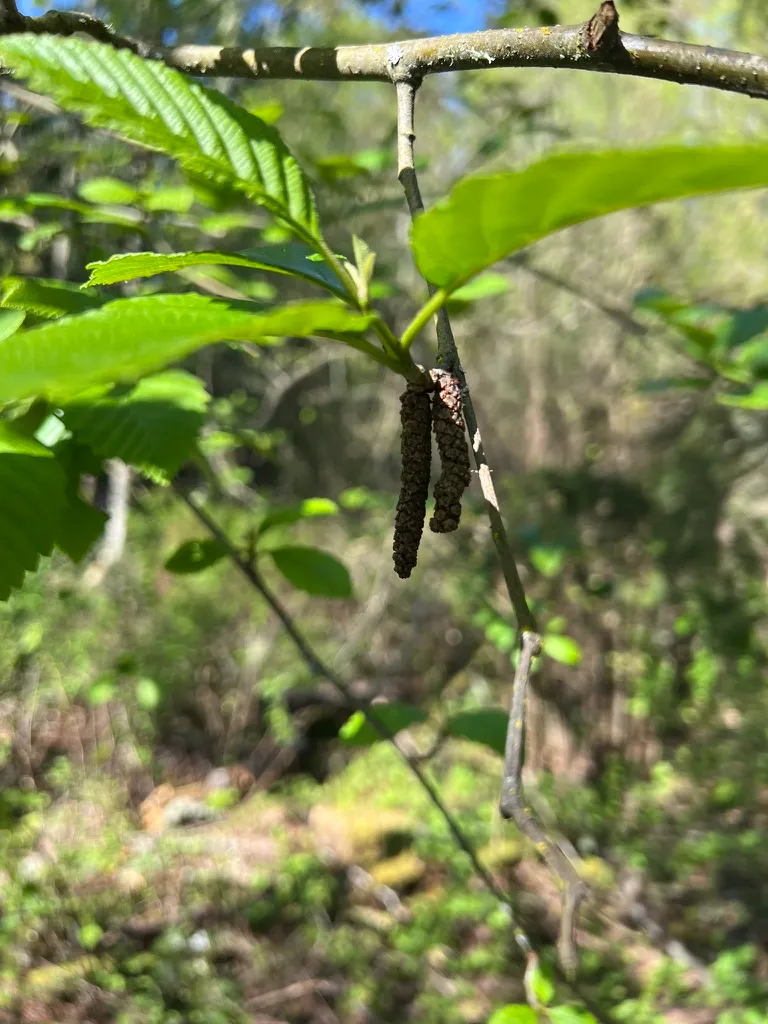
Yellow-brown pendulous male catkins 3-6 inches (7-15 cm) long emerge in clusters from bare branches during February and March in zones 4-9 alongside smaller reddish erect female catkins, producing the reproductive display for approximately 4 weeks before leaf-out begins. The flowering display is wind-pollinated and carries no value to bees or other insect pollinators — red alder is one of the earliest wind-pollinated trees of the Pacific Northwest spring and releases abundant pollen that is a minor hay-fever allergen in some sensitive individuals. Female catkins develop through spring and summer into woody cone-like strobili 0.5-0.75 inch long that mature by fall and release small winged seeds during winter, with the empty strobili persisting on the branches through the following year as the diagnostic bare-branch identifier. Seed dispersal is by wind and water, and stream-bank trees release seeds into moving water that carries them to new alluvial sites downstream where they establish the next generation of pioneer alder stands.
Detailed Descriptions
Flower Description
Yellow-brown male catkins; smaller reddish female catkinsFoliage Description
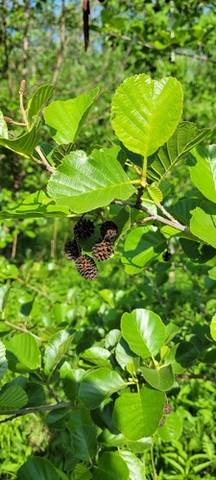
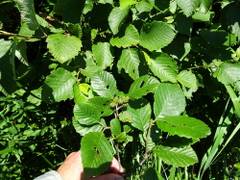
dark green above with pale grayish-green undersides; broadly ovate to elliptic leaves 3-6 inches (7-15 cm) long with doubly serrate margins that roll downward at the edges to form a curled-rim profile (the rolled-under margin is a recognizable field character separating Alnus rubra from other alder species); fall color progresses to dull yellow-green and brown rather than the vivid yellows of many other deciduous treesGrowing Conditions
Sun Requirements
Requires 4-8 hours of direct sunlight daily
• Full Sun: 6+ hours of direct sunlight
• Partial Shade: 3-6 hours of direct sunlight
• Full Shade: Less than 3 hours of direct sunlight
Care & Maintenance
Care Guide
Plant in moist to wet soil with a pH of 5.0-7.0 in full sun to partial shade (4-8 hours of direct sun); tolerated soil types include loam, clay, silt, and sand, and the species grows well on poor mineral soils where most other trees fail because of its nitrogen-fixing root symbiosis. The species is not drought-tolerant and needs consistent soil moisture through the growing season — dry summer conditions cause premature leaf drop and tree decline, and red alder is therefore suited to stream banks, river bottom positions, low spots with naturally high water tables, and purpose-irrigated landscape positions rather than to upland garden sites that rely on summer rainfall alone. The nitrogen-fixing actinorhizal root symbiosis with Frankia alni bacteria means that no nitrogen fertilization is needed — mature trees contribute 60-120 pounds of nitrogen per acre per year to the soil through the symbiosis, and supplemental nitrogen fertilization has no benefit and can cause excess growth that increases wind-throw risk on wet soils. The short lifespan of 60-100 years is the central garden limitation compared to the multi-century lifespans of Pacific Northwest conifers, and gardeners planting red alder should plan for the tree to reach mature size in 15-20 years, to decline through age 40-60, and to be removed or allowed to fall through age 60-100 rather than planning for a multi-generational specimen tree. Pruning is done during winter dormancy (November through January) because alders release sap heavily from pruning wounds during the spring sap flow period and winter pruning minimizes the sap loss. Deer browse the foliage on young trees and physical protection of young trunks may be needed in areas with heavy deer populations. Non-toxic to humans and pets. Wildlife value is high — the persistent strobili feed pine siskins and other finches through winter and the wood becomes cavity-nesting habitat as trees mature.Pruning
Pruning is done during winter dormancy from November through January when the tree is fully leafless and the sap flow is at its seasonal minimum. Alders release sap heavily from pruning wounds during the late-winter and spring sap flow period, and winter pruning minimizes the cosmetic and physiological impact of the bleeding that occurs when the sap flow resumes. Dead, crossing, and structurally weak branches are removed during the winter pruning pass, and young trees are shaped to develop a clear central leader during their first 5-10 years in the landscape. Mature trees generally need little structural pruning beyond deadwood removal, and aging trees past 50-60 years are typically not pruned because the species' short lifespan means that major structural work is not justified.Pruning Schedule
Prune: November–January
winter