Agrimonia, Genus, eupatoria, Species,
- Genus & species
common agrimony
Europe, western Asia, and North Africa
Overview
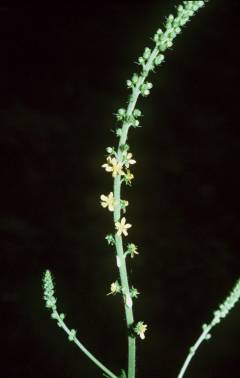
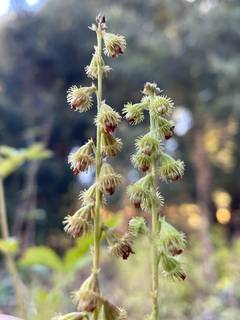
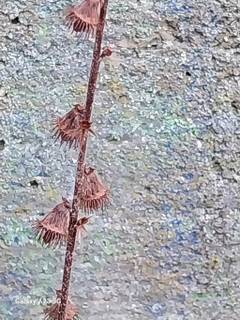
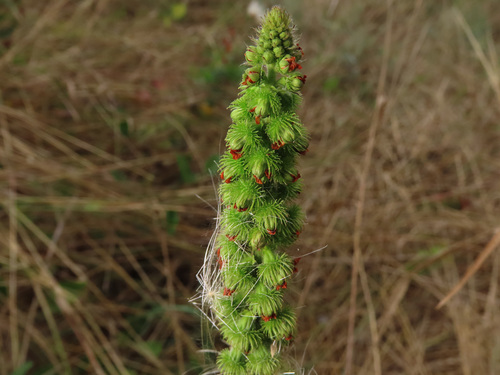
Agrimonia eupatoria is an upright herbaceous perennial in the rose family, reaching 24–47 inches (60–120 cm) tall on a single hairy, rarely branched stem. The pinnate leaves are divided into 3–6 pairs of toothed leaflets 0.8–2.4 inches (2–6 cm) long, with smaller leaflets between them, the whole softly hairy and aromatic when bruised. From June to August it produces a slender, tapering spike of small yellow five-petaled flowers, each about 0.2–0.3 inch (5–8 mm) across, opening from the base upward. The flowers are followed by bristly, grooved seed cases (hooked burrs) that catch on fur and clothing for dispersal. The plant grows from a short rhizome in hedgerows, field margins, roadsides, and rough grassland on calcareous to neutral soils. It dies back to the rootstock in winter. Foliage has long been dried for herbal teas and tannin-rich preparations. Flowering moves up the spike over several weeks rather than opening all at once.
Native Range
Native to Europe, western Asia, and North Africa, and naturalized in parts of North America. It grows in sunny hedge banks, grassy field edges, roadsides, and woodland margins on lime-rich to neutral soils.Suggested Uses
Used in wildflower meadows, herb gardens, and naturalized hedge-bank plantings. Suited to dry, sunny banks and the back of informal borders where its narrow spikes rise above lower plants. Grown as a nectar source and as a traditional medicinal and dye herb.How to Identify
Appearance
Size & Dimensions
Height2' - 3'11"
Width/Spread1' - 1'6"
Bloom Information
Blooms from June to August, opening sequentially from the base of the spike upward. Each flower is short-lived, but the spike stays in bloom for several weeks. Burr-like fruits ripen from late summer into autumn.
Detailed Descriptions
Foliage Description
green, grey-green beneathGrowing Conditions
Sun Requirements
Requires 5-9 hours of direct sunlight daily
• Full Sun: 6+ hours of direct sunlight
• Partial Shade: 3-6 hours of direct sunlight
• Full Shade: Less than 3 hours of direct sunlight
Care & Maintenance
Care Guide
Grows in full sun to light shade on well-drained, neutral to alkaline soils with a pH of 6.0–7.8. It tolerates dry, poor soils once established and does not tolerate waterlogged ground. No feeding is needed, and lean soil keeps the stems upright. Plants are raised from seed sown in autumn or by division in spring. Hardy in USDA zones 6 to 9. Self-sown seedlings appear nearby where burrs drop, and unwanted spikes are cut before seed set to limit spread.Pruning
Flower spikes are cut back after flowering to limit self-seeding from the clinging burrs. Stems are trimmed to ground level in late autumn as growth dies down. Division of the rhizome in spring renews older clumps.Pruning Schedule
Prune: September–November
fall