Agalinis, Genus, purpurea, Species,
- Genus & species
purple false foxglove
Overview
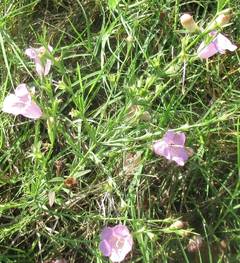
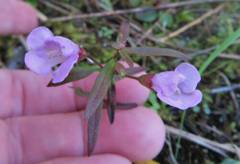
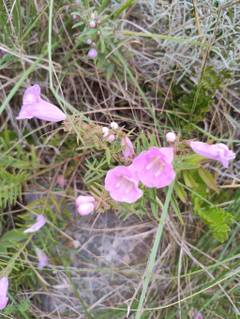
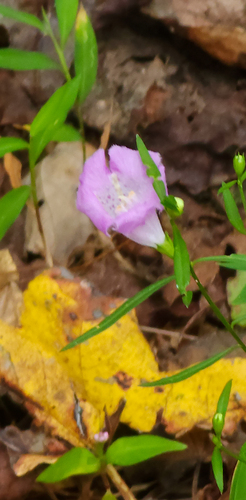
Agalinis purpurea is an annual hemiparasitic wildflower of the broomrape family native to moist meadows, marsh edges, bogs, and open damp ground of eastern and central North America. It grows 8-48 inches (20-120 cm) tall on slender, branching, four-angled stems with narrow, opposite, linear leaves 0.5-1.5 inches (1.5-4 cm) long. From late summer into autumn it bears pink to rose-purple, bell-shaped flowers 0.6-1.2 inches (15-30 mm) long and wide, with five flaring lobes, a paler spotted throat, and two yellow lines inside. As a hemiparasite it taps the roots of nearby grasses and other plants through specialized connections to supplement its own photosynthesis, so it grows more strongly among host plants and is difficult to cultivate alone. The flowers open for a single day and draw bumblebees as their main pollinators. Being annual, it dies after seed set and depends on reseeding, so it leaves no persistent structure and can vanish from a site between years. In cultivation it is used in native meadow, wetland-edge, and pollinator plantings on moist, lean soils.
Native Range
Native to eastern and central North America, from Nova Scotia and Ontario south to Florida and west to Texas and the Great Plains. It grows in moist meadows, marsh and pond margins, bogs, wet pine savannas, and damp open ground.Suggested Uses
Used in native meadow, wet-prairie, bog-edge, and pollinator plantings on moist, lean soils with grass or sedge hosts. It suits wetland restoration and naturalistic damp gardens.How to Identify
Appearance
Size & Dimensions
Height8" - 4'
Width/Spread6" - 1'6"
Bloom Information
Detailed Descriptions
Flower Description
pink to rose-purpleFoliage Description
greenGrowing Conditions
Sun Requirements
Requires 6-12 hours of direct sunlight daily
• Full Sun: 6+ hours of direct sunlight
• Partial Shade: 3-6 hours of direct sunlight
• Full Shade: Less than 3 hours of direct sunlight
Water & Climate
Water Needs
Care & Maintenance
Care Guide
Grow in full sun in moist to wet, sandy, peaty, or lean soils near grasses or sedges that serve as hosts. As a hemiparasite it draws part of its water and nutrients from neighboring roots, so it establishes poorly in bare or sterile soil. Sow seed in autumn where it is to grow, since it transplants poorly and is hard to raise in isolation. It needs consistent moisture and tolerates seasonal flooding but not prolonged drought. No fertilizer is needed, and rich soil favors competing plants. It dies after seed set and returns only from self-sown seed.Pruning
No pruning is needed. As an annual, the plant dies after flowering and seeding and can be cleared once seed has dropped. Leaving plants in place allows reseeding for the next year.Toxicity
Non-toxicPlanting Guide
Planting Methods & Timing
Planting Method
direct sow
Direct Sow Timing
Fall
Plant Spacing
12 inches