Overview
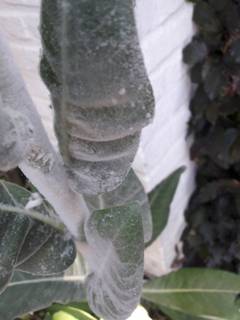
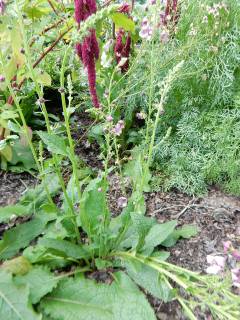
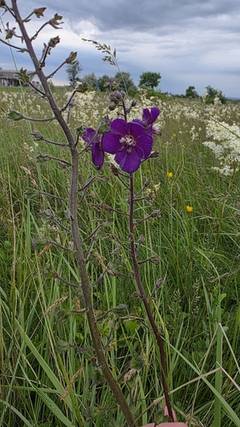
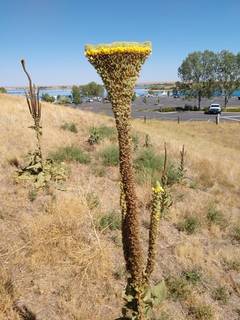
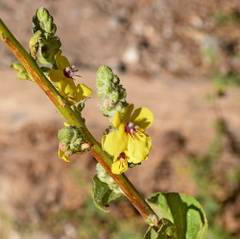
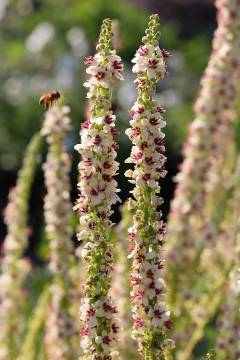
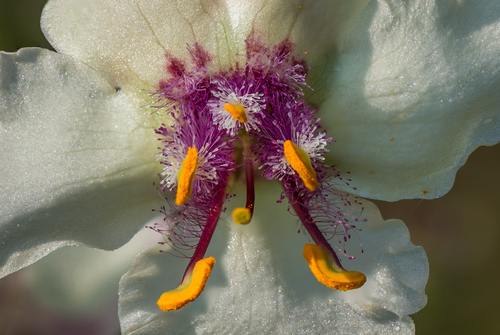
Verbascum blattaria is a slender, erect biennial in the figwort family (Scrophulariaceae) reaching 24–48 inches (60–120 cm) tall with a 12–18 inch (30–45 cm) spread. First-year rosette leaves are oblong to lanceolate, 3–8 inches (8–20 cm) long, dark green, glossy, smooth (glabrous), with toothed to irregularly lobed margins — the smooth, glossy leaves are the primary distinction from V. thapsus. Second-year flowering stems are erect, slender, smooth, unbranched. Flowers are five-petaled, 0.8–1.2 inches (20–30 mm) across, yellow or white (both color forms exist), with 5 stamens bearing conspicuous purple-woolly (bearded) filament hairs — the purple stamen beards are diagnostic. Flowers are borne singly on short pedicels in an open, slender raceme, not densely packed. Fruit is a rounded capsule 0.2–0.3 inch (6–8 mm) in diameter. A single plant produces 5,000–15,000 seeds. The taproot is less massive than that of V. thapsus. Less common than V. thapsus in the Pacific Northwest but present on roadsides and dry disturbed sites.
Native Range
Native to Europe and western Asia, occurring on roadsides, dry disturbed sites, and waste ground from sea level to approximately 5,000 feet (1,500 m). Naturalized across most of North America. Less common than V. thapsus in the Pacific Northwest.Suggested Uses
Used in the two-species Verbascum comparison: V. blattaria (smooth glossy leaves, open raceme, large flowers, purple stamen beards) versus V. thapsus (woolly gray leaves, dense spike, smaller flowers, all-yellow stamens). The biennial rosette-to-bolt life cycle is taught alongside V. thapsus and Onopordum acanthium (Scotch thistle). The purple-bearded stamen filaments are a floral morphology teaching feature.How to Identify
Appearance
Size & Dimensions
Height2' - 4'
Width/Spread1' - 1'6"
Bloom Information
Flowers from June through August. The slender raceme blooms from the base upward over 3–4 weeks. Individual flowers open for one day. Pollinated by bees. Seeds mature 4–6 weeks after flowering. In the Pacific Northwest, peak bloom occurs in July.
Detailed Descriptions
Flower Description
Yellow or white with purple-centered stamensFoliage Description
Dark green, glossy, smooth (glabrous), oblong to lanceolate, with toothed to irregularly lobed margins; not woollyGrowing Conditions
Sun Requirements
Requires 6-12 hours of direct sunlight daily
• Full Sun: 6+ hours of direct sunlight
• Partial Shade: 3-6 hours of direct sunlight
• Full Shade: Less than 3 hours of direct sunlight