Tulipa, Genus, praestans, Species,
- Genus & species
excellent tulip
Pamir-Alai mountains of Tajikistan, Central Asia
Overview
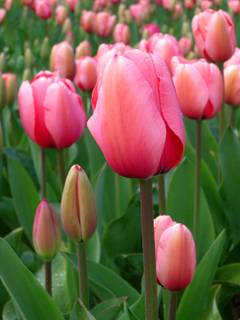
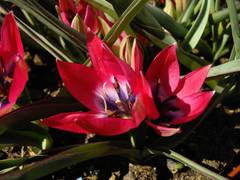
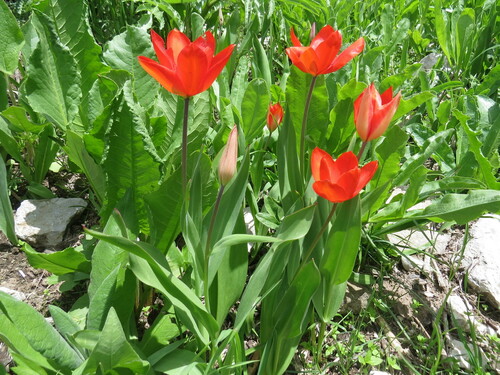
Tulipa praestans is a bulbous perennial in the family Liliaceae that produces multiple flowers per stem - typically 2-5 per scape - a trait uncommon among tulip species. Plants grow 8-14 inches (20-35 cm) tall from a tunicate bulb 1-1.5 inches (2.5-4 cm) in diameter. Leaves are broad, ovate to lance-shaped, 4-8 inches (10-20 cm) long and 2-3 inches (5-8 cm) wide, grey-green, lightly hairy, and clasping the stem at the base. Flowers are cup-shaped, 2-3 inches (5-8 cm) across when open, with six broad rounded tepals in bright orange-red to scarlet, each carrying a small dark basal blotch. The multi-flowered habit gives a single bulb the cluster effect that other tulip species require dense planting to achieve. The cultivar 'Fusilier' is widely grown, producing 3-5 vivid orange-red flowers per stem on compact 8-10 inch (20-25 cm) plants. The cultivar 'Unicum' has variegated cream-margined leaves. The species is native to the mountains of Central Asia (Tajikistan), where it grows on rocky slopes at 5,000-8,500 feet (1,500-2,600 m). The species perennializes reliably, with bulbs returning for 5-10+ years in well-drained soil and not requiring the annual replanting common with hybrid tulips. Susceptible to tulip fire (Botrytis tulipae) in wet springs and to slugs on emerging shoots.
Native Range
Tulipa praestans is native to the Pamir-Alai mountains of Tajikistan in Central Asia, where it grows on rocky stony slopes and in light scrub at elevations of 5,000-8,500 feet (1,500-2,600 m). Introduced to Western cultivation in 1903.Suggested Uses
Planted in rock gardens, raised beds, gravel gardens, and at the front of sunny borders, spaced 4-6 inches (10-15 cm) apart in groups of 10-20 for the densest color effect. The multi-flowered habit gives a denser color effect from fewer bulbs than single-flowered species. The cultivar 'Fusilier' is a standard for reliable perennial tulip planting. Suitable for containers (minimum 3 gallons / 11 L) with bulbs planted 3 inches (8 cm) apart. Toxic to pets if ingested.How to Identify
Appearance
Size & Dimensions
Height8" - 1'2"
Width/Spread4" - 6"
Bloom Information
Flowers open in mid to late April in the Pacific Northwest, approximately 1-2 weeks before Darwin hybrid tulips. Each stem bears 2-5 flowers that open sequentially over 7-10 days. Individual flowers last 7-10 days in cool weather, less in warm spells. Bloom period is approximately 2-3 weeks. Pollinated by bees.
Detailed Descriptions
Flower Description
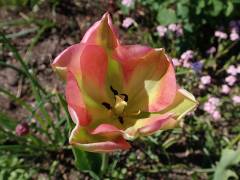
Bright orange-red to scarlet; cup-shaped 2-3 inches (5-8 cm) across; six broad rounded tepals; small dark basal blotch; 2-5 flowers per stemFoliage Description
Grey-green; broad ovate to lance-shaped 4-8 inches (10-20 cm); lightly hairy; clasping the stem at the base; deciduousGrowing Conditions
Sun Requirements
Requires 6-10 hours of direct sunlight daily
• Full Sun: 6+ hours of direct sunlight
• Partial Shade: 3-6 hours of direct sunlight
• Full Shade: Less than 3 hours of direct sunlight
Care & Maintenance
Care Guide
Bulbs are planted 4-6 inches (10-15 cm) deep and 4-6 inches (10-15 cm) apart in autumn (October-November). Sited in full sun in well-drained moderately fertile soil at pH 6.5-7.5. Sharp drainage is essential for perennializing; heavy clay is amended with coarse grit. After flowering, foliage is allowed to yellow and die back naturally over 6 weeks. Green leaves are not removed or braided. Fed with a potassium-rich bulb fertilizer at planting and again in early spring. Unlike most hybrid tulips, the species returns reliably for many years without lifting and replanting, provided drainage is adequate and summer dormancy is dry.Pruning
Spent flower stems are removed at the base after petals drop to prevent seed set and redirect energy to the bulb. Foliage is left until it yellows completely (typically mid-June). No other pruning is required.Pruning Schedule
Prune: May
late spring
Container Growing
Suitable for container growing
Minimum container size: 3 gallons