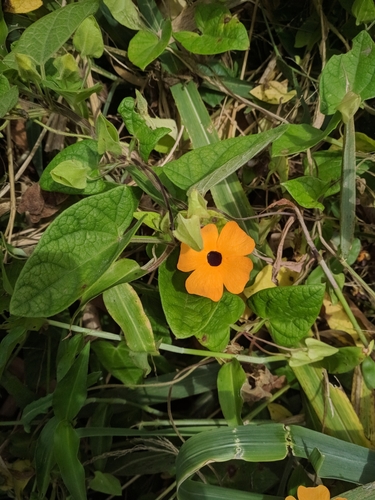
Thunbergia, Genus, alata, Species,
- Genus & species
black-eyed susan vine
Tropical eastern Africa — Kenya, Tanzania, and Uganda.
SunFull Sun – Part Shade
WaterMedium
Overview
Thunbergia alata is a twining annual vine reaching 6-10 feet (1.8-3 m) tall in a single growing season on slender branching lightly hairy stems. Leaves are triangular-ovate to hastate (arrowhead-shaped), 1.5-3 inches (4-7.5 cm) long, medium green, held on conspicuously winged petioles; the specific epithet 'alata' means 'winged'. Flowers are solitary in the leaf axils, 1.5-2 inches (4-5 cm) across, with five broad rounded petals in orange-yellow to deep orange surrounding a deep purple-black to dark brown central tube; yellow-flowered and white-flowered forms also exist. Flowering runs continuously from June or July through the first frost; individual flowers last 2-3 days, and continuous bud production on new growth carries the display. The plant is a tender perennial in its native range (USDA zones 9-11) and is grown as a warm-season annual elsewhere. In USDA zones 9-11, the species sets viable seed and has naturalized as an invasive plant in parts of Florida, California, Hawaii, and Australia; in temperate zones 4-8 with reliable frost, self-seeding does not occur because seeds are killed by winter cold. Growth and flowering accelerate in summer heat.
Native Range
Thunbergia alata is native to tropical eastern Africa, including Kenya, Tanzania, and Uganda, where it grows along moist disturbed forest margins, roadsides, and scrubland. The species has naturalized as an invasive plant in tropical and subtropical regions worldwide, including parts of Florida, California, Hawaii, Australia, and the Pacific islands.Suggested Uses
Trained on trellises, fences, obelisks, pergolas, arbors, and wire mesh for rapid single-season vertical cover, or in hanging baskets and containers of 3 gallons (11 L) or more where the vines trail over the rim. Planted at 12 inch (30 cm) spacing along a support, a single plant covers 6-10 feet (1.8-3 m) of structure in one season. Companions in container plantings include Ipomoea batatas (ornamental sweet potato vine), Calibrachoa, and Lantana. The species is grown as an annual across USDA zones 4-8, where the first frost ends the season. In USDA zones 9-11, the species has naturalized as an invasive plant and is not grown near natural areas where escape into surrounding vegetation is a documented concern.How to Identify
Appearance
Size & Dimensions
Height6' - 10'
Width/Spread1'6" - 2'
Bloom Information
Solitary axillary flowers 1.5-2 inches (4-5 cm) across open continuously from June or July through the first fall frost in USDA zones 4-8, for a total bloom span of 16-20 weeks in cool-summer climates such as the Pacific Northwest. In USDA zones 9-11 plants bloom nearly year-round. Individual flowers last 2-3 days; continuous bud production on new growth sustains the display. Flowering accelerates in summer heat above 75°F (24°C).
Detailed Descriptions
Flower Description
Orange-yellow to deep orange; solitary axillary flowers 1.5-2 inches (4-5 cm) across with five broad rounded petals and a deep purple-black to dark brown central tube; yellow and white forms occurFoliage Description
Medium green; triangular-ovate to hastate (arrowhead-shaped), 1.5-3 inches (4-7.5 cm) long; petioles carry conspicuous wings (the specific epithet 'alata' means 'winged')Growing Conditions
Sun Requirements
Requires 4-8 hours of direct sunlight daily
• Full Sun: 6+ hours of direct sunlight
• Partial Shade: 3-6 hours of direct sunlight
• Full Shade: Less than 3 hours of direct sunlight
Care & Maintenance
Care Guide
Seed is started indoors 6-8 weeks before the last frost; seeds benefit from soaking overnight in warm water to improve germination uniformity. Transplants are set out once frost danger has passed, supplied with a trellis, fence, or mesh support at planting, and spaced 12 inches (30 cm) apart. Plants grow in full sun to part shade in fertile, moist, well-drained soil with a pH of 6.0-7.0. Regular watering is required; plants wilt and flower production drops under drought stress. Growth accelerates in warm summer weather, with 6-10 feet (1.8-3 m) of new cover produced in a single season from a transplant. In USDA zones 9-11, seed heads are removed before maturity to reduce invasive escape into surrounding vegetation.Pruning
No deadheading is required for continuous bloom in temperate zones. Stems can be trimmed at any point through the growing season to control density or direction. All plant material is removed after frost kill in fall. In USDA zones 9-11 where self-seeding is a documented invasive concern, plant material and any mature seed pods are bagged for landfill disposal rather than composted, as seeds survive home compost temperatures.Pruning Schedule
Prune: October
fall
Container Growing
Suitable for container growing
Minimum container size: 3 gallons
Toxicity
Non-toxicPlanting Guide
Planting Methods & Timing
Planting Method
transplant
Indoor Start
7 weeks before last frost
Days to Maturity
60–75 days
Plant Spacing
12 inches
Companion Planting
Good Companions