Image 1 of 10
1 / 10
© Peter Halasz from Melbourne, Australia ( User:Pengo ), some rights reserved (CC-BY-SA) · Wikimedia Commons
Syzygium, Genus, luehmannii, Species,
- Genus & species
Riberry
Subtropical and littoral rainforest, north-eastern New South Wales and eastern Queensland, Australia
Overview
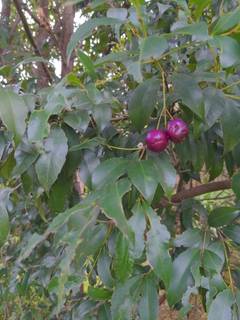
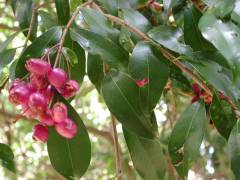
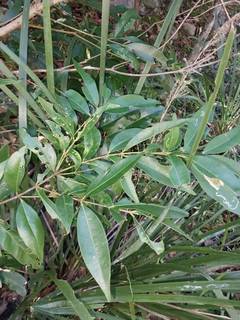
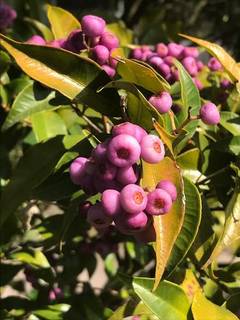
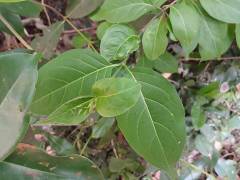
Syzygium luehmannii is an evergreen rainforest tree in the Myrtaceae reaching 100 feet (30 m) in closed forest and 16-40 feet (5-12 m) in open cultivation, with a dense conical to rounded crown 10-20 feet (3-6 m) across. Bark is grey-brown and finely scaly, buttressed at the base on old forest trees. Leaves are opposite, ovate-lanceolate with a drawn-out tip, 1.2-2.4 inches (3-6 cm) long and 0.4-1 inch (1-2.5 cm) wide, glossy dark green when mature; each growth flush emerges pink to red and holds that colour for 2-3 weeks before hardening to green. Cream to white flowers 0.2-0.3 inches (5-8 mm) across open in branched terminal panicles from November to January, each built from numerous stamens rather than showy petals. Fruit are pear-shaped red drupes 0.3-0.5 inches (8-13 mm) long with a single seed, ripening December to February with a tart flavour combining cranberry and clove, and are harvested commercially as an Australian native food. Growth runs 12-24 inches (30-60 cm) per year under irrigation. Young plants are damaged below 30F (-1C), fruit set falls sharply in dry summers, and heavy crops draw fruit fly and fruit-piercing moths.
Native Range
Syzygium luehmannii is native to eastern Australia, occurring in subtropical and littoral rainforest from around Kempsey in New South Wales north to Cape Tribulation in Queensland. It grows on basaltic and alluvial soils from sea level to 2,600 feet (800 m), as a canopy or sub-canopy tree in closed forest along the coast and adjacent ranges. Remaining stands are fragmented after historic clearing of lowland rainforest for agriculture.Suggested Uses
Grown as a screening and hedging plant in subtropical and warm-temperate gardens, spaced 3-6 feet (1-1.8 m) apart for hedging and 16-26 feet (5-8 m) apart as a shade tree. Planted in commercial native-food orchards for fruit harvested December to February and sold fresh, frozen or dried. Also grown in containers of 20 gallons (76 litres) or larger on courtyards, and included in rainforest revegetation plantings on the east coast.How to Identify
Appearance
Size & Dimensions
Height16' - 100'
Width/Spread10' - 20'
Bloom Information
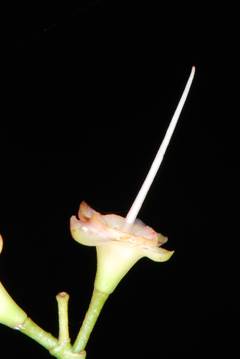
Flowering runs from November to January in eastern Australia, with a main flush of 3-4 weeks in December that follows the summer growth flush. Flowers are cream to white, 0.2-0.3 inches (5-8 mm) across, made up of stamens about 0.2 inches (5 mm) long in branched terminal panicles. Fruit ripen 6-10 weeks after flowering, from late December through February. Flowering is heavier following a wet spring and is reduced or skipped after drought.
Detailed Descriptions
Flower Description
Cream to whiteFoliage Description
Glossy dark green, new growth pink to redGrowing Conditions
Sun Requirements
Requires 4-10 hours of direct sunlight daily
• Full Sun: 6+ hours of direct sunlight
• Partial Shade: 3-6 hours of direct sunlight
• Full Shade: Less than 3 hours of direct sunlight
Care & Maintenance
Care Guide
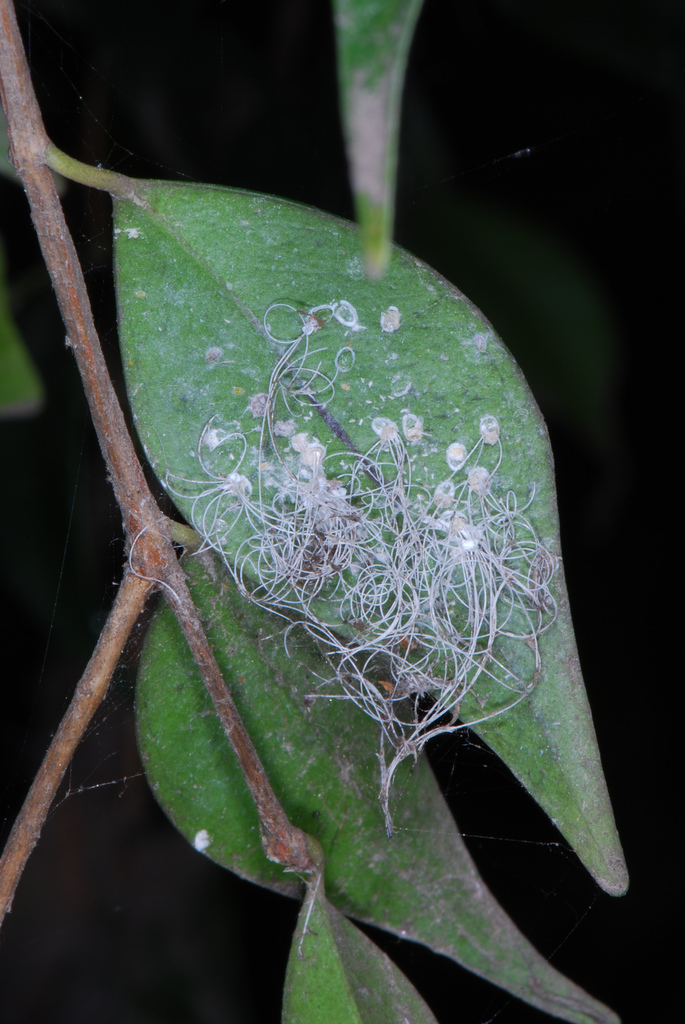
Syzygium luehmannii grows in full sun to part shade with 4-10 hours of direct exposure; plants in deep shade grow upright with sparse branching and set little fruit. It roots on moisture-retentive loam, clay loam and volcanic soils at pH 5.5-7.0 with free drainage, and struggles on dry sandy soils without irrigation. Water use is 8-13 gallons (30-50 litres) weekly in summer for young trees, dropping to occasional deep watering once established, though fruit size falls in dry seasons. A spring application of 3.5 oz per square yard (100 g per square metre) of complete fertiliser carries the summer flush, and this species tolerates phosphorus levels that damage many Australian natives. Established trees withstand 30F (-1C) briefly, while young plants defoliate at that temperature. Psyllid damage is lighter than on S. paniculatum and S. smithii, though scale insects and sooty mould build up on shaded interior growth.Pruning
Pruning is carried out after fruiting ends in late summer to early autumn, so that flower buds formed on the following spring growth are retained. The species reshoots from bare wood, and hedged plants cut back by 12-24 inches (30-60 cm) refoliate within 6-8 weeks in warm conditions. Hedging two or three times a year produces repeated pink growth flushes but removes most flowering and fruiting wood. Lower limbs are lifted over the first 5 years where a clear trunk is wanted.Pruning Schedule
Prune: February–March
summerfall
Container Growing
Suitable for container growing
Minimum container size: 20 gallons