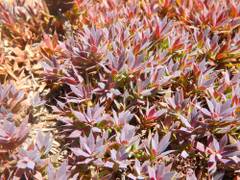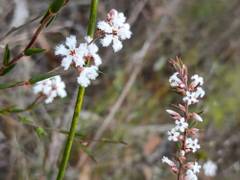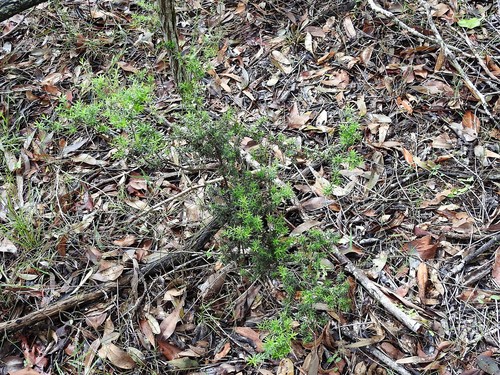
Styphelia, Genus, sieberi, Species,
- Genus & species
prickly beard-heath
South-eastern Australia (New South Wales)
Overview
Styphelia sieberi is an evergreen shrub growing 1-3 feet (0.3-1 m) tall with wiry, spreading to erect branches forming a low, open bush. The leaves are small, narrow, and stiff, 0.2-0.5 inch (5-13 mm) long, crowded along the stems and tipped with a sharp point. Small tubular flowers about 0.2-0.4 inch (5-10 mm) long, cream to greenish or pink-tinged, hang in the leaf axils, their five petal lobes curling back and lined inside with dense white hairs. Flowering occurs mainly through autumn, winter, and early spring. The flowers are followed by small fleshy fruits. Growth is slow, and plants form a wiry, twiggy framework over several years. The pointed leaves are prickly to touch. The species needs sharply drained acidic soil and is difficult to establish in gardens, which keeps it uncommon in cultivation.
Native Range
Native to south-eastern Australia, in the heath and woodland of coastal and tableland New South Wales and adjoining areas. Grows on shallow, sandy, acidic soils over sandstone, on exposed ridges and slopes.Suggested Uses
Grown by native-plant specialists in heath gardens, rockeries, and sandy revegetation, spaced 1-3 feet (0.3-0.9 m) apart. Used among other small heathland shrubs on acidic soils. Its prickly foliage and exacting soil needs limit it to specialist plantings.How to Identify
Appearance
Size & Dimensions
Height1' - 3'
Width/Spread1' - 3'
Bloom Information
Detailed Descriptions
Flower Description
cream to greenish or pink-tingedFoliage Description
greenGrowing Conditions
Sun Requirements
Requires 5-8 hours of direct sunlight daily
• Full Sun: 6+ hours of direct sunlight
• Partial Shade: 3-6 hours of direct sunlight
• Full Shade: Less than 3 hours of direct sunlight
Care & Maintenance
Care Guide
Grows in full sun to light shade on sharply drained sandy or rocky acidic soils; it fails on heavy, wet, or limy ground. Water sparingly, as the species is adapted to low-nutrient, free-draining sites and is sensitive to phosphorus. Plants are frost hardy in their native range. Root rot from Phytophthora kills plants in poorly drained soil. The species is slow-growing and hard to propagate, so it is rarely offered in nurseries.Pruning
Light tip-pruning after flowering keeps the wiry growth bushy. Hard cutting into bare old wood is slow to reshoot. Plants need little routine pruning.Pruning Schedule
Prune: February–March
early spring