Stackhousia, Genus, viminea, Species,
- Genus & species
yellow stackhousia
Overview
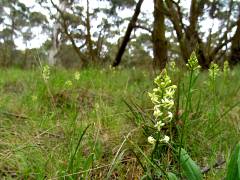
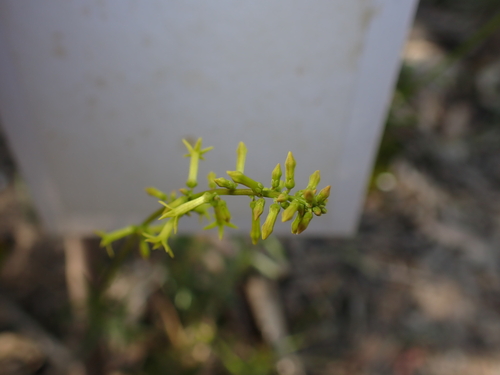
Stackhousia viminea is a slender perennial herb forming clumps of erect, wiry stems 8-24 inches (20-60 cm) tall. The stems are sparsely branched and carry narrow, fleshy leaves 0.4-1.2 inches (1-3 cm) long that are widely spaced and reduced toward the flowering tips. Small tubular flowers are crowded into narrow terminal spikes 2-6 inches (5-15 cm) long. Each flower is creamy to pale yellow, with five petals fused into a slender tube about 0.2-0.3 inch (5-8 mm) long that flares into spreading lobes. The flowers carry a sweet scent and open progressively up the spike. The plant grows from a woody rootstock and resprouts after fire or grazing. It occurs across a wide range of soils and tolerates seasonal dryness once established. The fruit is a segmented capsule that breaks into single-seeded portions at maturity. The wiry habit and sparse foliage give the plant an open, nearly leafless appearance when in flower, which reduces its visual mass in a planting.
Native Range
Stackhousia viminea is widespread across eastern and southern mainland Australia and Tasmania. It grows in open forest, woodland, and grassland on soils ranging from sands to clay loams.Suggested Uses
Used in native and habitat gardens, dry meadow plantings, and revegetation on light soils. Suits informal borders where its open, wiry form mixes with grasses and groundcovers. Grown in containers of free-draining mix in regions with wet summers.How to Identify
Appearance
Size & Dimensions
Height8" - 2'
Width/Spread8" - 1'4"
Bloom Information
Detailed Descriptions
Foliage Description
greenGrowing Conditions
Sun Requirements
Requires 6-10 hours of direct sunlight daily
• Full Sun: 6+ hours of direct sunlight
• Partial Shade: 3-6 hours of direct sunlight
• Full Shade: Less than 3 hours of direct sunlight
Care & Maintenance
Care Guide
Grows in full sun to light shade on free-draining soils of low to moderate fertility. Tolerates extended dry periods once the woody rootstock is established and needs only occasional deep watering in cultivation. Sandy or gravelly soils suit it, and heavy, poorly drained ground shortens its life. Plants reshoot from the rootstock after damage. Light applications of low-phosphorus fertilizer suit this Australian native. Excess water and rich soils produce weak, floppy stems.Pruning
Stems are cut back to the rootstock after flowering and seed fall to keep the clump compact. The plant reshoots from the base in the following season. No formative pruning is needed.Container Growing
Suitable for container growing
Minimum container size: 2 gallons