Image 1 of 11
1 / 11
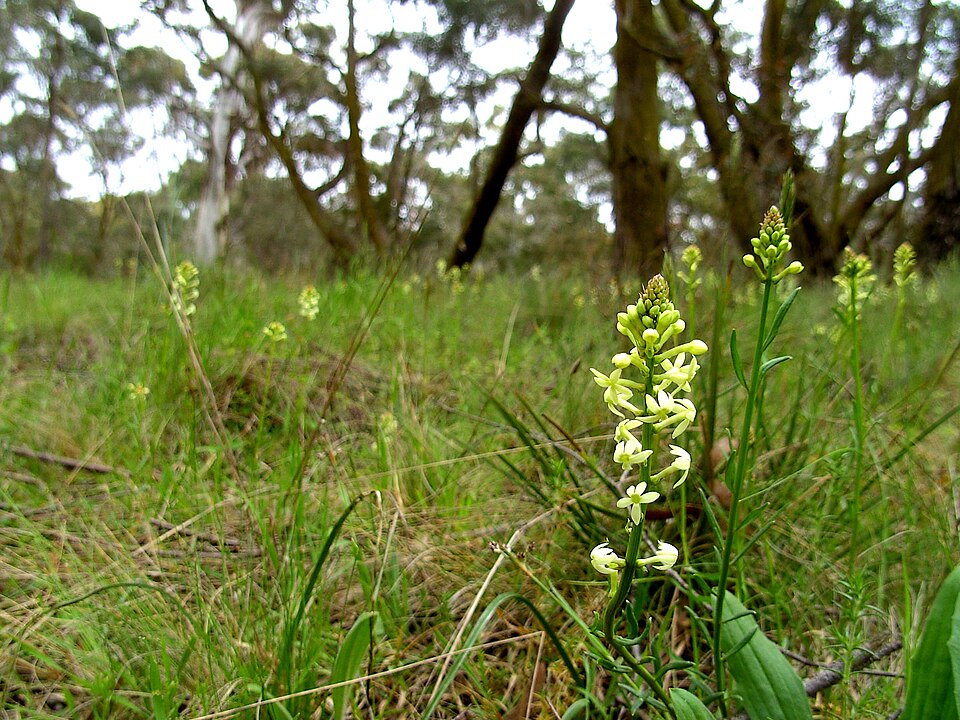
© Ian Sutton from Collinsville and Oberon, Australia, some rights reserved (CC-BY) · Wikimedia Commons
Stackhousia, Genus, monogyna, Species,
- Genus & species
creamy candles
Overview
Stackhousia monogyna is an upright perennial herb in the family Celastraceae, sending up slender, mostly unbranched stems 6-16 inches (15-40 cm) tall from a woody rootstock. The narrow leaves are 0.4-1.2 inches (1-3 cm) long, fleshy, and crowded along the lower stem, becoming sparse toward the top. From late winter into spring each stem is topped with a dense cylindrical spike of small cream to white tubular flowers, each about 0.3 inch (8 mm) long, that release a sweet scent, strongest in the evening. The flowering spike gives the plant its common name. It grows in grassland, open forest, and heath across southern Australia, including Western Australia, South Australia, Victoria, New South Wales, and Tasmania, on a range of well-drained soils. The plant dies back to the rootstock after flowering and reappears the following season, behaving as a geophyte. It tolerates drought and frost once dormant. Flowering is reduced in shade and in heavily grazed sites. The plant is slow to establish from seed and is intolerant of root disturbance, so it is difficult to transplant. Above-ground growth is brief, lasting only through the cooler, wetter months.
Native Range
Stackhousia monogyna is native to southern Australia, occurring across Western Australia, South Australia, Victoria, New South Wales, Tasmania, and parts of Queensland. It grows in grassland, open forest, and heath on well-drained soils.Suggested Uses
Grown in native grassland, meadow, and rockery plantings, and in containers, where the fragrant spring spikes rise among low groundcovers. It suits restoration of native grassland and seasonally dry borders. The evening scent and flowers draw moths and native bees.How to Identify
Appearance
Size & Dimensions
Height6" - 1'4"
Width/Spread4" - 8"
Bloom Information
Cream to white fragrant flowers open in dense spikes from late winter into spring, roughly August to November in the native range. The sweet scent is strongest in the evening. The stems die back to the rootstock once flowering and seeding finish.
Detailed Descriptions
Flower Description
cream to whiteFoliage Description
greenGrowing Conditions
Sun Requirements
Requires 5-9 hours of direct sunlight daily
• Full Sun: 6+ hours of direct sunlight
• Partial Shade: 3-6 hours of direct sunlight
• Full Shade: Less than 3 hours of direct sunlight
Care & Maintenance
Care Guide
Grow in full sun to light shade in free-draining sandy or loamy soil. Water through the growing season from autumn to spring, then keep dry during summer dormancy. The plant dies back to its rootstock after flowering, so the bare ground is not overwatered. Use only low-phosphorus native fertiliser. It tolerates frost and drought when dormant. Because the plant disappears over summer, its position is easily lost in a mixed planting.Pruning
No pruning is needed. Spent flower stems can be removed once seed has set, or left to self-seed. The plant withdraws to its rootstock on its own and reshoots in autumn.Container Growing
Suitable for container growing