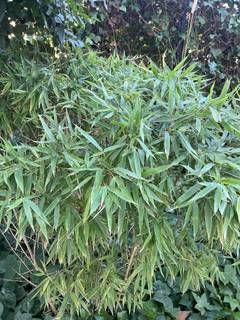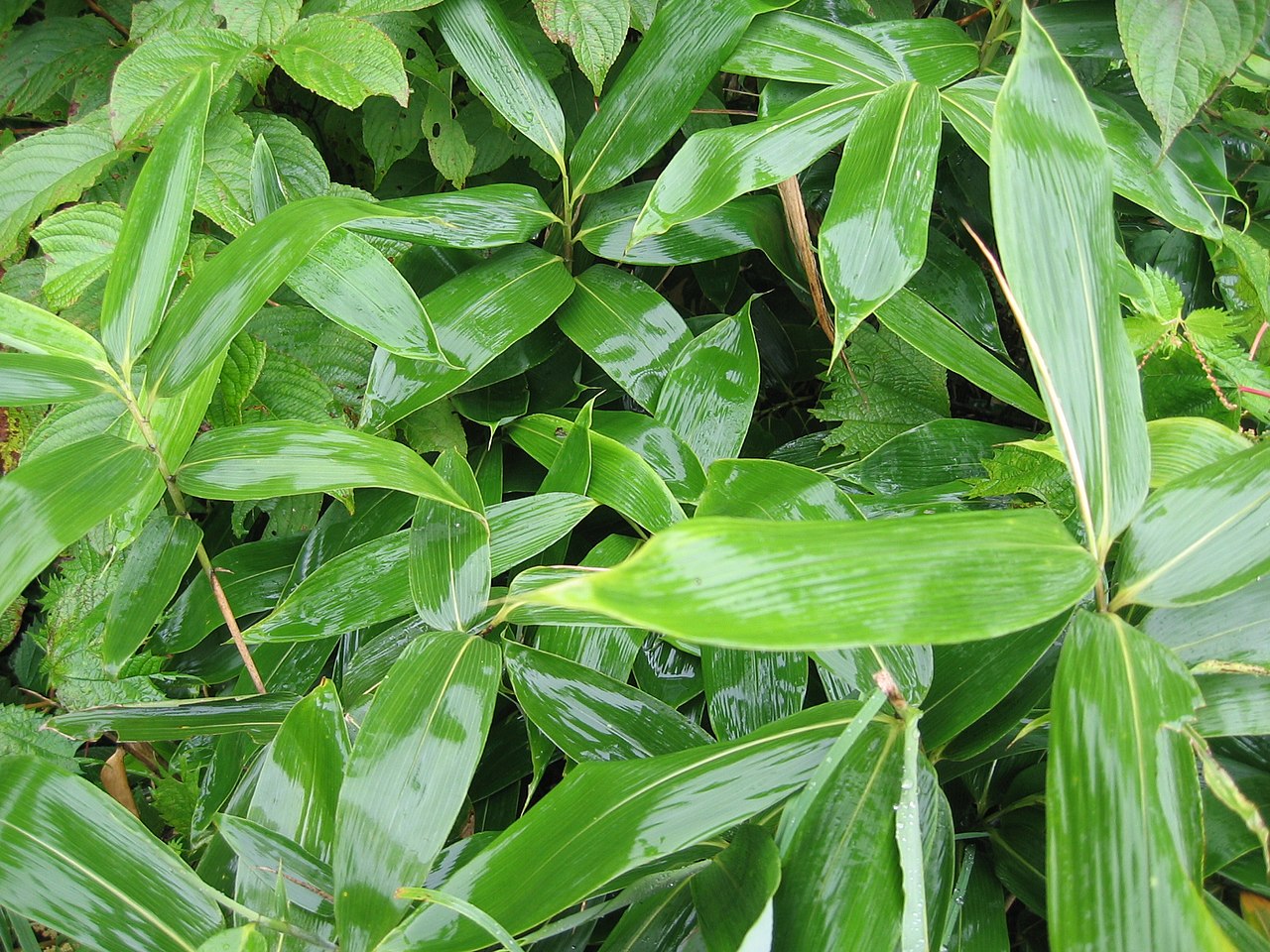
Sasa, Genus, veitchii, Species,
- Genus & species
Kuma bamboo grass
Overview
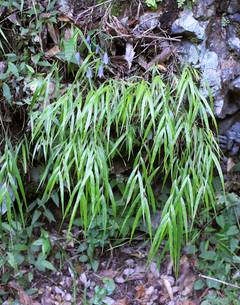
Sasa veitchii is an evergreen running dwarf bamboo in the Poaceae, reaching 2–4 feet (60–120 cm) tall on culms 0.2–0.3 inch (5–8 mm) in diameter that carry a single branch at each node and a purple flush along the internodes. Leaves are large in proportion to the culm, 5–10 inches (13–25 cm) long and 1.5–2.5 inches (4–6 cm) wide, dark green through summer, with a white waxy bloom on the culm sheaths. From late autumn the leaf margins wither to a buff-white band 0.1–0.4 inch (3–10 mm) wide that persists until the leaves are shed the following spring, so winter foliage carries a pale edge. Spread is by leptomorph rhizomes running 12–18 inches (30–45 cm) below the surface and extending 3–6 feet (0.9–1.8 m) a year, and unconfined plantings colonise beds, lawns, and neighbouring gardens. A rhizome barrier 24–30 inches (60–75 cm) deep holds the colony in place. Culms live 2–4 years, and old canes accumulate at the base unless cut out. Flowering is gregarious at intervals of several decades, after which the flowered culms die back.
Native Range
Sasa veitchii is native to Japan, occurring on Honshu and Hokkaido in the understorey of cool temperate broadleaf and conifer forest. It forms dense continuous colonies on forest floors and along woodland edges from lowland to about 5,000 feet (1,500 m), frequently beneath Fagus crenata. Colonies persist under heavy winter snowpack, with culms flattened by snow and rising again in spring.Suggested Uses
Grown as a groundcover and low screen in woodland gardens and on shaded banks, spaced 3–4 feet (0.9–1.2 m) apart for closed cover within three seasons. Also planted for slope stabilisation, where the rhizome mat binds soil on gradients up to 1 in 2, and in containers of 15 gallons (57 L) or larger where the spread has to be contained. Cut leaves are used in Japan to wrap rice and confectionery.How to Identify
Appearance
Size & Dimensions
Height2' - 4'
Width/Spread3' - 6'
Bloom Information
Sasa veitchii flowers gregariously at intervals of several decades rather than annually, so most plantings pass their whole life without flowering. When flowering does occur, panicles of green to purple-brown spikelets 0.4–1 inch (10–25 mm) long appear on the upper culms in spring and early summer. The flowered culms die back afterwards, and colonies regenerate from rhizomes over two to three seasons or from seed. Because flowering is synchronised across clonal material, plants from a shared origin flower in the same years wherever they are grown.
Detailed Descriptions
Foliage Description
Dark green with buff-white withered margins in winterGrowing Conditions
Sun Requirements
Requires 2-8 hours of direct sunlight daily
• Full Sun: 6+ hours of direct sunlight
• Partial Shade: 3-6 hours of direct sunlight
• Full Shade: Less than 3 hours of direct sunlight
Care & Maintenance
Care Guide
Two to eight hours of direct sun daily supports growth, and leaf margins scorch in full sun in zones 8 and 9 where the soil dries. Moist, free-draining soil with a pH of 5.5 to 7.0 suits the rhizomes, which run through the top 12–18 inches (30–45 cm) and stall in compacted or waterlogged ground. Watering during dry spells longer than two weeks keeps the blades from rolling, since drought produces brown leaf tips that persist until the following spring. The plant is hardy in USDA zones 6–9, tolerating winter lows near -10°F (-23°C) with foliage burn above the snow line. A rhizome barrier of 40-mil polyethylene set 24–30 inches (60–75 cm) deep, with 2 inches (5 cm) standing above grade, contains the colony, and the top edge is inspected each autumn for rhizomes crossing over. Nitrogen at 2 pounds per 1,000 square feet (1 kg per 100 m²) in spring maintains leaf size.Pruning
Cutting the whole planting to 2–4 inches (5–10 cm) in February or March removes winter-marked leaves and spent culms, and replacement culms reach full height by June. Where a planting is left uncut, culms accumulate over 2–4 years and dead canes build up at the base. Individual culms are cut at ground level rather than shortened, since a cut culm does not extend again from that point. Rhizomes escaping a barrier are severed with a spade to 18 inches (45 cm) depth in spring and autumn.Pruning Schedule
Prune: February–March
early spring
Container Growing
Suitable for container growing
Minimum container size: 15 gallons