Salicornia, Genus, pacifica, Species,
- Genus & species
Pacific glasswort
Overview
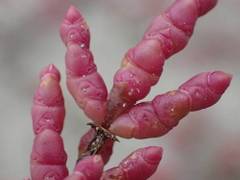
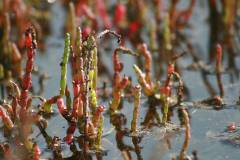
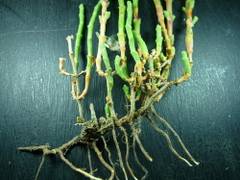
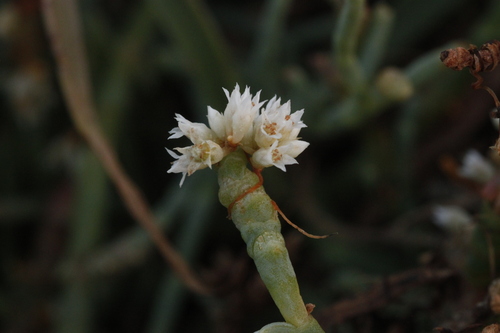
Salicornia pacifica is a perennial succulent of coastal salt marshes, forming low, spreading mats of jointed, leafless stems 4-20 in (10-50 cm) tall. The fleshy, cylindrical stems are divided into swollen segments and store water, an adaptation to saline, waterlogged ground. True leaves are reduced to tiny opposite scales at each joint, so the green stems carry out photosynthesis. The plant is bright green through summer and turns red, pink, or bronze in fall as salts gather in the tissue. Minute flowers are sunk in pits in the upper stem joints, three to a group with the central flower largest; they are wind-pollinated and bloom from August to October. Older stems become woody at the base, while the tips stay soft and succulent. It grows in the middle and upper zones of tidal salt marshes and on saline flats, tolerating regular flooding by salt water that kills most other plants. The stems are edible raw or cooked and taste salty. Its tolerance is the reverse of most garden plants: without saline, wet soil it is outcompeted and does not persist in ordinary beds.
Native Range
Native to the Pacific coast of North America, from Alaska and British Columbia south through California to Baja California, Mexico. It occupies tidal salt marshes, estuary margins, and saline flats within reach of salt water.Suggested Uses
Grown in salt-marsh restoration, coastal bioremediation, and saline or tidal garden settings. Cultivated on a small scale as an edible vegetable known as sea bean or pickleweed.How to Identify
Appearance
Size & Dimensions
Height4" - 1'8"
Width/Spread1' - 3'
Bloom Information
Tiny wind-pollinated flowers open from August to October, sunk in groups of three within the upper stem joints. They have no petals and are easy to overlook. The stems redden as the flowering season ends.
Detailed Descriptions
Foliage Description
green turning redGrowing Conditions
Sun Requirements
Requires 6-12 hours of direct sunlight daily
• Full Sun: 6+ hours of direct sunlight
• Partial Shade: 3-6 hours of direct sunlight
• Full Shade: Less than 3 hours of direct sunlight
Care & Maintenance
Care Guide
Grows in full sun on saline, wet to waterlogged soil of sand, silt, or clay, and tolerates regular salt-water flooding. It needs high soil salinity and a pH from about 7.0 to 8.5; ordinary garden soil without salt does not sustain it. Standing brackish or salt water at the roots is tolerated, unlike nearly all garden plants. Hardy to about USDA zone 7, with stems dying back at the tips in winter and regrowing from the woody base. No fertilizer is needed, as the plant is adapted to mineral-rich tidal mud. Freshwater-only conditions and competition from upland plants cause it to fade out.Pruning
No pruning is required. Dead stem tips are trimmed in late winter before new growth. Woody bases can be cut back to renew soft, succulent shoots.Container Growing
Suitable for container growing
Minimum container size: 3 gallons