Salicornia, Genus, europaea, Species,
- Genus & species
common glasswort
Coasts of Europe and the temperate Northern Hemisphere
Overview
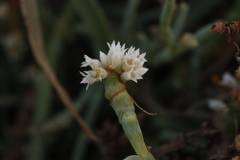
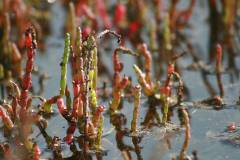
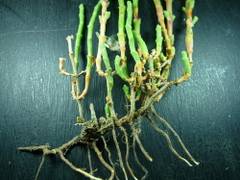
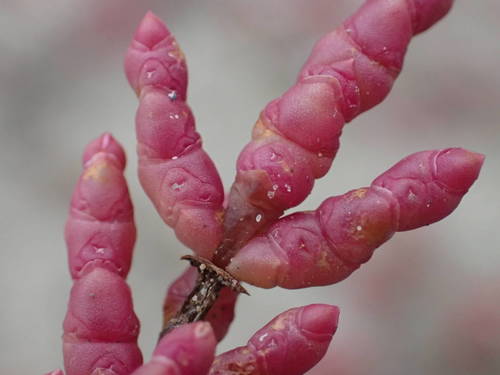
Salicornia europaea is an annual succulent in the family Amaranthaceae, forming low, much-branched, fleshy plants 2–14 inches (5–35 cm) tall with jointed, leafless stems. The stems are smooth, cylindrical, and segmented, bright green in summer and often flushing yellow to red and purple in late summer and autumn. True leaves are reduced to tiny opposite scales fused around the stem joints. The flowers are minute, sunk in threes into the upper joints, with the central flower a little larger; they appear from August to October and are wind-pollinated. The seeds are small and salt-tolerant. It grows on bare mud and sand of coastal salt marshes, estuaries, and tidal flats, often as a pioneer on open ground that is regularly covered by salt water. The plant tolerates high salinity and tidal flooding that exclude most species, but it is short-lived, dies back completely each winter, and is overtaken on stable marsh by perennial salt-tolerant plants. The young stems are eaten as the vegetable known as marsh samphire.
Native Range
Native to the coasts of Europe, including Britain and Ireland, and found on saline ground across temperate and northern regions. Closely related glassworts occur on North American and Asian shores.Suggested Uses
Salicornia europaea is harvested as marsh samphire, a salty, crisp vegetable eaten lightly cooked or raw, and is grown commercially in some coastal areas. In nature it stabilises bare estuarine mud and begins the build-up of salt marsh, and its seeds feed wintering birds.How to Identify
Appearance
Size & Dimensions
Height2" - 1'2"
Width/Spread4" - 1'
Bloom Information
The minute flowers appear from August to October, set in threes within the upper stem joints with the middle flower slightly larger. They have no petals and are pollinated by wind. Small seeds ripen in autumn as the plant reddens and dies back, and they lie in the mud over winter, germinating the following spring.
Detailed Descriptions
Foliage Description
bright green, reddening in autumnGrowing Conditions
Sun Requirements
Requires 6-12 hours of direct sunlight daily
• Full Sun: 6+ hours of direct sunlight
• Partial Shade: 3-6 hours of direct sunlight
• Full Shade: Less than 3 hours of direct sunlight
Water & Climate
Water Needs
Care & Maintenance
Care Guide
Salicornia europaea grows in full sun on wet, saline mud and sand and is adapted to regular flooding by salt water. It needs salt and bare, open ground and will not grow in ordinary garden soil or fresh water. Where it is cultivated for food, it is grown in saline beds or coastal aquaculture with brackish to seawater irrigation and full sun. It is sown from seed each year, as the plant is a true annual that dies after seeding. Growth is fast in warm weather, and stems are cut for eating from early to midsummer before flowering.Pruning
No pruning is needed for this annual. When grown for food, the tender stem tips are cut repeatedly through summer, which encourages branching and delays flowering.Container Growing
Suitable for container growing
Minimum container size: 2 gallons