Sagina, Genus, subulata, Species,
- Genus & species
Irish moss
Western and central Europe; rocky slopes, crevices, and sandy soils in coastal and mountain habitats at low to middle elevations
Overview
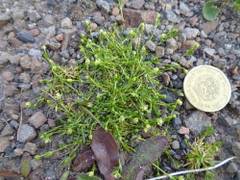
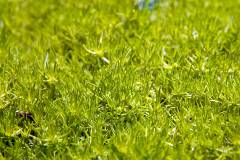
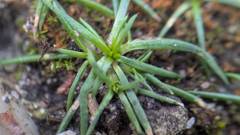
Sagina subulata is a very low trailing evergreen perennial in the carnation family Caryophyllaceae growing 0.5–1 inch (1–2.5 cm) tall and spreading 12–18 inches (30–45 cm) wide as a dense moss-like cushion of narrow awl-shaped leaves. The species is not a true moss despite the common name Irish moss — it is a flowering plant with tiny 5-petaled white flowers and woody stems that merely resembles the cushion form of true mosses, and the resemblance is close enough to fool casual observers and to give the species its common name across temperate garden literature. The specific epithet subulata is Latin for awl-shaped and refers to the narrow pointed leaves that taper to a sharp tip like the point of a shoemaker's awl. Leaves are bright green in the species type, and the cultivar 'Aurea' carries chartreuse to golden-yellow foliage and is sold in the nursery trade as Scotch moss, which is a second common name that separates the golden form from the green species-type Irish moss even though both are the same species. Tiny white 5-petaled star-shaped flowers 0.2 inch (5 mm) across open on slender stalks 0.5–1 inch (1.3–2.5 cm) above the mat in May, June, and July across a 6-week bloom period, and the flowers are visited by small solitary bees and other short-tongued pollinators for the small nectar reward. The species tolerates light foot traffic between stepping stones, which is the main reason for its use as a planted cushion in pathway and patio joints where the moss-like texture softens the hardscape edges. Native to western and central Europe, growing on rocky slopes, crevices, and sandy soils in coastal and mountain habitats. Limitation: the mat humps up in the center and develops brown patches in hot humid summers as the older center growth suffocates under the expanding perimeter, and this heat-related browning is the main maintenance consideration for the species in warm-summer climates — the humped and browned sections are pulled apart and the gaps are filled with fresh pieces from the margins to rebuild the cushion and restore the uniform surface. The species is not drought-tolerant and does not tolerate waterlogged soil or heavy foot traffic. Non-toxic and deer-resistant.
Native Range
Native to western and central Europe, growing on rocky slopes, crevices, sandy soils, and the shallow substrates of coastal and mountain habitats at low to middle elevations. The species is widespread across the natural European range from the British Isles and Iberian Peninsula east through France, Germany, and the Alps, and it has been cultivated in European gardens since at least the 18th century as a lawn substitute and pathway cushion planting.Suggested Uses
Used between stepping stones, in rock garden crevices, as a small-area lawn substitute, along the edges of pathway joints and patio cracks, and in containers and troughs of at least 2 gallons (7.5 L) at 12–18 inch (30–45 cm) spacing between planting pieces. The moss-like cushion form and the low 0.5–1 inch (1–2.5 cm) height allow the species to fill pathway joints and fill hardscape gaps where taller ground covers would be out of scale. Cool maritime climates (Pacific Northwest, coastal New England, the British Isles, and northern Europe) support the cushion through the full summer without heat-related browning, while warm humid continental climates give some midsummer browning that calls for the patch-repair maintenance described above. Heavy foot traffic positions, waterlogged positions, and hot dry sun-exposed sites are unsuitable because of the delicate cushion and the moisture requirement.How to Identify
Appearance
Size & Dimensions
Height1" - 1"
Width/Spread1' - 1'6"
Bloom Information
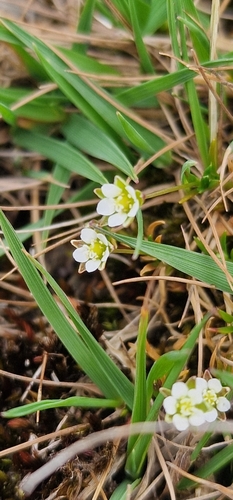
Tiny white 5-petaled star-shaped flowers 0.2 inch (5 mm) across open on slender stalks 0.5–1 inch (1.3–2.5 cm) above the moss-like mat in May, June, and July across a 6-week bloom period. Small solitary bees and other short-tongued pollinators work the flowers for the small nectar reward during the late spring and early summer bloom window. Seed sets through July and August and releases small seeds that germinate on bare soil to establish new plants at the margins of the parent cushion.
Detailed Descriptions
Flower Description
tiny white 5-petaled star-shaped flowers 0.2 inch (5 mm) across on slender stalks 0.5-1 inch (1.3-2.5 cm) above the moss-like matFoliage Description
bright green in the species type; narrow awl-shaped leaves forming a dense moss-like cushion 0.5-1 inch (1-2.5 cm) thick; the cultivar 'Aurea' (sold as Scotch moss) carries chartreuse to golden-yellow foliage; evergreen year-round in mild climatesGrowing Conditions
Sun Requirements
Requires 2-8 hours of direct sunlight daily
• Full Sun: 6+ hours of direct sunlight
• Partial Shade: 3-6 hours of direct sunlight
• Full Shade: Less than 3 hours of direct sunlight
Care & Maintenance
Care Guide
Site in part sun to full sun with 2–8 hours of direct sun per day in cool maritime climates, and afternoon shade is the suited exposure in warm continental climates where hot summer afternoons accelerate the heat-related browning of the cushion. Well-drained moist soil with a pH of 5.5–7.0 holds the cushion through the growing season, and the species is not drought-tolerant and does not tolerate waterlogged soil or heavy foot traffic. Light foot traffic between stepping stones is acceptable because the cushion recovers from brief compression, but heavy pedestrian traffic crushes the growing points and leaves bare patches. The mat humps up in the center and develops brown patches in hot humid summers, and the humped sections are pulled apart and the gaps are filled with fresh pieces from the margins to rebuild an even surface. Non-toxic and deer-resistant. Hardy in USDA zones 4–8.Pruning
Humped or browned sections of the cushion are pulled apart by hand and the exposed gaps are filled with fresh pieces broken from the healthy margins of the same planting, which rebuilds the uniform mat surface over several weeks as the new pieces root into the soil. No mowing or shearing is done because the cushion has no upright growth to cut back, and the tiny flowers are left in place through the 6-week bloom period without deadheading. Any weeds that root through the mat are pulled by hand as they appear.Pruning Schedule
Prune: July–August
summer
Container Growing
Suitable for container growing
Minimum container size: 2 gallons