Sagina, Genus, procumbens, Species,
- Genus & species
pearlwort
Europe; pavement cracks, sidewalk joints, spaces between pavers, nursery container surfaces, and moist compacted ground from sea level to approximately 6,000 feet (1,800 m).
Overview
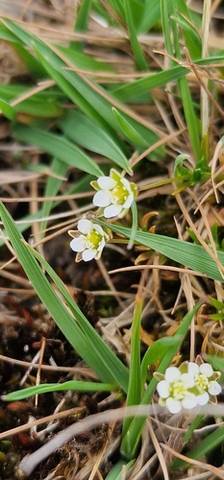
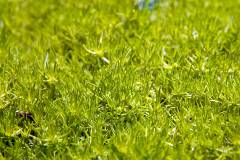
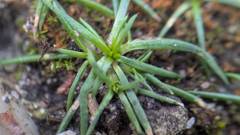
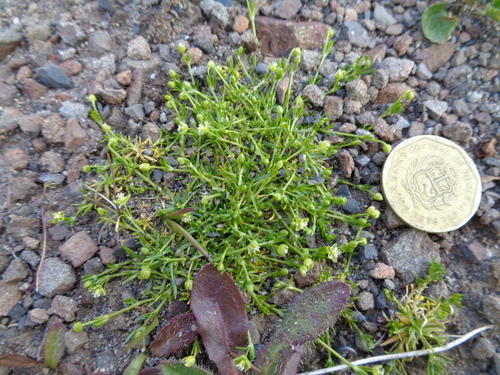
Sagina procumbens is a tiny mat-forming evergreen perennial reaching 0.5-3 inches (1-8 cm) tall and 2-8 inches (5-20 cm) wide, forming dense moss-like cushions in cracks, joints, and moist compacted surfaces. Stems are prostrate, thread-like, rooting at the nodes, and freely branching. Leaves are opposite, linear, 0.2-0.5 inch (5-12 mm) long, fused at the base into a short sheath, smooth, bright green, with an awl-shaped tip. Tiny four-parted flowers 0.08-0.12 inch (2-3 mm) across open singly on thread-like peduncles, with 4 sepals and usually 4 white petals, though the petals are minute and often absent (the species frequently flowers in an apetalous form). Fruit is a capsule slightly longer than the sepals that splits into 4 valves at maturity. A single plant produces 1,000-10,000 seeds that are extremely small, 0.01 inch (0.3 mm), dispersed by water and foot traffic. The moss-like cushion appearance causes frequent misidentification as a bryophyte in the field, even though the species is a flowering dicot. Plants are widespread in pavement cracks, between pavers, and in nursery container surfaces across the Pacific Northwest. Hardy in USDA zones 4-9 (-30°F / -34°C). The cool moist Pacific Northwest climate favors establishment and year-round growth.
Native Range
Sagina procumbens is native to Europe and has naturalized widely across the Pacific Northwest and temperate North America. Plants grow in pavement cracks, sidewalk joints, between pavers, on nursery container surfaces, and on moist compacted ground from sea level to approximately 6,000 feet (1,800 m). The cool moist Pacific Northwest climate supports year-round growth and flowering in mild-winter lowland sites.Suggested Uses
The species is used in weed identification courses as the primary moss-lookalike exercise: students must separate this flowering plant from true mosses using opposite leaves, flowers, and root system as the key characters. Plants are included in pavement and hardscape weed identification curricula. The tiny seed size and crack-colonizing habit are studied in urban ecology and in dispersal biology, and the Caryophyllaceae family characters (opposite leaves, four-parted capsule fruit) are taught at a microscopic scale using this species because of the compact plant size.How to Identify
Appearance
Size & Dimensions
Height1" - 3"
Width/Spread2" - 8"
Bloom Information
Tiny four-parted flowers 0.08-0.12 inch (2-3 mm) across open continuously on thread-like peduncles from April through September, with a total bloom span of 12-16 weeks. Flowers are self-pollinating and often cleistogamous, so plants set seed without opening the flower fully. Capsules mature 2-3 weeks after flowering and split into 4 valves at maturity. In the Pacific Northwest, flowering occurs nearly year-round on sheltered sites in mild winters.
Detailed Descriptions
Flower Description
White to greenish; tiny four-parted flowers 0.08-0.12 inch (2-3 mm) across carried singly on thread-like peduncles, with 4 sepals and usually 4 white petals that are minute and often absent (the species frequently flowers in apetalous form)Foliage Description
Bright green; linear leaves 0.2-0.5 inch (5-12 mm) long, opposite, fused at the base forming a short sheath, smooth, with an awl-shaped tipGrowing Conditions
Sun Requirements
Requires 3-8 hours of direct sunlight daily
• Full Sun: 6+ hours of direct sunlight
• Partial Shade: 3-6 hours of direct sunlight
• Full Shade: Less than 3 hours of direct sunlight