Sabal, Genus, spp., Multiple species,
- Genus
- Multiple species
palmettos
Southeastern United States, Caribbean, Mexico, Central and South America
Overview
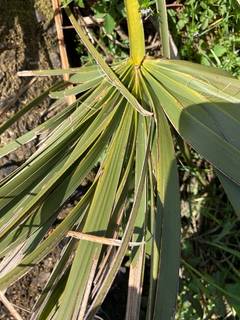
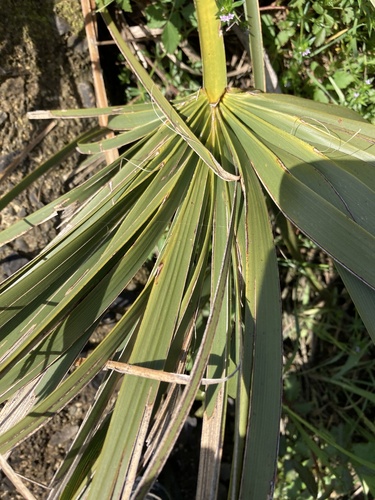
Sabal is a genus of about 15 species of fan palms in the family Arecaceae, native to the southeastern United States, the Caribbean, Mexico, and Central and northern South America. Members range from trunkless, ground-level plants such as S. minor to single-trunked palms such as S. palmetto reaching 20 to 65 feet (6 to 20 m). All species produce costapalmate fronds, fan-shaped blades whose midrib curves so the segments arch downward, held on unarmed petioles that separate the genus from the spiny-stalked saw palmetto. Leaf blades span 3 to 6 feet (90 to 180 cm) and divide into many stiff segments, often with thread-like fibers along the margins. Branched flower clusters emerge among the leaves in summer, carrying small cream flowers that develop into round black fruit 0.3 to 0.5 inch (8 to 13 mm) across. The genus occupies coastal plains, hammocks, scrub, and floodplain margins, and several species tolerate salt spray, brief flooding, and drought once established. A limitation across the genus is slow growth, particularly during the establishment years before a trunk forms. Cold tolerance varies: S. minor and S. palmetto withstand winter lows of roughly 0 to 10 F (minus 18 to minus 12 C), while tropical members are damaged by temperatures below freezing.
Native Range
Sabal is native to the southeastern United States, the Caribbean, Mexico, and Central and northern South America. The genus is most diverse along the Gulf and Atlantic coastal plains and in the West Indies, where species grow in coastal hammocks, pine flatwoods, and floodplain forests.Suggested Uses
Sabal species are used as specimen palms, in coastal and roadside plantings, and in naturalized groupings. S. palmetto is planted as a street and avenue palm in mild climates, while trunkless species such as S. minor are used as evergreen groundcover and understory in shaded borders.How to Identify
Appearance
Size & Dimensions
Height2' - 65'
Width/Spread6' - 15'
Colors
Bloom Information
Sabal species flower in late spring and summer, roughly May through July. Branched inflorescences extend among or beyond the leaves, bearing small fragrant cream-white flowers. Round black fruits ripen by late summer and fall, each containing a single seed.
Detailed Descriptions
Foliage Description
green to blue-greenGrowing Conditions
Sun Requirements
Requires 6-12 hours of direct sunlight daily
• Full Sun: 6+ hours of direct sunlight
• Partial Shade: 3-6 hours of direct sunlight
• Full Shade: Less than 3 hours of direct sunlight
Water & Climate
Water Needs
Drought Tolerance
Drought tolerant when established
Care & Maintenance
Care Guide
Across the genus, Sabal grows in full sun to part shade and adapts to sandy, loamy, or clay soils, including ground that floods periodically. Established plants tolerate drought, salt spray, and wind, which suits coastal sites. Soil pH from about 6.0 to 7.5 is suitable. Growth is slow, and trunk-forming species spend several years as a ground-level rosette before vertical growth begins. Transplanting is done with a substantial root mass during warm weather, as cool soils slow root regeneration. Water is supplied regularly during the first two seasons, after which most species need little supplemental irrigation.Pruning
Pruning is limited to removing fully browned fronds. Green and partly green leaves move nutrients to the plant and are generally left in place. Removing many living fronds narrows the crown and slows growth.Container Growing
Suitable for container growing
Minimum container size: 7 gallons