Rhododendron, Genus, 'Vulcan''s Flame', Cultivar,
- Genus
- Cultivar
Vulcan's flame rhododendron
Hybrid of garden origin; related to Rhododendron Vulcan
Overview
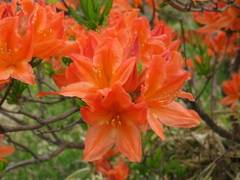
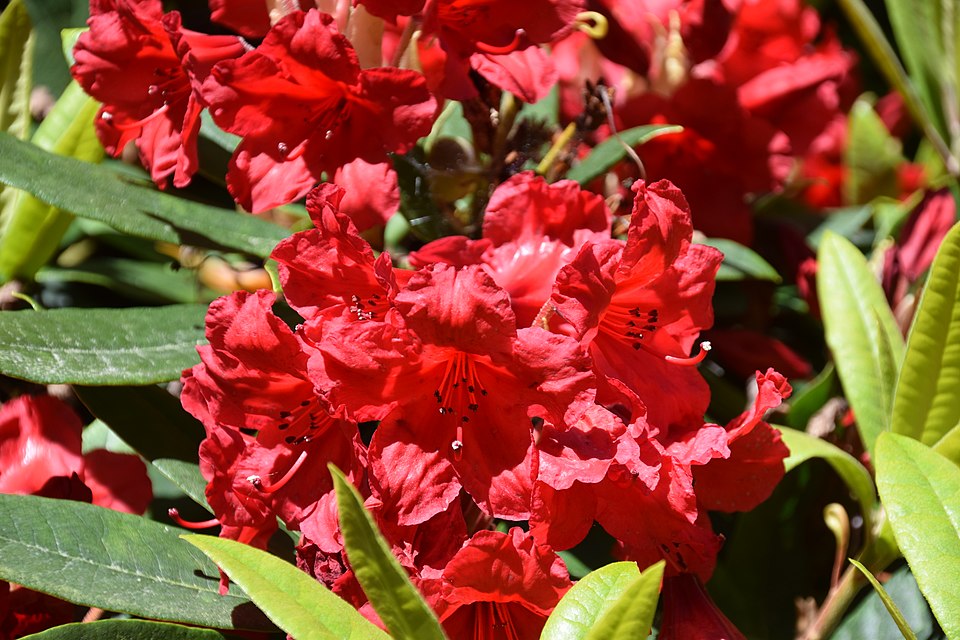
Rhododendron 'Vulcan's Flame' is an evergreen shrub reaching 4–5 feet (1.2–1.5 m) tall and 4–5 feet (1.2–1.5 m) wide, with a compact dense rounded habit. The cultivar is an elepidote rhododendron related to Rhododendron 'Vulcan' and selected for a more intensely orange-influenced flower color than the parent. Flower color reads as bright orange-red to flame-red with the orange component carrying higher saturation than in 'Vulcan', producing a hue closer to the orange-red end of the color wheel than to pure red. Trusses are dome-shaped and hold 12–16 funnel-shaped flowers 2.5 inches (6 cm) wide, borne in May–June on the previous year's wood over a 3–4 week window. Mature size is 1 foot (0.3 m) smaller in both dimensions than 'Vulcan', placing this cultivar in the compact end of the large-leaved rhododendron range. Leaves are simple, alternate, elliptic, 4–5 inches (10–13 cm) long, glossy dark green, leathery, held year-round. Growth rate is moderate; the shrub reaches full mature size in 8 growing seasons. Hardy to USDA zone 6. All parts of the plant contain grayanotoxins and are toxic to pets and humans if ingested.
Native Range
Rhododendron 'Vulcan's Flame' is a hybrid cultivar of garden origin, related to Rhododendron 'Vulcan' and selected for intensified orange coloration in the flower.Suggested Uses
Used in mixed perennial borders, woodland garden plantings, north- or east-facing foundation beds, or large containers at 4–5 foot (1.2–1.5 m) spacing. The flame-red flower color reads as the warmest red tone among the collection's large-leaved rhododendrons and fits positions where a warm-palette spring display is the design goal. Pairing with orange-flowered companions such as Geum 'Totally Tangerine' or yellow-foliaged Berberis thunbergii 'Aurea' keeps the warm-tone color register consistent across the planting. Pairing with cool blue- or purple-flowered companions reads as a color clash because of the saturated orange cast, so the cultivar does not suit pink-and-purple-dominant border schemes; gardeners working in cool color palettes should select signal-red or crimson alternatives rather than 'Vulcan's Flame'. Compact 4–5 foot mature size fits positions where the larger 'Vulcan' at 4–6 feet would outgrow the space by 1 foot in each dimension. The plant does not grow well in alkaline soils above pH 6.5, full afternoon sun in USDA zones 7 and warmer, dry positions, or climates below USDA zone 6.How to Identify
Appearance
Size & Dimensions
Height4' - 5'
Width/Spread4' - 5'
Bloom Information
Dome-shaped trusses of 12–16 funnel-shaped bright orange-red to flame-red flowers 2.5 inches (6 cm) wide with strong orange saturation appear in May–June over a 3–4 week window on the previous year's wood. The orange component carries higher intensity than in the related cultivar 'Vulcan', producing a hue closer to the orange-red end of the color wheel than to pure red.
Detailed Descriptions
Flower Description
Bright orange-red to flame-red with strong orange saturation; funnel-shaped 2.5 inches in dome-shaped trusses of 12-16; May-June on previous year's woodFoliage Description
Glossy dark green; simple, alternate, elliptic, 4-5 inches long, leathery; evergreen year-roundGrowing Conditions
Sun Requirements
Requires 3-6 hours of direct sunlight daily
• Full Sun: 6+ hours of direct sunlight
• Partial Shade: 3-6 hours of direct sunlight
• Full Shade: Less than 3 hours of direct sunlight
Care & Maintenance
Care Guide
Grow in partial shade with 3–6 hours of direct or filtered morning light in moist, well-drained, acidic loam, peat, or sandy loam at pH 4.5–6.0. The pH requirement is strict — soils above pH 6.0 cause iron and manganese chlorosis that yellows foliage and slows growth. Morning sun exposure preserves the orange saturation in the flower color; all-afternoon shade positions reduce color intensity toward a cooler reading. Afternoon sun in USDA zones 7 and warmer scorches leaf margins and bleaches flower color toward washed-out red within the first week of bloom. Apply 3–4 inches (8–10 cm) of organic mulch over the root zone in spring to retain soil moisture and keep the shallow fibrous root system cool. Water deeply once per week during dry periods from April through September. Hardy to USDA zone 6.Pruning
Deadhead spent flower trusses after bloom in late June or early July by snapping them off at the base with thumb and forefinger above the developing growth buds. The compact dense rounded habit develops naturally without shaping cuts. Size-reduction pruning when needed takes place immediately after flowering, before new growth buds extend.Pruning Schedule
Prune: June
summer
Container Growing
Suitable for container growing
Minimum container size: 5 gallons