Rhododendron, Genus, 'President Roosevelt', Cultivar,
- Genus
- Cultivar
president roosevelt rhododendron
Hybrid of garden origin — parentage uncertain but likely involves selections from the {Rhododendron catawbiense} hybrid group of broad-leaved hardy hybrids developed in 19th century European nursery breeding programs
Overview
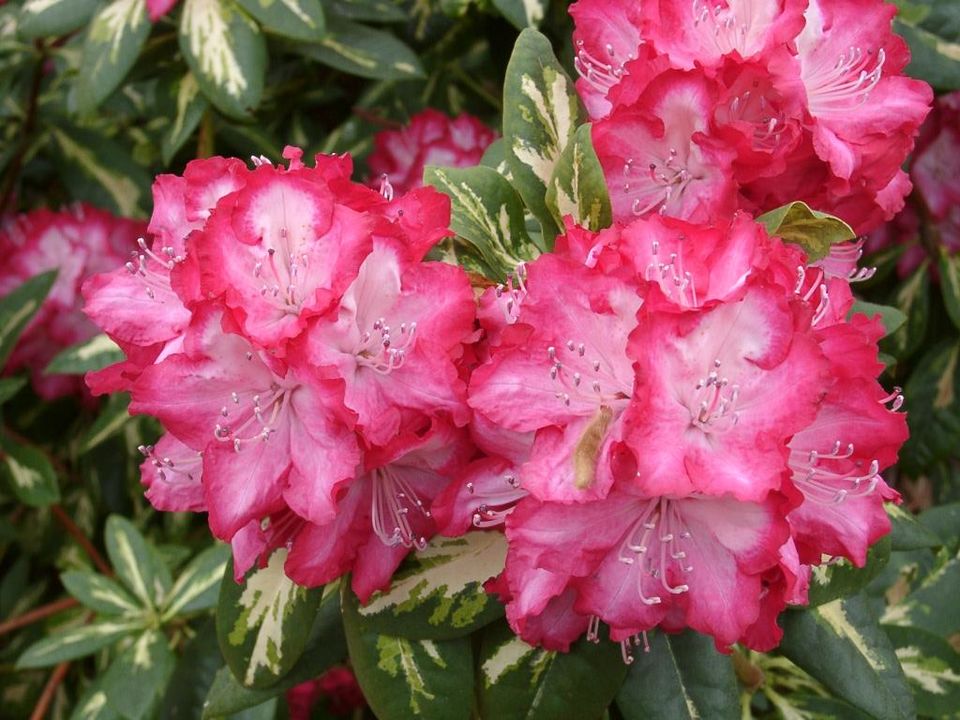
Rhododendron 'President Roosevelt' is an upright broadleaf evergreen rhododendron in the heath family Ericaceae growing 5-8 feet (1.5-2.4 m) tall and 5-7 feet (1.5-2.1 m) wide on a multi-stemmed base. The cultivar's defining ornamental character is the simultaneous expression of two visual variegations: the foliage is dark green with an irregular creamy-yellow central variegation pattern (chimeral variegation, a stable somatic mutation in which the leaf-tissue layer responsible for chlorophyll production carries a mutated yellow zone in the leaf center while the marginal tissue retains the normal green color), and the flowers are bicolor with deep red to rose-red margins blending inward to a white or pale pink center. The combination of variegated foliage and bicolor flowers is rare among cultivated rhododendrons and supports the cultivar's standing as a specimen plant in shade gardens despite the slower growth and the higher maintenance compared with non-variegated rhododendron cultivars. Bicolor funnel-shaped flowers 2-3 inches (5-7 cm) across open in conical trusses of 8-14 flowers each in mid-spring (April through May) across a 2-3 week bloom period. Limitation: the variegated foliage is prone to all-green reversion shoots — branches that revert to the wild-type all-green chlorophyll expression of the underlying genetic background, which grow more vigorously than the variegated tissue and will progressively dominate the canopy if not removed. All-green reversion shoots are removed promptly back to the parent stem below the point of reversion to remove the latent reversion buds and to prevent the green growth from outcompeting the variegated tissue. The cultivar grows more slowly than non-variegated rhododendrons because the reduced chlorophyll in the yellow-variegated leaf zones limits the photosynthetic capacity of the plant. The yellow-variegated leaf zones lack the protective chlorophyll content of fully green leaves and scorch under hot afternoon sun exposure — part shade with morning sun and afternoon shade is the cultural position that preserves the variegation pattern intact. Like all rhododendrons, the cultivar requires strictly acidic soil with a pH of 4.5-6.0 and develops chlorosis at higher pH levels. The cultivar is not drought-tolerant and calls for consistent moisture through the growing season. All parts of the plant — leaves, stems, flowers, and nectar — contain grayanotoxin and are severely toxic to humans, livestock, cats, dogs, and horses if ingested. Deer-resistant.
Native Range
Hybrid of garden origin — parentage uncertain but likely involves selections from the Rhododendron catawbiense hybrid group of broad-leaved hardy hybrids developed in 19th century European nursery breeding programs from crosses involving the southern Appalachian native R. catawbiense (mountain rosebay) and the related Caucasus and Himalayan species. The variegated foliage form arose as a chimeral mutation that has been propagated vegetatively from cuttings to maintain the chimeric tissue structure across nursery stock generations.Suggested Uses
Used as a variegated specimen rhododendron in shade gardens, woodland understory feature plantings, mixed acidic-soil shade borders alongside green-leaved rhododendron and Camellia companions, foundation plantings on the north or east side of buildings where the variegated foliage stands out against contrasting green companions, and container specimens in containers of at least 7 gallons (26 L) with acidic potting mix at 60-84 inch (150-210 cm) spacing in USDA zones 5 through 8. The double variegation display (variegated foliage paired with bicolor flowers) supports the cultivar's standing as a specimen plant in shade gardens despite the slower growth and higher maintenance than non-variegated cultivars. Hot-afternoon-exposure full-sun positions are unsuitable because the yellow-variegated leaf zones scorch without the protective chlorophyll of fully green leaves; alkaline-soil positions without acidification, dry-summer regions without irrigation, and households where children, pets, livestock, or horses may access the foliage or flowers should be considered carefully because of the cultural soil and moisture requirements and the severe grayanotoxin toxicity of all plant parts.How to Identify
Appearance
Size & Dimensions
Height5' - 8'
Width/Spread5' - 7'
Bloom Information
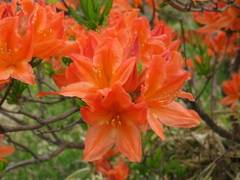
Mid-spring (April through May) across a 2-3 week bloom period. Bicolor funnel-shaped flowers 2-3 inches (5-7 cm) across with deep red to rose-red margins blending inward to a white or pale pink center, carried in conical trusses of 8-14 flowers each. Honeybees, bumblebees, and hummingbirds work the flowers for nectar across the spring bloom — the nectar contains grayanotoxin and is toxic in volume to humans (the mad-honey concern that applies broadly to flowers in the family Ericaceae).
Detailed Descriptions
Flower Description
bicolor funnel-shaped flowers 2-3 inches (5-7 cm) across with deep red to rose-red margins blending inward to a white or pale pink center, carried in conical trusses of 8-14 flowers each in mid-spring (April through May) across a 2-3 week bloom period; the bicolor red-and-white flower form combined with the variegated yellow-and-green foliage produces a double-variegation display rare among cultivated rhododendronsFoliage Description
dark green with an irregular creamy-yellow central variegation pattern (chimeral variegation — a stable somatic mutation in the leaf-tissue layer that produces the yellow center while the leaf margin retains normal green chlorophyll); elliptic, leathery, 4-7 inches (10-18 cm) long; the variegation pattern varies from leaf to leaf because the chimeral tissue boundary between the green and yellow zones is irregular; evergreen year-roundGrowing Conditions
Sun Requirements
Requires 3-6 hours of direct sunlight daily
• Full Sun: 6+ hours of direct sunlight
• Partial Shade: 3-6 hours of direct sunlight
• Full Shade: Less than 3 hours of direct sunlight
Care & Maintenance
Care Guide
Site in part shade with 3-6 hours of direct sun per day, ideally morning sun with afternoon shade in a position protected from hot afternoon exposure that scorches the yellow-variegated leaf zones, in well-drained acidic loam or peat-amended soil with a strictly acidic pH of 4.5-6.0 — the cultivar develops chlorosis at higher pH levels and calls for naturally acidic native soil or sustained acidification through pine-needle mulch and elemental-sulfur amendment to maintain the low pH at the root zone. The cultivar is not drought-tolerant and calls for consistent moisture through the growing season. All-green reversion shoots are removed promptly back to the parent stem below the point of reversion to remove the latent reversion buds and to prevent the more-vigorous green growth from outcompeting the variegated tissue and dominating the canopy within a few years. Spent flower trusses are deadheaded by snapping at the base immediately after bloom finishes (May), with care to preserve the small growth buds at the base of each truss. All parts contain grayanotoxin and are severely toxic to humans, livestock, cats, dogs, and horses if ingested. Deer-resistant. Hardy in USDA zones 5-8.Pruning
Spent flower trusses are deadheaded by snapping at the base immediately after bloom finishes (May), with care to preserve the small growth buds at the base of each truss. All-green reversion shoots are removed promptly whenever they appear and are cut back to the parent stem below the point of reversion to remove the latent reversion buds — leaving any reverted shoots in place will produce dominance of the green reversion growth within a few years and loss of the variegated character. Light shape pruning is done after flowering if needed; the cultivar tolerates moderate corrective pruning back into the canopy with regrowth from latent buds within 1-2 growing seasons.Pruning Schedule
Prune: May
late spring
Container Growing
Suitable for container growing
Minimum container size: 7 gallons