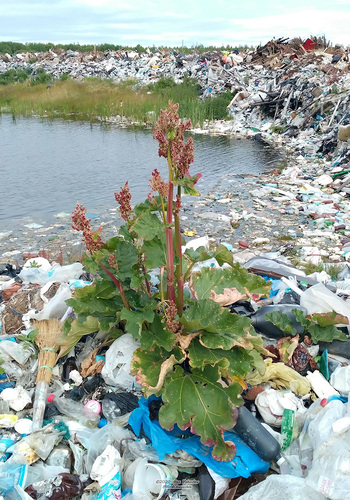
Rheum, Genus, rhabarbarum, Species,
- Genus & species
rhubarb
Southern Siberia, Mongolia, northern China
Overview
Rheum rhabarbarum is a herbaceous perennial vegetable forming a clump 2-3 feet (60-90 cm) tall and 3-4 feet (90-120 cm) wide from a thick, branching underground crown. Each spring it produces large triangular to heart-shaped leaf blades up to 24 inches (60 cm) long, carried on thick fleshy petioles 1-2 feet (30-60 cm) long that range from green to deep red. The petioles are the edible portion, with a tart flavor from malic and oxalic acids, while the leaf blades hold high concentrations of oxalic acid and anthraquinone glycosides. In early summer mature crowns send up a stout hollow flowering stalk 5-6.5 feet (1.5-2 m) tall bearing a branched panicle of small creamy-white to greenish flowers. Flowering diverts energy from petiole growth, so stalks are often cut out on plants grown for harvest. The clump dies back to the crown in autumn and requires winter cold to break dormancy and resprout. Plants stay productive for ten years or more before the crown becomes congested and is divided. The leaf blades are poisonous if eaten and are removed from the harvested stalks.
Native Range
Rheum rhabarbarum originates in the cold-temperate regions of southern Siberia, Mongolia, and northern China, where it grows in rocky and riverine sites. It is not native to North America and reached Europe and the wider world through cultivation.Suggested Uses
Grown in kitchen gardens and allotments for its tart petioles, used in pies, crumbles, sauces, and preserves. The bold foliage also suits the back of ornamental and mixed borders. It can be forced under cover in late winter for early, tender pink stalks.How to Identify
Appearance
Size & Dimensions
Height2' - 3'
Width/Spread3' - 4'
Bloom Information
Flower stalks rise in late spring to early summer, typically May to June, topped with branched panicles of small creamy-white to greenish flowers. The flowers are wind- and insect-pollinated and give way to winged three-sided fruits. On plants grown for harvest the stalks are commonly removed before flowering.
Detailed Descriptions
Flower Description
Creamy-white to greenishFoliage Description
Dark green blades on green to red petiolesGrowing Conditions
Sun Requirements
Requires 6-10 hours of direct sunlight daily
• Full Sun: 6+ hours of direct sunlight
• Partial Shade: 3-6 hours of direct sunlight
• Full Shade: Less than 3 hours of direct sunlight
Care & Maintenance
Care Guide
Grows in full sun to light shade in deep, fertile, moisture-retentive soil enriched with organic matter, at a pH of 6.0-6.8. The crown needs winter temperatures below 40 F (4 C) to break dormancy, so the plant fails in warm climates without a cold season. Consistent moisture through spring and summer sustains petiole size, though the crown rots in waterlogged ground. Plants are hardy to USDA zone 3 and withstand winter lows near -40 F (-40 C). A mulch of compost each spring maintains fertility. Crown rot, root rot, and rhubarb curculio are the main problems.Pruning
Flower stalks are cut at the base as they appear on plants grown for stalks, keeping energy in the petioles. Old outer leaves are removed as they yellow. Congested crowns are lifted and divided in late autumn or early spring every five to ten years.Pruning Schedule
Prune: May–June
late springsummer
Container Growing
Suitable for container growing
Minimum container size: 10 gallons