Rhaphiolepis, Genus, spp., Multiple species,
- Genus
- Multiple species
Indian hawthorn
Overview
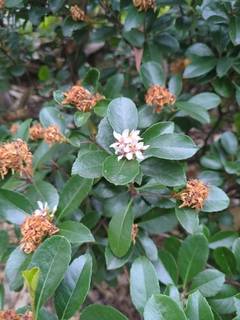
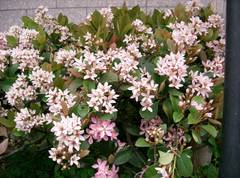
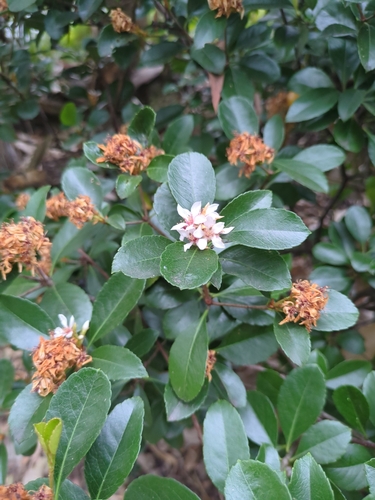
Rhaphiolepis is a genus of about 15 species of evergreen shrubs and small trees in the rose family Rosaceae, native to southern and eastern Asia, from the Himalayas through China to Japan. The plants form dense, rounded, slow-growing shrubs 3-10 feet (0.9-3 m) tall and wide, with thick, leathery, dark green leaves that are oval and bluntly toothed. In spring, branched clusters of small five-petaled flowers open at the branch tips, white to deep pink, lightly fragrant, and followed by small blue-black fruits like miniature pomes. The genus, often sold as Indian hawthorn, is grown widely as a landscape shrub in warm-temperate and subtropical regions for its compact form and spring flowers. Plants are hardy to about USDA zone 7 or 8, tolerating heat, coastal salt, and a range of soils, but are damaged by hard frost. In humid climates they are prone to Entomosporium leaf spot, which can defoliate plants and is the main limitation on their use. Many compact cultivars have been selected for flower color and disease resistance. The dense habit suits low hedges, foundation plantings, and mass plantings in mild regions.
Native Range
Rhaphiolepis is native to southern and eastern Asia, ranging from the Himalayas and southern China to Korea and Japan, where the plants grow in coastal scrub, thickets, and open woodland. R. indica and R. umbellata are the species behind most cultivated forms.Suggested Uses
Grown as a low hedge, foundation shrub, and in mass plantings in warm-temperate and subtropical gardens for the compact evergreen form and spring flowers. Compact cultivars suit containers and small spaces, while the salt tolerance suits coastal plantings. The spring flowers draw bees, and birds eat the dark fruit.How to Identify
Appearance
Size & Dimensions
Height3' - 10'
Width/Spread3' - 10'
Bloom Information
Flowering occurs in spring, roughly March to May depending on climate, with clusters of small white to pink flowers that are lightly fragrant. Some cultivars produce a lighter second flush in autumn. The flowers are followed by blue-black fruits that ripen through summer and into winter.
Detailed Descriptions
Flower Description
white to pinkFoliage Description
dark greenGrowing Conditions
Sun Requirements
Requires 6-10 hours of direct sunlight daily
• Full Sun: 6+ hours of direct sunlight
• Partial Shade: 3-6 hours of direct sunlight
• Full Shade: Less than 3 hours of direct sunlight
Care & Maintenance
Care Guide
Indian hawthorn grows in full sun to part shade in well-drained soil and flowers most heavily in full sun. Plants tolerate heat, drought once established, and coastal conditions, which suits them to warm-climate and seaside gardens. They are hardy to about USDA zone 7 or 8 and are damaged or killed by hard frost. In warm, humid regions Entomosporium leaf spot can cause heavy leaf drop, so an open position with good air movement and resistant cultivars reduces the problem. Plants need little feeding and only light watering once established. Overhead watering that wets the foliage encourages the leaf spot disease.Pruning
Prune lightly after flowering to shape the plant and remove wayward shoots, as the dense habit needs little cutting. Heavy shearing removes flower buds and creates dense outer growth that traps moisture and worsens leaf spot. Remove any diseased or dead wood as it appears.Container Growing
Suitable for container growing
Minimum container size: 5 gallons