Reynoutria, Genus, japonica, Species,
- Genus & species
Japanese knotweed
Overview
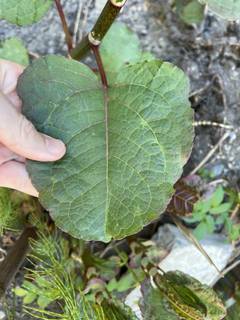
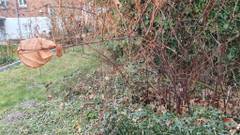
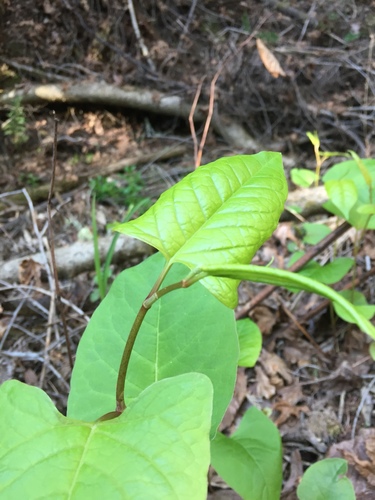
Reynoutria japonica is a large herbaceous perennial in the knotweed family, sending up hollow, bamboo-like canes 3-10 feet (1-3 m) tall each year from a deep, woody rhizome system. The stems are green with reddish-purple speckling, jointed, and swollen at the nodes where papery sheaths clasp them. Broad ovate to triangular leaves 3-6 inches (8-15 cm) long are arranged alternately in a zigzag along the canes, with a flat or squared base and an abruptly pointed tip. In late summer and early autumn it bears branched sprays of small creamy-white flowers, with male and female blooms usually on separate plants. Top growth dies back to brown, persistent canes after frost, and the plant regrows from rhizomes that can extend several feet deep and 20 feet (6 m) outward. It spreads almost entirely by rhizome and stem fragments rather than seed, and even small fragments can root. It is listed as invasive across much of North America and Europe, where it forms dense stands that crowd out other vegetation and can damage pavement and foundations.
Native Range
Native to East Asia, including Japan, Korea, China, and Taiwan, where it colonizes volcanic slopes, riverbanks, and disturbed ground. In its native range natural enemies and competition keep it in check. It was introduced to Europe and North America as an ornamental and erosion-control plant in the 19th century and has naturalized aggressively.Suggested Uses
It was originally planted as an ornamental screen and for bank stabilization, uses now discouraged or banned because of its invasive spread. In current practice it is managed and removed rather than cultivated. It has no recommended garden use in regions where it is regulated.How to Identify
Appearance
Size & Dimensions
Height3' - 10'
Width/Spread6' - 20'
Bloom Information
Flowers in late summer to early autumn, generally August into September. The small creamy-white blooms are carried in branched clusters from the upper leaf axils and draw bees and other insects. In many naturalized stands plants are a single sex, so little viable seed is set.
Detailed Descriptions
Foliage Description
greenGrowing Conditions
Sun Requirements
Requires 4-12 hours of direct sunlight daily
• Full Sun: 6+ hours of direct sunlight
• Partial Shade: 3-6 hours of direct sunlight
• Full Shade: Less than 3 hours of direct sunlight
Care & Maintenance
Care Guide
Grows in full sun to part shade and tolerates a very wide range of soils, including poor, compacted, saline, and disturbed ground, as well as periodic flooding. It needs no care to persist and spreads rapidly once established. Because it is invasive across North America and Europe, planting is prohibited or restricted in many jurisdictions. Control is difficult and usually requires repeated cutting combined with targeted herbicide over several seasons. Cut stems and rhizome fragments regenerate readily and require careful disposal. Digging often worsens spread by scattering fragments.Pruning
Repeated cutting through the growing season weakens the rhizome over time but rarely eliminates it alone. Cut canes regrow quickly, and dead canes persist through winter. Mechanical removal is treated as control rather than ornamental pruning.Pruning Schedule
Prune: June–August
summer