Kniphofia, Genus, uvaria, Species,
- Genus & species
red hot poker
Overview
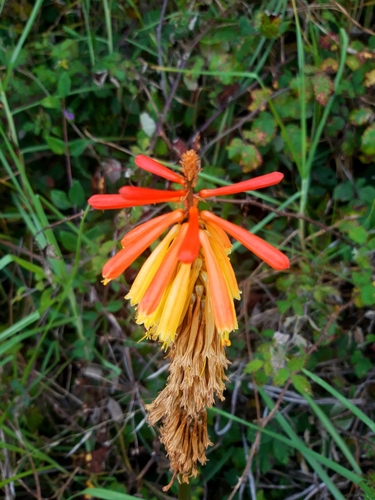
Kniphofia uvaria is a clump-forming evergreen-to-semi-evergreen perennial with a basal rosette of stiff, strap-shaped leaves and erect flowering stems reaching 36-48 inches (90-120 cm) tall. Leaves measure 24-36 inches (60-90 cm) long and 1 inch (2.5 cm) wide, grey-green to blue-green, V-shaped in cross section, with finely toothed margins. The dense conical-to-cylindrical flower spike is 6-10 inches (15-25 cm) long, composed of 50-100 pendulous tubular florets each 1-1.5 inches (2.5-4 cm) long. Florets open from the bottom upward over 2-3 weeks; coral-red buds open to yellow at maturity, producing a two-tone spike. Bloom occurs from June through August in zones 5-7 and from May through July in zones 8-9. Plants spread slowly by short underground rhizomes, forming clumps 24-30 inches (60-75 cm) wide in 3-4 years. Foliage tips brown in winter in zones 5-6 and require trimming in spring. The crown rots in waterlogged soils, particularly during winter dormancy. Crown borer larvae and the variegated cutworm occasionally damage flower stalks. K. uvaria has naturalized in coastal grasslands of California, Oregon, southern Australia, and New Zealand, where it is regarded as a weed in pasture and natural-area settings.
Native Range
Native to Cape Province, South Africa, where it grows in damp grasslands, along streambanks, and on moist mountain slopes from sea level to 7,500 feet (2,300 m). Naturalized in California, Oregon, southern Australia, New Zealand, and parts of southwestern Europe.Suggested Uses
Used in mixed perennial borders and dry-garden plantings spaced 24-30 inches (60-75 cm) apart, where the upright flower spikes contribute vertical line among lower-growing companions. Container plantings use pots of at least 7 gallons (26 L) with sandy well-drained mix; container specimens need winter protection in zones 5-7. Limited to USDA zones 5-9; crown rot is widespread in humid zones 10-11.How to Identify
Appearance
Size & Dimensions
Height3' - 4'
Width/Spread2' - 2'6"
Colors
Bloom Information
Bloom occurs from June through August in zones 5-7 and from May through July in zones 8-9, with each spike opening over 2-3 weeks and a mature clump producing 5-10 spikes in succession over 6-8 weeks. Removal of spent stalks encourages a smaller second flush in late summer in zones 7-9. Bloom is reduced or absent in years following severe winter dieback in zones 5-6.
Detailed Descriptions
Flower Description
coral-red buds opening to yellow florets in a dense terminal spikeFoliage Description
grey-green to blue-greenGrowing Conditions
Sun Requirements
Requires 6-12 hours of direct sunlight daily
• Full Sun: 6+ hours of direct sunlight
• Partial Shade: 3-6 hours of direct sunlight
• Full Shade: Less than 3 hours of direct sunlight
Care & Maintenance
Care Guide
Crowns are planted at soil level in spring after frost, spaced 24-30 inches (60-75 cm) apart in a site with sharp drainage. Weekly watering during the first growing season aids establishment; mature plants tolerate 2-4 weeks between rainfalls of 1 inch (2.5 cm). Annual fertilization is unnecessary in average soils; over-fertilized plants produce excess foliage and fewer flower spikes. Crown rot (Phytophthora and Pythium species) develops in waterlogged or poorly drained soils, particularly during winter; raised beds and gravel mulches reduce risk. In zones 5-6, a 4-6 inch (10-15 cm) layer of straw or pine-needle mulch applied in late autumn buffers the crown against freeze-thaw cycles. Clumps require division every 5-7 years in spring when bloom decreases or the center of the clump dies out.Pruning
Spent flower stalks are cut at the base after seedhead formation to encourage a second flush and prevent self-seeding. In zones 5-6, foliage is left intact through winter and trimmed back in spring after new growth emerges; in zones 7-9, browned outer leaves are removed in late winter. Whole-clump cutbacks to 4-6 inches (10-15 cm) above ground reduce the subsequent year's bloom and are not part of routine maintenance.Pruning Schedule
Prune: March–April & August–September
early springsummer
Container Growing
Suitable for container growing
Minimum container size: 7 gallons