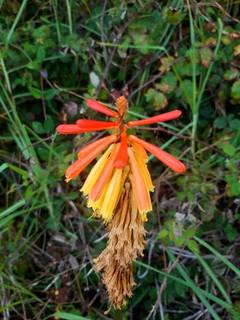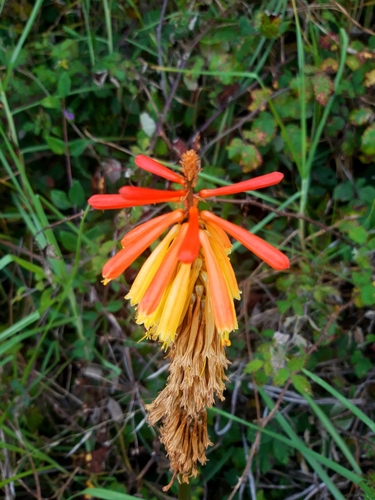
Kniphofia, Genus, spp., Multiple species,
- Genus
- Multiple species
pokers
Africa, primarily South Africa, with species in tropical East Africa, Ethiopia, Madagascar, and Arabia
Overview
Kniphofia is a genus of about 70 species of clump-forming perennials in the family Asphodelaceae, native to Africa and concentrated in South Africa. Plants form basal tufts of narrow, keeled, grass-like leaves 1.5 to 4 ft (45 to 120 cm) long, blue-green to grey-green, from which leafless stalks rise to carry dense, cylindrical spikes of tubular flowers. Including the spikes, plants stand 1.5 to 6 ft (45 to 180 cm) tall and 1.5 to 3 ft (45 to 90 cm) wide. Each spike holds dozens of pendent tubular florets that open from the base upward; in many species the unopened upper buds differ in color from the open lower flowers, producing a two-tone spike in red, orange, yellow, cream, or green. The tubular flowers hold nectar and draw sunbirds in Africa and hummingbirds in North American gardens. Foliage may be evergreen or die back to the crown depending on species and climate. Limitations across the genus include rot where winter soils stay wet, frost damage in the tender tropical species, and self-seeding that can crowd a planting over time.
Native Range
Kniphofia is native to Africa, with most species in South Africa and others in tropical East Africa, Ethiopia, Madagascar, and the Arabian Peninsula. Plants grow in moist grassland, on stream banks, in marshy ground, and on mountain slopes, often where soils are damp in summer and drier in winter. The genus ranges from sea level to high montane elevations.Suggested Uses
Kniphofia is grown in mixed and herbaceous borders, gravel and coastal gardens, and as a clump among grasses and other prairie-style plantings. The nectar-rich spikes suit wildlife and pollinator gardens. Compact species are kept in large containers.How to Identify
Appearance
Size & Dimensions
Height1'6" - 6'
Width/Spread1'6" - 3'
Colors
Bloom Information
Most Kniphofia species bloom from late spring through summer, with some flowering into autumn and a few in winter in frost-free climates. In gardens the main display runs June through September, and individual spikes last two to three weeks. Staggered bloom across species can extend color over several months.
Detailed Descriptions
Flower Description
red, orange, yellow, cream, and greenFoliage Description
blue-green to grey-greenGrowing Conditions
Sun Requirements
Requires 6-10 hours of direct sunlight daily
• Full Sun: 6+ hours of direct sunlight
• Partial Shade: 3-6 hours of direct sunlight
• Full Shade: Less than 3 hours of direct sunlight
Water & Climate
Water Needs
Drought Tolerance
Drought tolerant when established
Care & Maintenance
Care Guide
Kniphofia grows in full sun in deep, free-draining soil with a pH from about 6.0 to 7.0 and steady moisture through the growing season. The plants are drought tolerant once established but flower more freely with summer water; the main risk is crown rot where soil stays wet through cold winters, so sharp drainage matters most in winter. Hardiness varies across the genus, with garden species such as K. uvaria hardy to about zone 6 and tropical species tender below freezing. A winter mulch protects the crowns in colder zones. Evergreen species hold their foliage year-round, while deciduous species die back and resprout in spring. Plants resent root disturbance and may skip a season of bloom after division.Pruning
Spent flower spikes on Kniphofia are cut to the base after blooming to limit self-seeding. Evergreen species are tidied by pulling away dead outer leaves rather than shearing the clump. Deciduous foliage is left over winter for crown protection and cut back in early spring.Container Growing
Suitable for container growing