Pyrus, Genus,
- Genus
pear
Temperate Europe, western Asia, Caucasus, Central Asia, East Asia (China, Japan, Korea)
Overview
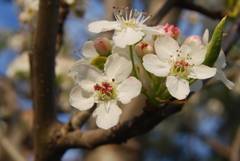
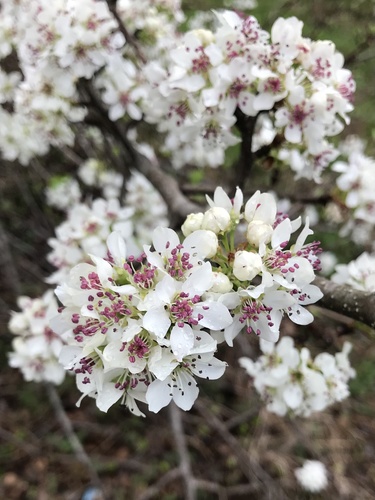
Pyrus is a genus of deciduous trees in the Rosaceae family reaching 20–50 feet (6–15 m) tall and 15–35 feet (4.6–10.7 m) wide depending on species, with crown form ranging from narrowly pyramidal in P. calleryana cultivars through broadly rounded in mature P. communis. The genus contains approximately 30 species native from Britain and the Mediterranean across Eurasia to Japan and Korea, split by use into the fleshy-fruited edible pears (primarily P. communis for European pears and P. pyrifolia for Asian pears) and the small-fruited ornamental species (primarily P. calleryana for street-tree cultivars such as 'Bradford', 'Cleveland Select', and 'Chanticleer'). Leaves are simple, alternate, ovate to elliptic, 1–4 inches (2.5–10 cm) long, glossy dark green, turning red, orange, or purplish-red in autumn — the red autumn color in P. calleryana cultivars is among the more reliable autumn displays of any street tree. Flowers are white, 5-petaled, 0.5–1.5 inches (13–38 mm) wide, in clusters of 5–12 appearing in spring (March through May depending on species and climate) before or with emerging leaves over a 2–3 week window. Fruit is a pome — true botanical pears with gritty stone-cell flesh — ranging from the 3–5 inch (8–13 cm) fleshy edible pears of P. communis to the 0.3–0.5 inch (8–13 mm) hard small ornamental fruits of P. calleryana. Growth rate is moderate. Hardiness ranges from USDA zones 4 through 8 depending on species. Not known to be toxic to pets or humans. P. calleryana cultivars have escaped cultivation through cross-pollination between grafted cultivars (originally thought to be self-sterile) and have established invasive populations in deciduous forests, roadsides, and abandoned fields across the eastern United States; Ohio, South Carolina, and Pennsylvania have passed laws prohibiting the sale or planting of Callery pear as of 2023–2024, with additional states considering similar restrictions.
Native Range
Pyrus species are native to temperate regions of Europe, western Asia, the Caucasus, Central Asia, and East Asia — from Britain and the Mediterranean east through the Caucasus to China, Japan, and Korea, occurring in mixed deciduous forests, forest margins, and river valleys. P. calleryana is native to China and Vietnam. The genus has no North American native species.Suggested Uses
Used as specimen trees, shade trees, street trees, and orchard plantings at 15–30 foot (4.6–9 m) spacing depending on species. Fruiting species (P. communis, P. pyrifolia) produce edible pears and fit orchard or backyard-garden positions where fruit harvest is the primary use. Ornamental species (P. calleryana) produced a generation of street tree plantings from the 1960s through the 2000s, but the escape of Callery pear into wild populations in the eastern United States has reversed the recommendation: gardeners in the eastern US should choose non-invasive alternative flowering trees such as Amelanchier, Cercis canadensis, or Nyssa sylvatica rather than ornamental pears. The plant does not grow well in waterlogged soils, deep shade, or climates outside USDA zones 4–8.How to Identify
Appearance
Size & Dimensions
Height20' - 50'
Width/Spread15' - 35'
Bloom Information
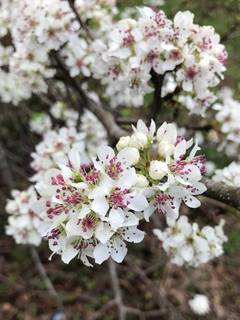
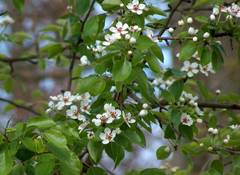
White 5-petaled flowers 0.5–1.5 inches (13–38 mm) wide appear in clusters of 5–12 in spring (March through May depending on species and climate) before or with the emerging leaves over a 2–3 week window. Fruit develops from pollinated flowers through summer and matures in late summer or autumn.
Detailed Descriptions
Flower Description
White; 5-petaled flowers 0.5-1.5 inches wide in clusters of 5-12; spring (March-May); pome fruit with gritty stone-cell flesh followsFoliage Description
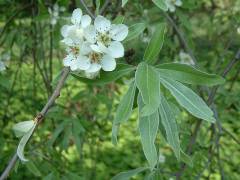
Glossy dark green; simple, alternate, ovate to elliptic, 1-4 inches long, leathery; red to orange to purplish-red autumn colorGrowing Conditions
Sun Requirements
Requires 6-10 hours of direct sunlight daily
• Full Sun: 6+ hours of direct sunlight
• Partial Shade: 3-6 hours of direct sunlight
• Full Shade: Less than 3 hours of direct sunlight
Care & Maintenance
Care Guide
Grow in full sun with 6 or more hours of direct light in well-drained loam, clay, or silt at pH 6.0–7.5. The genus is adaptable to a range of soil types including heavy clay and urban compacted soils. Water deeply once per week during the first three growing seasons to establish, then rely on natural rainfall. Fire blight (the bacterial disease caused by Erwinia amylovora) is the principal disease concern across the genus and eliminates susceptible cultivars from regions with hot humid summers; selecting disease-resistant species and cultivars at planting time addresses the problem more reliably than curative treatment. Hardiness runs USDA zones 4 through 8 depending on species. P. calleryana is banned from sale and planting in Ohio as of 2023, South Carolina as of 2024, and Pennsylvania as of 2024, with additional states considering similar legislation — gardeners in eastern US locations planting ornamental pears should confirm the species is not Callery pear before buying nursery stock.Pruning
Prune in late winter (January–February) while trees are dormant. Remove crossing and rubbing branches, water sprouts, and any branches showing the blackened shepherd's-crook tip symptom of fire blight; blight-infected branches require removal 12 inches (30 cm) below the visible infection boundary, with pruning tools sterilized between cuts using a 10% bleach solution or isopropyl alcohol. Ornamental pears require minimal pruning once trained to a central leader in the first 5 years. Fruiting pears grown for harvest benefit from spur-bearing training systems that concentrate fruit production on short woody spurs along horizontal scaffold branches.Pruning Schedule
Prune: January–February
winter