Pultenaea, Genus, scabra, Species,
- Genus & species
rough bush-pea
Overview
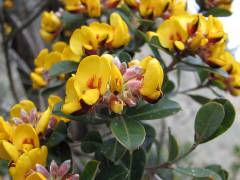
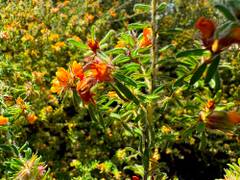
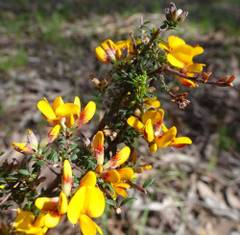
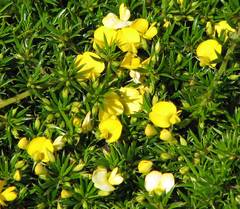
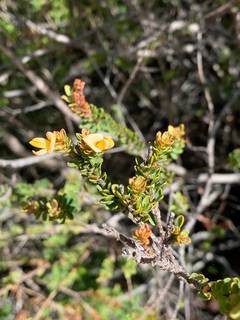
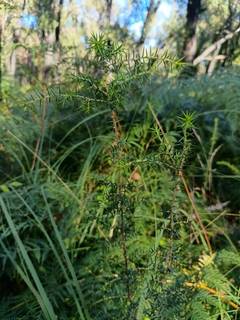
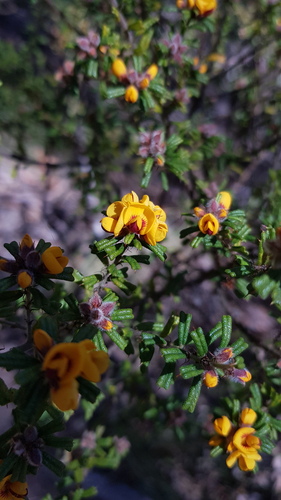
Pultenaea scabra is an evergreen shrub in the Fabaceae family growing 1.5-6.5 feet (0.5-2 m) tall with an upright to spreading habit. The small leaves are wedge-shaped, 0.2-0.5 inch (5-12 mm) long, with rough recurved margins and a notched or short-pointed tip, arranged alternately along the stems. Pea-shaped flowers 0.3-0.5 inch (8-12 mm) across appear in spring, yellow to orange with red to brown markings on the back of the standard petal, clustered toward the branch tips. Flat pods 0.2-0.3 inch (5-8 mm) long follow, each holding one or two seeds. Growth is moderate, with plants reaching mature size in 3-4 years. As a legume, it fixes atmospheric nitrogen through root nodules and grows on nutrient-poor soils. Lower branches can become bare and woody with age, and the species is generally short-lived, persisting 8-12 years in cultivation.
Native Range
Native to southeastern Australia, occurring in New South Wales, Victoria, and Tasmania. Grows in dry sclerophyll forest, heathland, and rocky hillsides on well-drained sandy and gravelly soils.Suggested Uses
Planted in native and habitat gardens, on embankments, and in low-water borders, spaced 3-5 feet (0.9-1.5 m) apart. The spring pea flowers draw native bees and other insects. The short lifespan limits its use where long-term permanence is needed.How to Identify
Appearance
Size & Dimensions
Height1'6" - 6'6"
Width/Spread2' - 5'
Bloom Information
Flowers in spring, roughly September to November in its native range. The clustered display lasts 4-6 weeks. Flowering is heaviest in open sunny positions and sparser in shade.
Detailed Descriptions
Flower Description
yellow to orange with red markingsFoliage Description
dark greenGrowing Conditions
Sun Requirements
Requires 5-10 hours of direct sunlight daily
• Full Sun: 6+ hours of direct sunlight
• Partial Shade: 3-6 hours of direct sunlight
• Full Shade: Less than 3 hours of direct sunlight
Care & Maintenance
Care Guide
Grows in full sun to light shade on free-draining sandy or gravelly soil. Water through the first summer after planting; established shrubs tolerate dry periods of several weeks. As a legume it forms nitrogen-fixing root nodules and needs little added fertilizer. Root rot from Phytophthora cinnamomi develops on poorly drained sites and causes wilting and collapse. Plants are short-lived and may need replacement after about a decade.Pruning
Light tip pruning after flowering keeps the shrub compact and slows the bare, woody growth at the base. Cutting back into old leafless wood regenerates slowly. Removing spent flower clusters is not required for plant health.Pruning Schedule
Prune: November–December
late springsummer
Container Growing
Suitable for container growing
Minimum container size: 3 gallons