Pteridium, Genus, aquilinum, Species,
- Genus & species
bracken fern
Cosmopolitan: every continent except Antarctica; Pacific Northwest open forests, clearcuts, meadows, and disturbed ground
Overview
Pteridium aquilinum is a coarse, upright, colony-forming, summer-deciduous fern in the family Dennstaedtiaceae. It occurs on every continent except Antarctica and is found across Pacific Northwest open forests, clearcuts, forest edges, meadows, and disturbed ground. The specific epithet aquilinum translates as eagle-like and refers to the broadly triangular, eagle-wing shape of the expanded frond, or to the appearance of the vascular bundles in cross-section. Plants reach 2–5 feet (60–150 cm) tall, occasionally taller, from a deep, branching rhizome system that can extend several feet below the soil surface and allows colonies to expand rapidly after fire, logging, or disturbance. Fronds are broadly triangular, bipinnate to tripinnate, and held horizontally on a long, stiff, grooved stipe. Pinnules are oblong with inrolled margins concealing the linear marginal sori; the inrolled margins act as the indusium. Fronds emerge as fiddleheads in spring, expand fully by early summer, and die back to tan-brown in fall. All parts contain ptaquiloside, a sesquiterpene glycoside classified as a carcinogen and linked to elevated gastric cancer risk through ingestion of the plant or contaminated milk and water. The plant also contains thiaminase, which destroys vitamin B1 and causes bracken poisoning in horses, cattle, and sheep through chronic ingestion. Limitation: rhizome spread is aggressive and the plant is difficult to remove once established; the carcinogenic content makes the species unsuitable for gardens with children, pets, or livestock access.
Native Range
Native across Pacific Northwest open forests, clearcuts, meadows, and disturbed ground; broadly distributed across every continent except Antarctica.Suggested Uses
Included in Pacific Northwest native plant collections for educational purposes related to fern morphology, marginal sori, and disturbance ecology. P. aquilinum colonizes rapidly after fire and logging and is a component of post-disturbance succession in Pacific Northwest forests. The aggressive spread, carcinogenic content, and livestock toxicity restrict ornamental use to large naturalistic settings without children, pets, or grazing animals.How to Identify
Appearance
Size & Dimensions
Height2' - 5'
Width/Spread2' - 4'
Bloom Information
Ferns do not flower. Spores are produced in a continuous linear sorus running along the inrolled margins of the pinnule undersides, with the margin itself acting as the indusium. Spores mature in mid to late summer (July through September). Pacific Northwest populations spread primarily by deep rhizomes rather than by spores.
Detailed Descriptions
Foliage Description
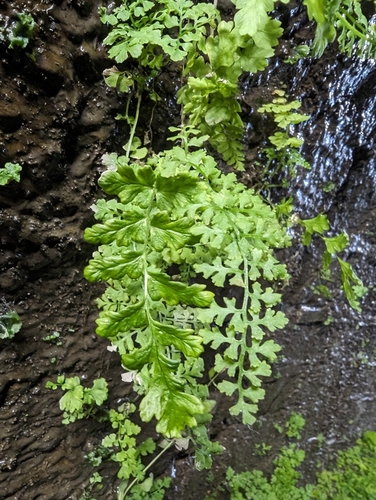
medium green; broadly triangular bipinnate to tripinnate fronds held horizontally on a long, stiff, grooved stipe; pinnules oblong with inrolled margins concealing the linear marginal sori; fronds die back to tan-brown in fallGrowing Conditions
Sun Requirements
Requires 2-10 hours of direct sunlight daily
• Full Sun: 6+ hours of direct sunlight
• Partial Shade: 3-6 hours of direct sunlight
• Full Shade: Less than 3 hours of direct sunlight
Care & Maintenance
Care Guide
Site in full sun to partial shade with 2–10 hours of direct sun per day in well-drained to average, acidic to neutral soil with a pH of 4.5–7.0. The species tolerates low fertility, summer drought once established, and a wide range of exposures. Spread is aggressive by deep, branching rhizomes that can extend several feet below the soil surface within a single season. All parts contain ptaquiloside, a known carcinogen, and thiaminase, which causes bracken poisoning in horses, cattle, and sheep. The species is suited to large naturalistic restoration sites rather than ornamental garden settings.Pruning
Cut dead fronds to ground level in late winter (February through March) before fiddleheads emerge. Repeated cutting of green fronds at ground level over several seasons reduces colony vigor. Physical removal of rhizomes is difficult because of their depth and lateral spread.Pruning Schedule
Prune: February–March
early spring