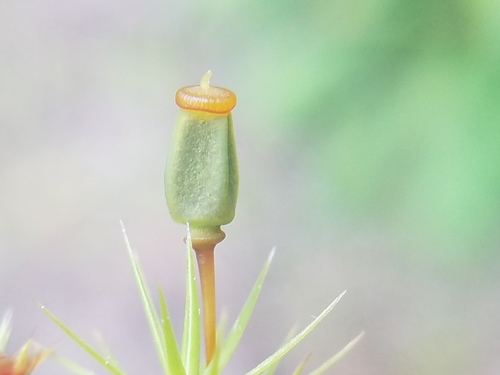
Polytrichum, Genus, commune, Species,
- Genus & species
common haircap moss
Cosmopolitan; circumboreal to temperate worldwide
Overview
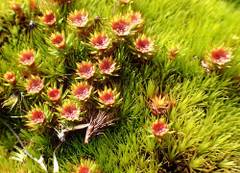
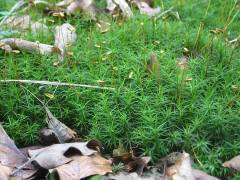
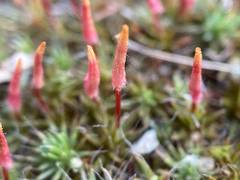
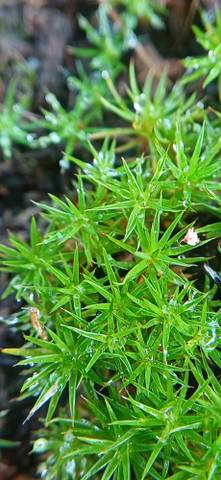
Polytrichum commune is a large moss in the family Polytrichaceae, forming open turfs that stand 2-8 inches (5-20 cm) tall, with stems in saturated bog conditions reaching 16 inches (40 cm). Unbranched stems carry stiff, lance-shaped leaves 6-12 mm long that spread outward when moist and fold against the stem when dry. Each leaf has a broad midrib covered on its upper surface by closely packed vertical plates called lamellae, which give the leaf a matte blue-green to dark green colour and increase its photosynthetic surface. Plants are dioecious: male stems end in a rosette of bracts that holds the splash cups, while female stems produce a four-angled spore capsule on a reddish seta 2-4 inches (5-10 cm) long. The capsule is covered by a dense golden-brown calyptra resembling a tuft of hair, the feature behind the common name. Internal conducting strands of hydroids and leptoids move water and sugars along the stem, an adaptation rare among mosses. Colonies bind soil on banks and form a sponge-like layer that holds water. One limitation is sensitivity to prolonged drought and to summer heat in exposed sites, where turfs brown and growth halts until moisture returns.
Native Range
Polytrichum commune has a cosmopolitan distribution, occurring across North America, Europe, Asia, and parts of Africa, Australia, and New Zealand. In North America it ranges from the Arctic south through Canada and much of the United States. It grows in bogs, wet heathland, coniferous forest floors, and stream banks on acidic, moisture-retentive substrates.Suggested Uses
Polytrichum commune is used as a groundcover in shaded, moist woodland and bog gardens, in moss gardens, and for stabilising acidic banks. It is also grown in terrariums and as a component of green-roof plantings on suitable substrates.How to Identify
Appearance
Size & Dimensions
Height2" - 8"
Colors
Foliage Colors
Fall Foliage Colors
Bloom Information
Polytrichum commune reproduces by spores rather than flowers. Sperm released from male splash cups in spring fertilise female plants, and spore capsules mature through summer into autumn. Capsules shed spores over several weeks once the lid and calyptra fall, with dispersal continuing into the following spring in cool climates.
Detailed Descriptions
Foliage Description
Blue-green to dark greenGrowing Conditions
Sun Requirements
Tolerates up to 4 hours of direct sunlight daily
• Full Sun: 6+ hours of direct sunlight
• Partial Shade: 3-6 hours of direct sunlight
• Full Shade: Less than 3 hours of direct sunlight
Care & Maintenance
Care Guide
Polytrichum commune grows in consistently moist, acidic soil with a pH near 4.0-6.0 in dappled to full shade. It establishes on peat, sandy loam, and humus-rich woodland soil that drains slowly yet never dries completely. Supplemental watering during dry spells keeps the substrate damp, since turfs brown and stall under prolonged drought. Colonies need no fertiliser and draw nutrients from rainfall and decaying litter. Compacted foot traffic and competing vascular weeds reduce vigour, so an open, undisturbed position suits it. Growth is slow, with colonies expanding a few centimetres per year.Pruning
Polytrichum commune needs no pruning. Tattered or browned sections can be lifted away by hand in spring to let new growth fill in. Dividing established turfs into smaller pads is the usual method of propagation and is done in cool, damp weather.Container Growing
Suitable for container growing