Butia, Genus, capitata, Species,
- Genus & species
Pindo palm
Southern Brazil, Uruguay, northeastern Argentina
Overview
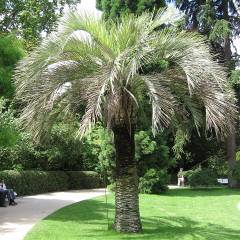
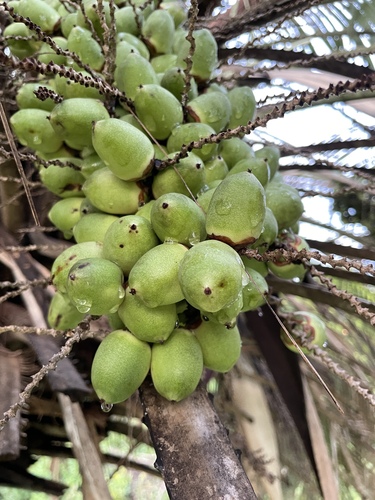
Butia capitata is an evergreen single-trunked palm in the family (Arecaceae), reaching 144-240 inches (360-600 cm) tall and 96-180 inches (240-450 cm) wide at maturity. Pinnate (feather-shaped) fronds 60-100 inches (150-250 cm) long arch strongly downward, giving the crown a bowed silhouette; leaflets are silver-blue to gray-green, 16-24 inches (40-60 cm) long, and stiff. The trunk is stout, 12-18 inches (30-45 cm) in diameter, and covered with persistent leaf-base scars. Cream to pale yellow flowers in panicles 36-60 inches (90-150 cm) long emerge from boat-shaped spathes in late spring to summer, followed by yellow to orange round fruit 0.75-1 inch (2-2.5 cm) across in summer to fall. The fleshy edible fruit has a pineapple-banana-apricot flavor and is used in jellies, jams, and wines, which is the source of the common name jelly palm. Native to grasslands and cerrado of southern Brazil, Uruguay, and northeastern Argentina. Hardy to zones 8-11 with foliage damage below 15°F (-9°C) and trunk damage below 5°F (-15°C); cold tolerance allows cultivation across the southern United States and along the Mediterranean coast of Europe, where most other feather palms are killed by frost. Slow-growing — 6-12 inches (15-30 cm) of trunk extension per year. Non-toxic. Suited to large containers of 25 gallons (95 L) or larger when young.
Native Range
B. capitata is native to grasslands, cerrado, and rocky outcrops of southern Brazil, Uruguay, and northeastern Argentina, where it grows in scattered open populations from sea level to 4,000 feet (1,200 m) elevation.Suggested Uses
Grown as a free-standing landscape specimen at 144-240 inch (360-600 cm) spacing in zones 8-11, as a parking-lot or street tree where the strongly arching crown is wanted, and in containers of 25-65 gallons (95-245 L) for patio culture in any zone. Edible non-toxic fruit used for jellies, jams, and wines.How to Identify
Appearance
Size & Dimensions
Height12' - 20'
Width/Spread8' - 15'
Bloom Information
Cream to pale yellow flowers in panicles 36-60 inches (90-150 cm) long emerge from boat-shaped spathes in late spring to summer in zones 8-11. Bloom period lasts 4-6 weeks per spathe; trees produce 1-3 spathes per year. Yellow to orange edible fruit ripens 4-6 months after flowering.
Detailed Descriptions
Flower Description
Cream to pale yellowFoliage Description
Silver-blue to gray-greenGrowing Conditions
Sun Requirements
Requires 6-12 hours of direct sunlight daily
• Full Sun: 6+ hours of direct sunlight
• Partial Shade: 3-6 hours of direct sunlight
• Full Shade: Less than 3 hours of direct sunlight
Care & Maintenance
Care Guide
Full sun (6+ hours). Soil pH 5.5-7.5, well-drained; tolerates clay, loam, sand, and rocky soils. Drought-tolerant once established and tolerates seaside salt spray. Water deeply but infrequently in the first 2 years to encourage deep rooting. Slow-growing — 6-12 inches (15-30 cm) of trunk extension per year. Pindo palm scale and palm leaf skeletonizer can damage foliage in some regions. Non-toxic. Hardy to zones 8-11 with foliage damage below 15°F (-9°C) and trunk damage below 5°F (-15°C).Pruning
Remove dead or fully brown fronds with a clean cut at the base; live green fronds at any angle are part of the active leaf area. Hard pruning that removes more than 1-2 years of foliage at once weakens the tree. The boots (persistent leaf-base scars) on the trunk can be left for textural effect or trimmed flush with a saw.Container Growing
Suitable for container growing
Minimum container size: 25 gallons