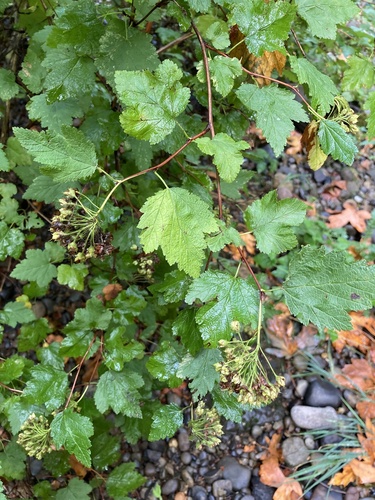
Physocarpus, Genus, capitatus, Species,
- Genus & species
Pacific ninebark
British Columbia south through Washington and Oregon to California; stream banks, moist forest edges, wetland margins, and disturbed moist ground
Overview
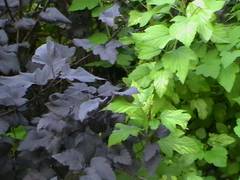
Physocarpus capitatus is Pacific ninebark (western ninebark), an upright deciduous shrub growing 4-12 feet (1.2-3.7 m) tall and 4-10 feet (1.2-3 m) wide. White small 5-petaled flowers form in rounded hemispherical clusters 1.5-3 inches (4-7.5 cm) covering the branch tips (capitatus = growing in dense head) from May through July (6 weeks); inflated reddish-brown papery seed capsule clusters follow and persist into winter. Medium green 3-lobed maple-like leaves turn orange to yellow and red in fall. Multi-layered shredding papery bark peels in strips to expose reddish-brown inner bark, the source of the common name 'ninebark'. Family Rosaceae. Native to British Columbia south through Washington and Oregon to California; the species occurs on stream banks, at moist forest edges, at wetland margins, and in disturbed moist ground. Tolerates a wide range of site conditions, from full sun to partial shade and from wet to average moisture. Drought-tolerant once established. The eastern North American counterpart Physocarpus opulifolius is the parent of dark-leaved 'Diabolo' and gold-leaved 'Dart's Gold' ornamental cultivars. Non-toxic. Hardy in zones 4-9. Grown in part sun to full sun. Growth rate is moderate to fast.
Native Range
Native to British Columbia south through Washington and Oregon to California. Found on stream banks, at moist forest edges, at wetland margins, and in disturbed moist ground.Suggested Uses
Physocarpus capitatus is grown in mixed borders, native plant gardens, riparian buffer plantings, wildlife hedgerows, and stream bank stabilization, spaced 4-10 feet (1.2-3 m) apart. Tolerates a wide range of site conditions. Non-toxic. Hardy in zones 4-9.How to Identify
Appearance
Size & Dimensions
Height4' - 12'
Width/Spread4' - 10'
Bloom Information
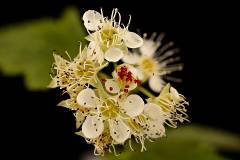
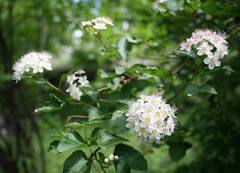
Late spring to mid summer (May-July). White small 5-petaled flowers form in rounded hemispherical clusters 1.5-3 inches (4-7.5 cm) at branch tips for about 6 weeks. Visited by bees and butterflies. Inflated reddish-brown papery seed capsules follow and persist into winter.
Detailed Descriptions
Flower Description
White, small 5-petaled flowers form in rounded to hemispherical clusters 1.5-3 inches (4-7.5 cm) covering the branch tips (capitatus = growing in dense head); May-July; followed by inflated reddish-brown papery seed capsule clusters that persist on the branches through fall and winter as a winter bird food source.Foliage Description
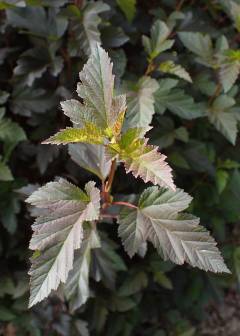
Medium green; 3-lobed maple-like leaves with toothed margins, 1.5-3.5 inches (4-9 cm); finely textured surface; turns orange to yellow and red in fall. Multi-layered shredding papery bark peels in strips to expose reddish-brown inner bark — the source of the common name 'ninebark'.Growing Conditions
Sun Requirements
Requires 3-10 hours of direct sunlight daily
• Full Sun: 6+ hours of direct sunlight
• Partial Shade: 3-6 hours of direct sunlight
• Full Shade: Less than 3 hours of direct sunlight
Care & Maintenance
Care Guide
Grown in part sun to full sun with 3-10 hours of direct sun. Soil tolerates clay, loam, or silt with a pH of 5.5-7.5. Adaptable to wet to average moisture. Drought-tolerant once established. Cold-hardy to zone 4. Non-toxic. Hardy in zones 4-9.Pruning
Pruned in early spring (February-March) to shape; the oldest stems are cut to the base every few years to maintain a fresh framework and renew bark display. Tolerates renovation pruning to ground level.Pruning Schedule
Prune: February–March
early spring