Parkinsonia, Genus, spp., Multiple species,
- Genus
- Multiple species
palo verde
Overview
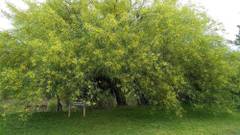
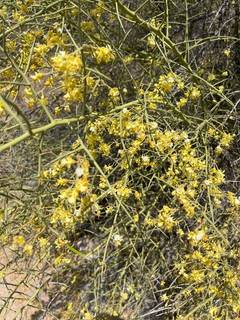
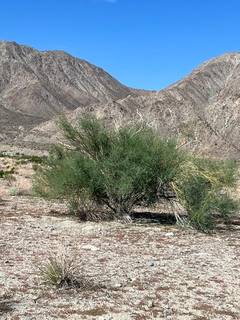
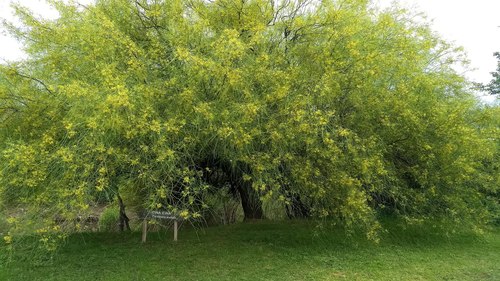
Parkinsonia is a genus of about 12 species of spiny trees and large shrubs in the pea family, Fabaceae, known as palo verde or Jerusalem thorn, native to the arid Americas and Africa and most familiar in the deserts of the southwestern United States and Mexico. Plants grow 10 to 35 feet (3 to 11 m) tall, with smooth green bark on the trunk and branches that carries out much of the plant's photosynthesis. The leaves are small and twice-divided into tiny leaflets along a flattened stalk, and they drop in drought or heat, leaving the green stems to keep the plant alive. In spring the branches are covered with five-petalled yellow flowers, sometimes with one petal marked orange or white, followed by slender seed pods. Most species carry spines at the leaf bases or branch tips. Parkinsonia grows in desert washes, plains, and rocky slopes, surviving long drought by shedding leaves and photosynthesizing through its bark. The genus includes P. florida, blue palo verde, and P. microphylla, foothill palo verde, both desert trees of the Sonoran region, while P. aculeata, Jerusalem thorn, has naturalized and become invasive in Australia, Africa, and other warm regions. The light shade and yellow spring bloom make these common street and desert-garden trees.
Native Range
Parkinsonia is native to the arid Americas, from the southwestern United States through Mexico to South America, and to drier parts of Africa. Plants grow in desert washes, plains, and rocky slopes. P. aculeata has spread far beyond its native range and is invasive in Australia and parts of Africa and Asia.Suggested Uses
Grown as a fast-growing shade and street tree in hot, dry climates and as a flowering specimen in desert and gravel gardens. The light, filtered canopy is used over patios and to shelter understorey desert plants. Thornless selections are planted along paths and drives where spines would be a hazard.How to Identify
Appearance
Size & Dimensions
Height10' - 35'
Width/Spread10' - 30'
Bloom Information
Parkinsonia flowers in spring, roughly March to May, when the branches are covered in small yellow flowers, with a lighter second bloom sometimes following summer rain. The display lasts two to four weeks. Slender seed pods develop through early summer and ripen to brown.
Detailed Descriptions
Flower Description
yellow, sometimes with orange or white markingsFoliage Description
green, with green photosynthetic barkGrowing Conditions
Sun Requirements
Requires 6-12 hours of direct sunlight daily
• Full Sun: 6+ hours of direct sunlight
• Partial Shade: 3-6 hours of direct sunlight
• Full Shade: Less than 3 hours of direct sunlight
Care & Maintenance
Care Guide
Parkinsonia grows in full sun in well-drained sandy, gravelly, or rocky soil and tolerates intense heat, drought, and alkaline ground. Trees are deep-rooted and drought-deciduous, dropping their leaves in dry spells and resuming growth after rain. They need little or no irrigation once established and are damaged mainly by overwatering and poorly drained soil. Young trees grow quickly and may need staking and early shaping. In cultivation the desert species and thornless hybrid selections are grown for fast shade. Hardiness is limited to USDA zones 8 to 11, with most species damaged by hard frost.Pruning
Parkinsonia is pruned in late spring or summer to raise the canopy, remove crossing or weak branches, and reduce wind resistance in fast-grown trees. Light, regular shaping is used rather than heavy cuts, which can spur weak regrowth. Spent pods and low spiny branches are removed where clearance is needed.Pruning Schedule
Prune: May–June
late springsummer